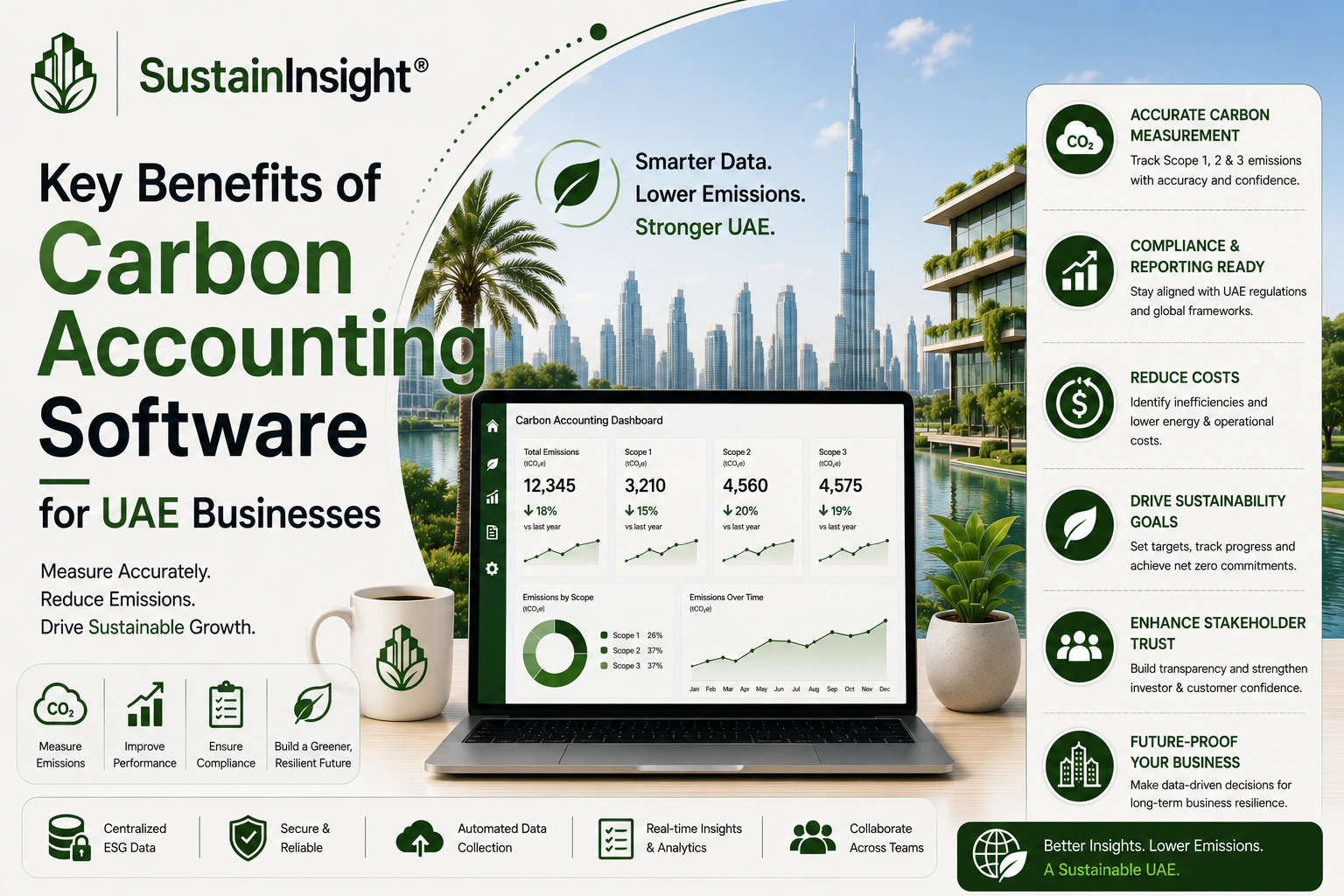
As the UAE advances toward its Net Zero 2050 strategy and regulators, investors, and trading partners raise expectations for transparent emissions reporting, businesses across the UAE are under growing pressure to measure their carbon footprint accurately. Manual spreadsheets and disconnected data sources are no longer sufficient for the level of detail modern sustainability reporting requires — which is why more organizations are adopting dedicated carbon accounting software.
In this article, we'll explore the key benefits of carbon accounting software for UAE businesses and how platforms like SustainInsight help organizations automate emissions tracking, simplify compliance, and turn carbon data into a strategic advantage.
What Is Carbon Accounting Software?
Carbon accounting software is a digital platform that helps businesses measure, track, and report greenhouse gas emissions across Scope 1, Scope 2, and Scope 3 categories. Instead of manually gathering utility bills, fuel receipts, and supplier data into spreadsheets, businesses use carbon accounting software to automate data collection, apply standardized emissions calculations, and generate reports aligned with frameworks such as the GHG Protocol, GRI, ISSB, CSRD, TCFD, and ISO 14064-1.
Why UAE Businesses Are Adopting Carbon Accounting Software?
The UAE's Net Zero 2050 strategy, along with growing ESG expectations from regional and international investors, is pushing organizations to formalize how they measure emissions. Businesses across real estate, construction, manufacturing, banking, hospitality, and logistics are increasingly expected to report carbon data accurately — not just for compliance, but to remain competitive for financing, partnerships, and tenders that now factor in sustainability performance.
Key Benefits of Carbon Accounting Software
1. Improves Emissions Data Accuracy
Manual carbon accounting is prone to human error, inconsistent methodologies, and outdated emission factors. Carbon accounting software applies standardized, auditable calculations across Scope 1, Scope 2, and Scope 3 emissions, significantly improving data accuracy and consistency over time.
2. Saves Time and Reduces Manual Work
Automating data collection and calculations eliminates hours of manual spreadsheet work, freeing sustainability teams to focus on reduction strategy rather than data wrangling.
3. Simplifies Regulatory and Framework Compliance
Carbon accounting software maps emissions data directly to the frameworks businesses need — GRI, ISSB, CSRD, TCFD, and ISO 14064-1 — reducing the effort required to prepare multiple reports from the same underlying data.
4. Strengthens Investor and Stakeholder Confidence
Transparent, well-documented emissions data signals credibility to investors, lenders, and partners who increasingly factor sustainability performance into their decisions, including access to green financing.
5. Identifies Emissions Reduction Opportunities
Real-time dashboards and trend analysis help businesses pinpoint the biggest sources of emissions across facilities, operations, and supply chains — turning carbon accounting from a reporting exercise into an actionable reduction roadmap.
6. Supports Audit Readiness
As third-party assurance becomes a standard requirement across ESG frameworks, having auditable, well-documented emissions data prepared in advance significantly reduces the time and cost of external verification.
7. Builds Long-Term Competitive Advantage
UAE businesses with strong, well-documented carbon performance are better positioned for government tenders, green financing, and partnerships with multinational companies that increasingly evaluate suppliers on sustainability criteria.
Challenges of Manual Carbon Accounting
Without dedicated software, UAE businesses commonly face:
-
Fragmented emissions data across departments and facilities
-
Inconsistent or outdated emission factors
-
Difficulty measuring Scope 3 (value chain) emissions
-
Time-consuming manual report preparation
-
Limited visibility into emissions trends over time
These challenges make it difficult to respond quickly to investor, regulator, or customer requests for reliable carbon data.
How SustainInsight Helps UAE Businesses?
SustainInsight is an AI-powered carbon accounting and ESG reporting platform built for businesses across the UAE and GCC. It helps organizations:
-
Automate Scope 1, Scope 2 & Scope 3 emissions tracking
-
Apply standardized, audit-ready calculations
-
Monitor emissions trends through real-time dashboards
-
Align reporting with GRI, ISSB, CSRD, TCFD, ISO 14064-1, and the GHG Protocol
-
Generate audit-ready reports for investors, regulators, and partners
By centralizing carbon data and automating reporting, SustainInsight helps UAE businesses reduce reporting time, improve data quality, and build a credible path toward their Net Zero goals.
Conclusion
The benefits of carbon accounting software go well beyond compliance. For UAE businesses, adopting the right platform means more accurate emissions data, faster reporting, stronger investor confidence, and a clearer path to reducing environmental impact.
As Net Zero 2050 expectations continue to shape how UAE businesses operate, platforms like SustainInsight make it possible to turn carbon accounting from a manual burden into a strategic advantage.