Every ESG report is only as good as the data behind it. Before a single disclosure gets published, that data has to be collected from dozens of internal systems and external suppliers, validated for accuracy, structured against a reporting framework, and kept auditable for years. This is the job of an ESG data management platform — the layer that sits beneath ESG reporting software and determines whether an organization's numbers can actually be trusted.
For enterprises in the UAE and GCC managing multi-entity operations, complex supply chains, and a growing list of regulatory frameworks (CSRD, ISSB, SEC climate rules, CBAM), a strong ESG data management platform is often the difference between a reporting process that scales and one that collapses under its own spreadsheets. This guide compares the leading options and outlines what to look for.
What ESG Data Management Actually Involves
ESG data management is distinct from ESG reporting itself. Reporting software formats and presents disclosures; data management platforms handle what happens before that — collecting raw activity data (energy bills, fuel receipts, supplier questionnaires, HR records), normalizing it into consistent units and categories, validating it for completeness and accuracy, calculating derived metrics like emissions, and maintaining a defensible audit trail. Many enterprises separate these concerns; increasingly, unified platforms handle both.
Top ESG Data Management Platforms
1. SustainInsight
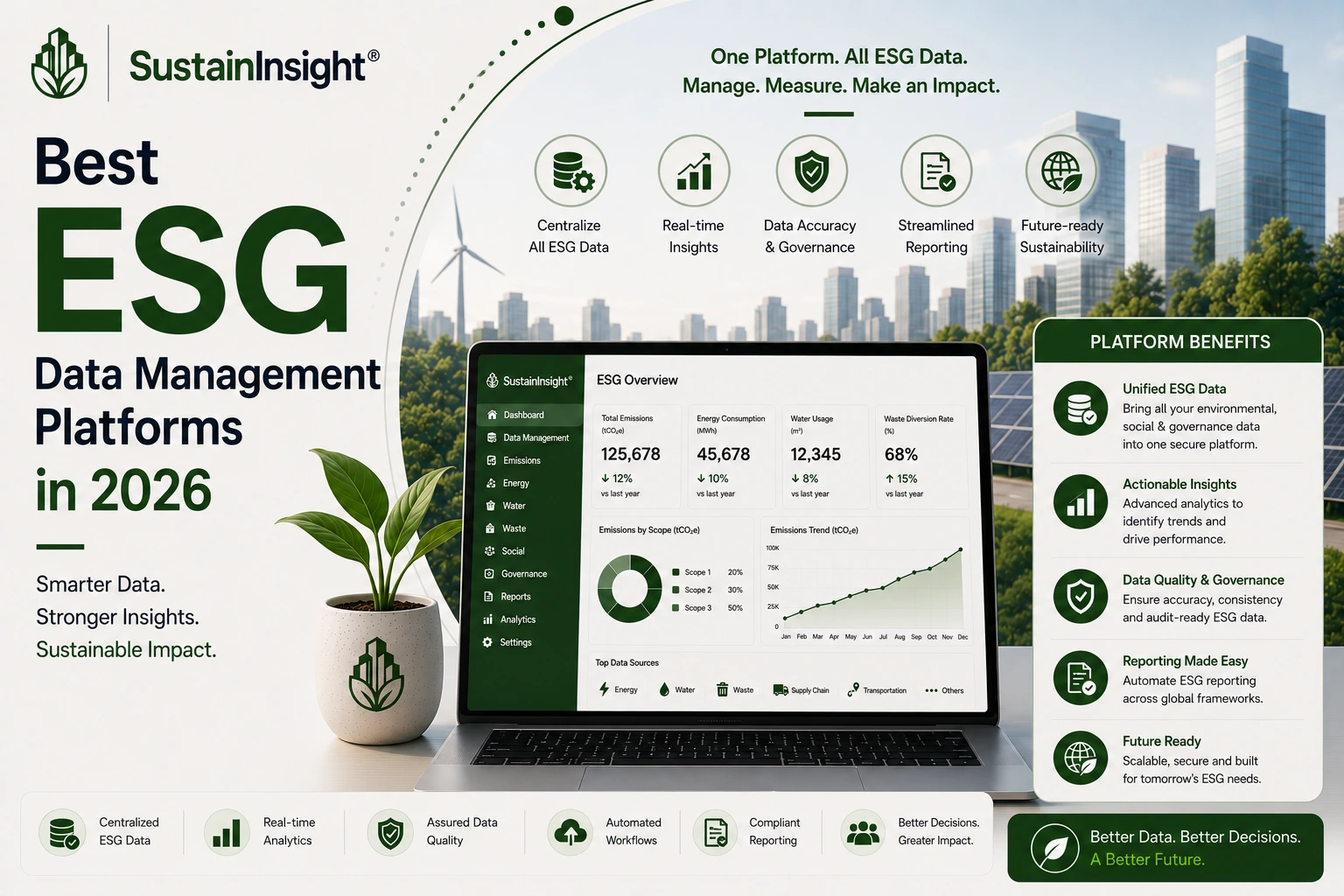
An AI-powered, agentic ESG and carbon data platform built to automate the most time-consuming part of ESG data management: data capture and verification. SustainInsight uses AI to pull activity data from documents and connected systems, flag anomalies and gaps automatically, and map validated data directly into report-ready structures aligned with SEC, EU CSRD, ISSB, and California SB-253 requirements. For UAE and GCC enterprises managing multi-entity, multi-country operations, SustainInsight's automation reduces the manual reconciliation work that typically consumes ESG teams during reporting season, while its Microsoft partnership supports integration into existing enterprise data environments.
2. IBM Envizi
A long-established ESG data management platform with strong capability for aggregating utility, energy, and facilities data across large real estate and operational portfolios. Envizi's strength is deep integration with IBM's broader enterprise software ecosystem, which suits large multinationals already running IBM infrastructure, though this can mean more implementation complexity for standalone deployments.
3. Workiva
Best known for its reporting and collaboration workspace, Workiva also offers ESG data collection and controls management, particularly valued by finance and audit teams who already use the platform for financial reporting. Its strength is in bringing ESG data into the same governance rigor as financial data, though the platform's broader financial-reporting orientation can mean a steeper learning curve for sustainability-only teams.
4. Sphera
Sphera offers robust ESG data management with particular depth in environmental, health, and safety (EHS) data — a natural fit for manufacturing and industrial enterprises that need to manage both operational risk data and ESG metrics in one system.
5. Benchmark Gensuite
A configurable platform with strength in EHS and operational sustainability data collection at the facility level, often used by large industrial and manufacturing organizations that need granular site-level data management alongside enterprise-level ESG reporting.
6. Diligent ESG
Diligent ESG (formerly Accuvio) combines data management with governance-oriented reporting workflows, appealing to organizations that want ESG data management tightly linked to board and governance reporting processes.
7. Novisto
A data-first ESG platform built specifically around the data management challenge — integrating data from multiple internal and external sources, tracking data lineage, and supporting multi-framework mapping, which appeals to enterprises prioritizing data governance and auditability.
8. Datamaran
Datamaran focuses on the earlier stage of ESG data management — materiality assessment and external risk data — making it a useful complement to platforms that handle operational data collection, though it is less oriented toward day-to-day emissions and activity data management.
What to Look For in an ESG Data Management Platform?
Automated data capture
The ability to pull data from utility bills, invoices, supplier submissions, and connected systems automatically, rather than relying entirely on manual entry.
Data validation and anomaly detection
Built-in checks that flag missing, inconsistent, or outlier data before it reaches a report, catching errors early rather than during an audit.
Multi-entity and multi-framework support
The ability to manage data across subsidiaries, regions, and business units, and map that same underlying data to multiple reporting frameworks without duplicating collection effort.
Auditability and data lineage
A clear, traceable record of where each data point came from and how it was calculated — essential as assurance requirements for ESG data tighten globally.
Integration with existing enterprise systems
Connectivity with ERP, utility management, and HR systems reduces the manual bridging work between operational data and ESG reporting.
Common Challenges in ESG Data Management
Data fragmentation across systems
Activity data often lives across dozens of disconnected systems and spreadsheets, particularly in enterprises with multiple business units or recent acquisitions.
Supplier and Scope 3 data gaps
Much of the hardest data to manage — supply chain emissions, purchased goods data — originates outside the organization's own systems entirely.
Maintaining data quality at scale
As reporting scope expands to cover more entities and metrics, manual validation processes that worked for a pilot program often break down.
Keeping pace with evolving frameworks
Data structures built for one framework may need reworking as new regulations (like CBAM or evolving ISSB guidance) introduce new data requirements.
How SustainInsight Helps?
-
AI-driven data capture that extracts activity data from documents, utility bills, and connected systems, reducing manual data entry
-
Automated anomaly and gap detection that flags data quality issues before they reach a report, rather than during audit season
-
Multi-entity data architecture built for enterprises managing subsidiaries and business units across the UAE, GCC, and beyond
-
Framework-mapped data structures that let a single validated dataset feed CSRD, ISSB, SEC, and California SB-253 disclosures without re-collecting data for each
-
Predictive analytics that use historical and current data to flag trends and risks ahead of formal reporting cycles
-
Full audit trail for every data point, supporting assurance readiness as third-party verification requirements expand.
Conclusion
The quality of an organization's ESG disclosures is set long before the report is drafted — it's determined by how well the underlying data is captured, validated, and structured. For UAE and GCC enterprises scaling ESG reporting across multiple entities and frameworks, choosing a data management platform built for automation and auditability, rather than one dependent on manual spreadsheet work, is one of the highest-leverage decisions in the reporting process. SustainInsight's AI-driven approach to data capture and validation is built specifically to remove that manual burden at enterprise scale.