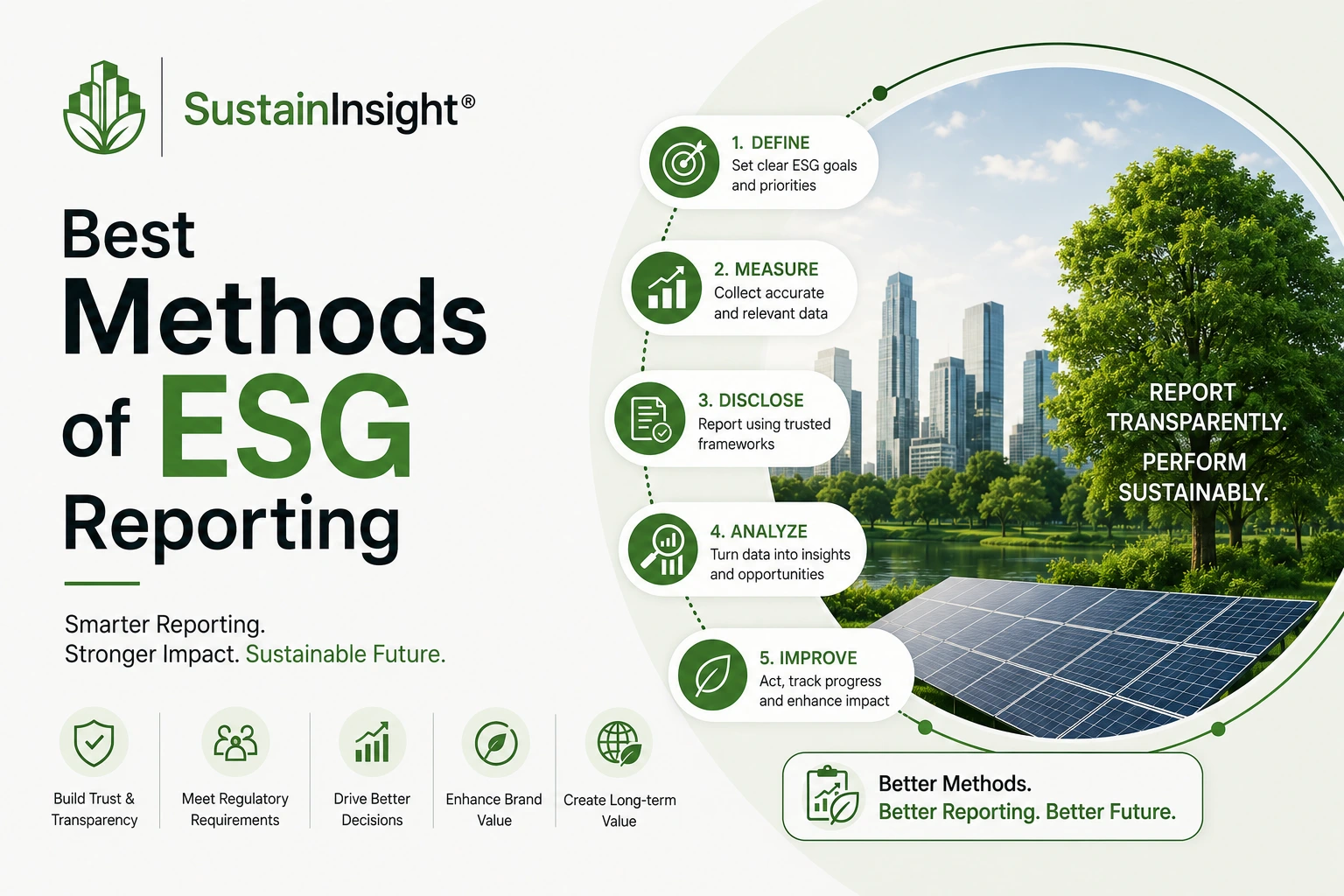
As sustainability becomes a business priority across the UAE, organizations are under increasing pressure to demonstrate transparency, accountability, and responsible corporate practices. This has made ESG reporting an essential part of modern business strategy. Investors, regulators, customers, and stakeholders now expect companies to disclose how they manage Environmental, Social, and Governance (ESG) risks and opportunities through standardized, data-driven reporting.
However, producing an effective ESG report involves much more than collecting sustainability data. Businesses must adopt the best methods of ESG reporting to ensure accuracy, compliance, and meaningful stakeholder communication. By using structured reporting methodologies and internationally recognized frameworks, organizations can improve decision-making, strengthen investor confidence, and support long-term business growth.
In this guide, we'll explore the most effective ESG reporting methods, best practices for implementation, and how SustainInsight helps UAE businesses simplify ESG reporting through AI-powered automation.
What is ESG Reporting?
ESG reporting is the process of measuring, managing, and disclosing an organization's performance across Environmental, Social, and Governance (ESG) factors.
It enables businesses to communicate sustainability performance using reliable data and globally recognized reporting standards.
An effective ESG report typically includes:
Carbon emissions
Energy consumption
Climate-related risks
Employee well-being
Diversity and inclusion
Corporate governance
Business ethics
Supply chain sustainability
Well-structured ESG reporting helps businesses improve transparency while meeting the growing expectations of investors and regulators.
Why ESG Reporting Matters for UAE Businesses
The UAE is accelerating its transition toward a sustainable economy through ambitious climate initiatives and responsible business policies.
As a result, businesses are increasingly expected to:
Improve ESG reporting
Measure Scope 1, Scope 2 & Scope 3 emissions
Align with global reporting frameworks
Enhance sustainability performance
Build investor confidence
Organizations adopting robust ESG reporting practices are often better positioned to attract investment, strengthen brand reputation, and maintain regulatory readiness.
Best Methods of ESG Reporting
1. Follow International ESG Reporting Frameworks
One of the most effective methods is reporting according to globally recognized standards.
Popular frameworks include:
GRI (Global Reporting Initiative)
ISSB (IFRS S1 & S2)
TCFD
CSRD
GHG Protocol
ISO 14064-1
Using internationally accepted frameworks improves report consistency, comparability, and credibility while simplifying compliance with evolving regulations.
2. Conduct a Materiality Assessment
A materiality assessment identifies the ESG topics that are most significant to your business and stakeholders.
This helps organizations focus reporting on areas such as:
Climate risk
Carbon emissions
Supply chain sustainability
Employee well-being
Data privacy
Corporate governance
Materiality assessments improve report relevance while reducing unnecessary disclosures.
3. Collect Accurate ESG Data
Reliable data is the foundation of successful ESG reporting.
Organizations should establish standardized processes for collecting data across:
Energy usage
Water consumption
Waste generation
Business travel
Procurement
Human resources
Governance metrics
High-quality ESG data improves reporting accuracy and supports informed business decisions.
4. Measure Scope 1, Scope 2 & Scope 3 Emissions
Carbon accounting has become one of the most important components of ESG reporting.
Businesses should measure:
Scope 1 emissions (direct emissions)
Scope 2 emissions (purchased electricity)
Scope 3 emissions (value chain emissions)
Accurate emissions tracking enables organizations to identify reduction opportunities and support Net Zero strategies.
5. Automate ESG Reporting
Manual spreadsheets often lead to inconsistent data and time-consuming reporting processes. Modern organizations increasingly use ESG reporting software to:
Automate data collection
Track ESG KPIs
Generate sustainability reports
Improve audit readiness
Monitor compliance
Automation reduces reporting errors while improving operational efficiency.
6. Use Real-Time ESG Dashboards
Interactive dashboards provide continuous visibility into sustainability performance.
Organizations can monitor:
Carbon emissions
Energy consumption
ESG KPIs
Compliance status
Sustainability targets
Real-time reporting enables faster decision-making and continuous performance improvement.
7. Verify and Audit ESG Data
Stakeholders increasingly expect ESG disclosures to be accurate and verifiable.
Businesses should:
Validate ESG metrics
Maintain audit trails
Review reporting methodologies
Verify supporting documentation
Strong data governance improves transparency and builds investor trust.
Common ESG Reporting Challenges
Many organizations struggle with:
Disconnected sustainability data
Manual spreadsheets
Inconsistent reporting methods
Complex reporting frameworks
Scope 3 emissions measurement
Audit preparation
These challenges make digital ESG platforms increasingly important for modern businesses.
How SustainInsight Simplifies ESG Reporting
As ESG reporting requirements continue to evolve, businesses need intelligent technology to simplify data management and compliance. SustainInsight is an AI-powered ESG and sustainability platform that helps organizations automate reporting, manage carbon accounting, and streamline compliance across multiple reporting frameworks.
Key capabilities include:
AI-powered ESG reporting
Automated sustainability report generation
Scope 1, Scope 2 & Scope 3 emissions tracking
Carbon accounting
Real-time ESG dashboards
Data verification
Predictive sustainability analytics
Framework-aligned reporting for GRI, ISSB, CSRD, TCFD, ISO 14064-1, and the GHG Protocol
By transforming operational data into audit-ready sustainability reports, SustainInsight enables businesses across the UAE and GCC to improve reporting accuracy, reduce manual effort, and make better sustainability decisions.
Conclusion
Choosing the best methods of ESG reporting is essential for organizations seeking to improve transparency, strengthen stakeholder trust, and meet evolving sustainability expectations. From adopting internationally recognized frameworks and conducting materiality assessments to automating ESG reporting and tracking carbon emissions, businesses can significantly improve the quality and effectiveness of their disclosures.
For organizations in the UAE, platforms like SustainInsight simplify ESG reporting by combining AI-powered automation, carbon accounting, and framework-aligned compliance into a single intelligent platform. This enables businesses to confidently meet global sustainability standards while accelerating their ESG journey.