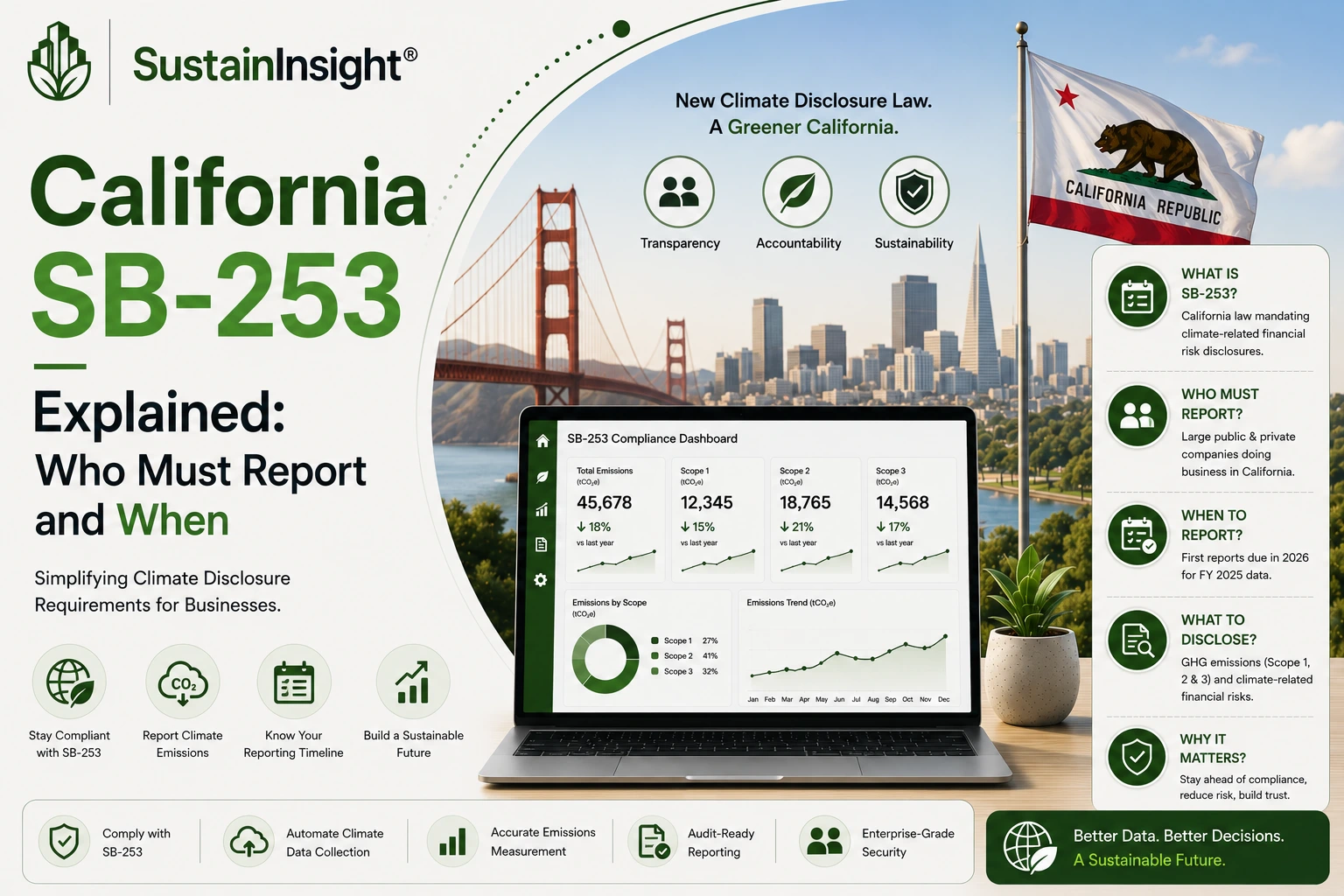
California's Climate Corporate Data Accountability Act, better known as SB-253, is one of the most significant corporate climate disclosure laws in the United States. It doesn't just affect California-headquartered companies — it applies to any large business that "does business in California," which increasingly includes UAE and GCC companies with US operations, subsidiaries, or significant California revenue. This guide explains what SB-253 requires, who must comply, and how to prepare.
Why SB-253 Matters Beyond California
Because SB-253 applies based on doing business in California rather than being headquartered there, its reach extends to any large multinational — including UAE and GCC-based companies — with sufficient California-linked revenue. Businesses expanding into the US market should understand these requirements early, since emissions data collection and assurance processes take time to build.
What Is SB-253?
SB-253 is a California law requiring large companies to publicly disclose their greenhouse gas emissions on an annual basis, following the GHG Protocol methodology. It's often discussed alongside a related law, SB-261, which requires climate-related financial risk disclosures for a broader group of companies.
Who Must Report Under SB-253?
SB-253 generally applies to companies with total annual global revenues above a high threshold (in the billions of dollars) that do business in California. The related SB-261 applies to a larger pool of companies at a lower revenue threshold, focused on climate-related financial risk reporting rather than emissions data specifically. Because thresholds, phase-in timing, and enforcement details have been subject to amendment and ongoing regulatory guidance from the California Air Resources Board (CARB), businesses should confirm their exact obligations against current CARB guidance rather than relying on a fixed threshold figure.
Key SB-253 Requirements and Timeline
Scope 1 and Scope 2 Emissions
In-scope companies must publicly disclose direct emissions (Scope 1) and emissions from purchased energy (Scope 2), calculated according to the GHG Protocol.
Scope 3 Emissions
Value chain emissions (Scope 3) are also required, typically phased in after Scope 1 and 2 reporting begins, reflecting the added complexity of collecting supply chain emissions data.
Third-Party Assurance
SB-253 requires third-party verification of reported emissions, starting with limited assurance and moving toward more rigorous assurance requirements over time.
Public Disclosure
Unlike some voluntary frameworks, SB-253 emissions data must be made publicly available, increasing scrutiny from investors, customers, and advocacy groups.
SB-253 and SB-261: What's the Difference?
SB-253 focuses specifically on greenhouse gas emissions disclosure. SB-261 requires a broader group of companies to report on climate-related financial risks, generally aligned with frameworks like the TCFD recommendations, covering how climate change could affect the business financially rather than emissions data alone. Many companies fall under both laws simultaneously.
Challenges Businesses Face with SB-253
-
Determining whether the "doing business in California" threshold applies, especially for non-US companies
-
Collecting accurate, auditable Scope 3 emissions data across complex supply chains
-
Preparing for third-party assurance requirements
-
Keeping pace with regulatory updates as CARB finalizes implementation guidance
-
Coordinating SB-253 reporting with other frameworks the business already follows (CSRD, ISSB, GHG Protocol)
How SustainInsight Helps with SB-253 Compliance
SustainInsight is an AI-powered ESG and carbon accounting platform that helps businesses — including UAE and GCC companies with US operations — prepare for regulations like SB-253. Key capabilities include:
-
Automated Scope 1, Scope 2 & Scope 3 emissions tracking
-
GHG Protocol-aligned calculations
-
Audit-ready reporting built for third-party assurance
-
Compliance alignment across multiple frameworks (SB-253, CSRD, ISSB, TCFD, GRI, ISO 14064-1)
-
Real-time dashboards for monitoring emissions ahead of reporting deadlines
By centralizing emissions data and automating calculations, SustainInsight helps businesses prepare for SB-253 and similar disclosure laws without building a manual reporting process from scratch.
Conclusion
SB-253 signals a broader shift toward mandatory, publicly disclosed corporate emissions reporting — and its reach extends well beyond companies headquartered in California. Businesses with US operations, including many UAE and GCC organizations, should assess their exposure now and start building the emissions data infrastructure needed to comply confidently as requirements take full effect.