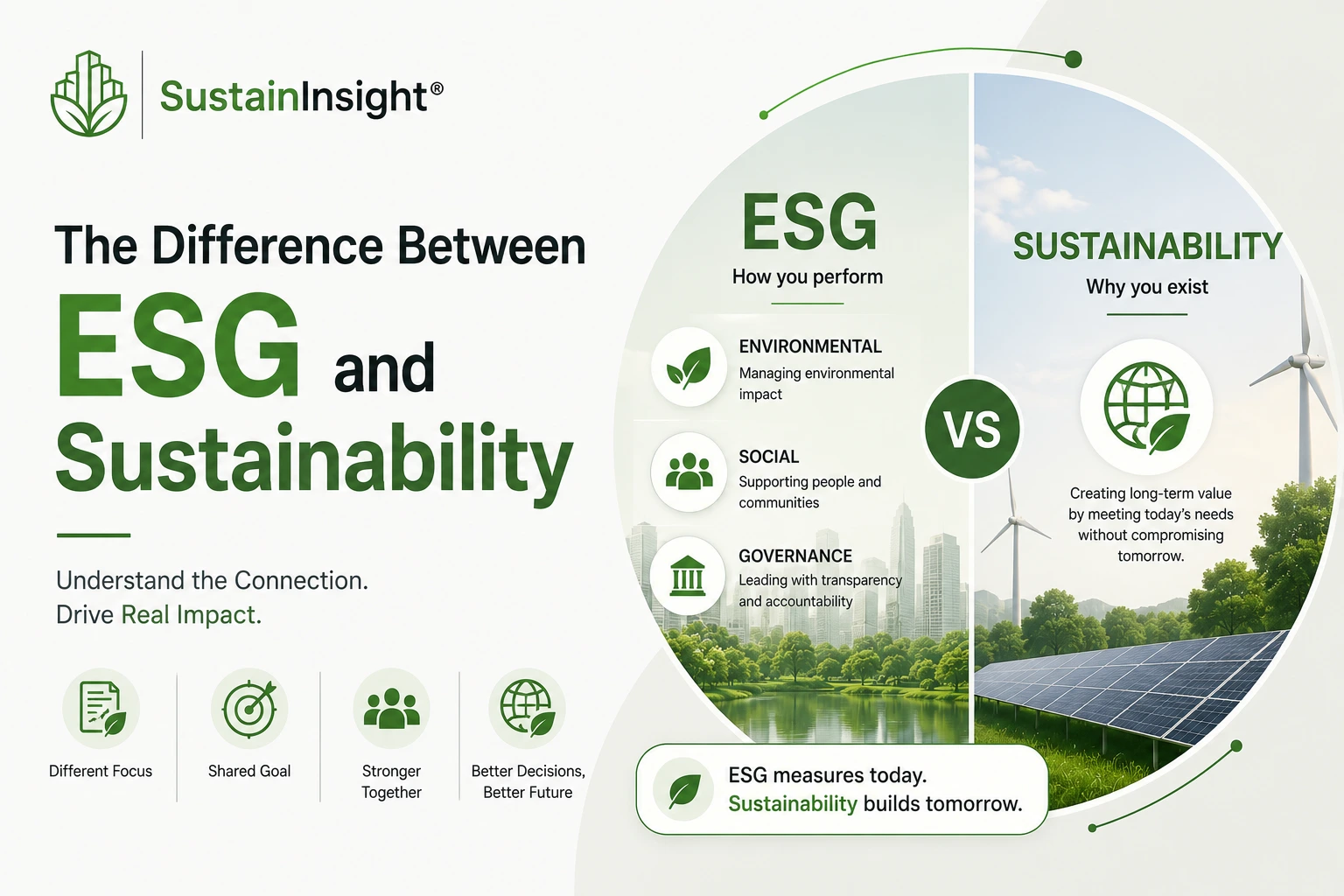
As businesses across the UAE accelerate their sustainability journey, the terms ESG (Environmental, Social, and Governance) and sustainability are often used interchangeably. While they are closely related, they are not the same. Understanding the difference between ESG and sustainability is essential for organizations looking to improve business resilience, attract investors, meet regulatory expectations, and achieve long-term growth.
Today, investors, customers, regulators, and employees expect companies to demonstrate responsible business practices while measuring and reporting their environmental and social impact. This is where both ESG and sustainability play a vital role. Although sustainability defines an organization's long-term vision for responsible growth, ESG provides the measurable framework used to evaluate and report that performance.
In this guide, we'll explore the key differences between ESG and sustainability, why both matter for businesses in the UAE, and how SustainInsight helps organizations simplify ESG reporting and sustainability management.
What is Sustainability?
Sustainability refers to a company's long-term commitment to operating responsibly while balancing economic growth, environmental protection, and social well-being.
A sustainability strategy focuses on creating long-term value by reducing environmental impact, supporting communities, conserving natural resources, and ensuring responsible business practices.
Examples of sustainability initiatives include:
-
Reducing carbon emissions
-
Improving energy efficiency
-
Water conservation
-
Waste reduction and recycling
-
Renewable energy adoption
-
Ethical sourcing
-
Employee well-being and diversity
The primary goal of sustainability is to ensure that today's business decisions do not compromise the ability of future generations to meet their needs.
What is ESG?
ESG (Environmental, Social, and Governance) is a structured framework used to measure, evaluate, and report an organization's sustainability performance.
Unlike sustainability, which is a broader business philosophy, ESG focuses on measurable metrics that investors, regulators, and stakeholders use to assess business performance.
The three pillars of ESG include:
Environmental
-
Carbon emissions
-
Climate risk
-
Energy consumption
-
Water management
-
Waste management
Social
-
Employee health and safety
-
Diversity and inclusion
-
Human rights
-
Customer privacy
-
Community engagement
Governance
-
Corporate ethics
-
Board diversity
-
Risk management
-
Regulatory compliance
-
Business transparency
Organizations increasingly use ESG reporting to communicate performance against globally recognized frameworks such as GRI, ISSB, CSRD, TCFD, and the GHG Protocol.
Difference Between ESG and Sustainability
Although both concepts aim to create responsible businesses, they differ in several important ways.
| Sustainability | ESG |
|---|---|
| Focuses on long-term environmental and social impact | Focuses on measurable business performance |
| Strategic business philosophy | Reporting and measurement framework |
| Future-oriented | Data-driven and performance-focused |
| Guides sustainability initiatives | Measures sustainability outcomes |
| Broader organizational vision | Used by investors, regulators, and stakeholders |
| Often voluntary initiatives | Increasingly linked to reporting and compliance requirements |
Simply put:
-
Sustainability answers "What should a responsible business do?"
-
ESG answers "How well is the business performing?"
Why Businesses Need Both ESG and Sustainability
Rather than choosing one over the other, successful organizations integrate both ESG and sustainability into their business strategy.
Sustainability provides direction, while ESG measures progress.
Together they help businesses:
-
Improve operational efficiency
-
Strengthen investor confidence
-
Reduce environmental impact
-
Enhance corporate reputation
-
Improve stakeholder trust
-
Support regulatory compliance
-
Build long-term resilience
For UAE businesses, combining sustainability initiatives with structured ESG reporting creates greater transparency while supporting national sustainability goals and international reporting expectations.
Why ESG and Sustainability Matter in the UAE
The UAE continues to strengthen its position as a regional sustainability leader through ambitious climate initiatives and increasing focus on responsible business practices.
Organizations are increasingly expected to:
-
Measure carbon emissions
-
Improve ESG reporting
-
Track Scope 1, Scope 2 & Scope 3 emissions
-
Align with global sustainability frameworks
-
Demonstrate climate-related performance
Businesses that successfully integrate ESG and sustainability are often better positioned to attract investment, improve compliance, and gain a competitive advantage.
Common Challenges Businesses Face
Many organizations struggle to:
-
Collect ESG data across multiple departments
-
Track carbon emissions accurately
-
Align with multiple reporting frameworks
-
Measure sustainability KPIs
-
Produce audit-ready ESG reports
-
Monitor sustainability performance consistently
Manual spreadsheets often make these processes slow, inconsistent, and prone to errors.
How SustainInsight Bridges ESG and Sustainability
Managing sustainability initiatives alongside ESG reporting requires reliable technology. SustainInsight is an AI-powered ESG and sustainability platform that helps organizations centralize sustainability data, automate reporting, and streamline compliance.
The platform enables businesses to:
-
Automate ESG reporting
-
Track Scope 1, Scope 2 & Scope 3 emissions
-
Manage carbon accounting
-
Generate AI-powered sustainability reports
-
Monitor ESG KPIs in real time
-
Align with GRI, ISSB, CSRD, TCFD, ISO 14064-1, and the GHG Protocol
-
Improve data accuracy and audit readiness
By transforming operational data into actionable sustainability insights, SustainInsight helps organizations across the UAE simplify ESG management while supporting long-term sustainability goals.
Conclusion
Understanding the difference between ESG and sustainability is essential for organizations looking to build resilient and future-ready businesses. While sustainability defines the broader vision of responsible growth, ESG provides the measurable framework that demonstrates progress through transparent reporting and data-driven decision-making.
As sustainability expectations continue to evolve across the UAE, businesses that integrate both ESG and sustainability into their strategy will be better equipped to meet stakeholder expectations, improve operational performance, and create lasting value.
With intelligent platforms like SustainInsight, organizations can automate ESG reporting, simplify carbon accounting, and confidently navigate an increasingly data-driven sustainability landscape.