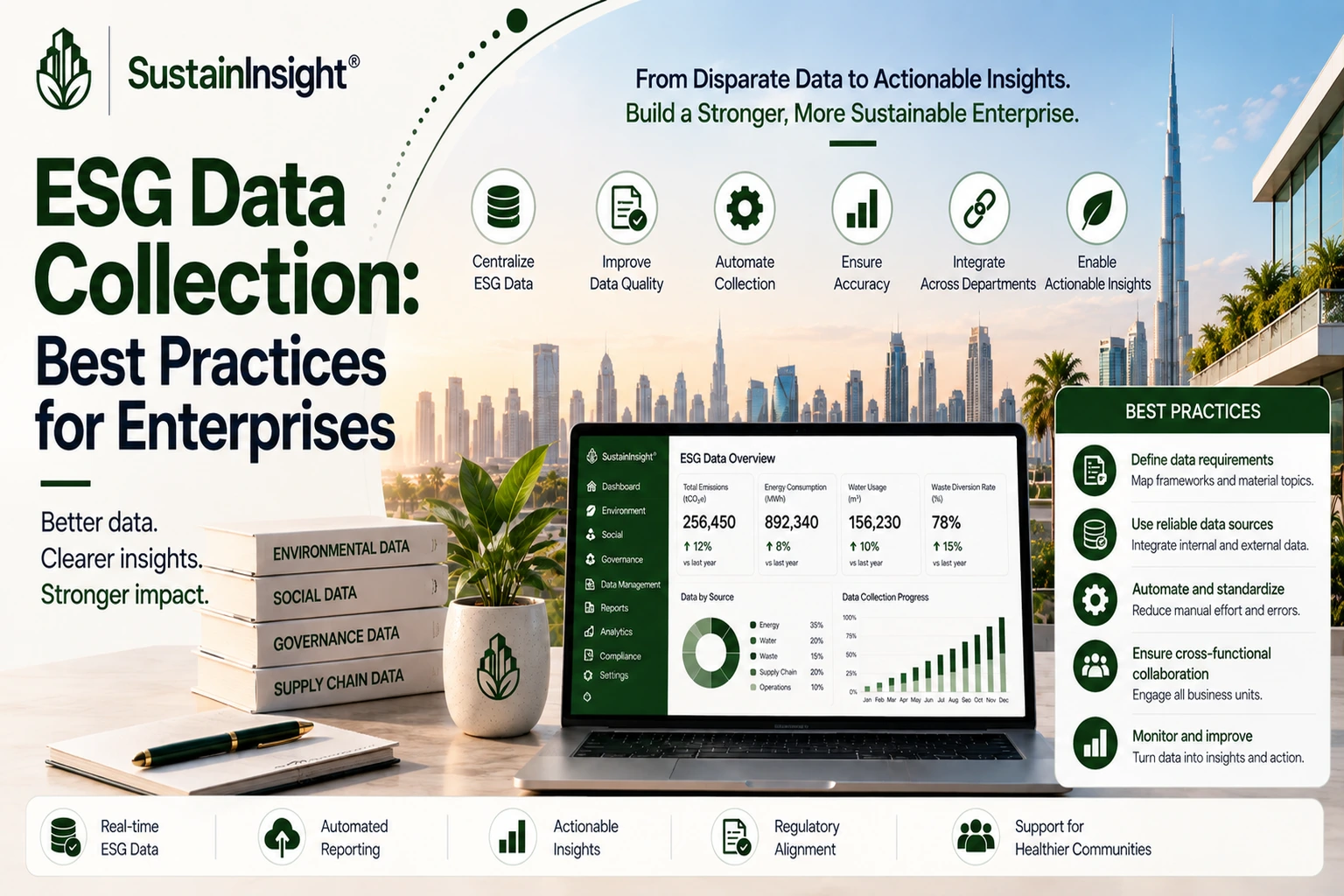
Every ESG report an enterprise publishes rests on one thing: the quality of the data collected underneath it. Yet data collection is where most ESG programs struggle most — data scattered across spreadsheets, business units reporting inconsistently, supplier information that's incomplete or unverifiable, and reporting deadlines that turn data collection into a last-minute scramble. For UAE and GCC enterprises scaling ESG reporting across multiple entities and frameworks, getting data collection right isn't a nice-to-have — it's the foundation everything else depends on. This guide sets out the practical best practices that separate ESG programs with credible, defensible data from those constantly firefighting at reporting time.
Why ESG Data Collection Is Harder Than It Looks
Unlike financial data, which flows through well-established accounting systems and controls, ESG data is collected from dozens of disparate sources — utility bills, HR systems, supplier questionnaires, facilities logs, travel records — many of which were never designed with sustainability reporting in mind. Add multiple business units, multiple countries, and multiple reporting frameworks with overlapping but not identical requirements, and it's easy to see why ESG data collection routinely takes longer and produces lower-confidence results than financial reporting, even at mature enterprises.
Best Practices for Enterprise ESG Data Collection
1. Define data ownership clearly before collecting anything
Every data point should have a named owner — the person or team responsible for its accuracy — rather than defaulting to the sustainability team collecting and guessing at figures from other departments. This single change resolves more data quality issues than any tool.
2. Build a consistent data collection calendar, not a once-a-year scramble
Collecting data monthly or quarterly, rather than compressing a year's worth of collection into the weeks before a reporting deadline, dramatically improves both data quality and the sustainability team's ability to catch and correct errors early.
3. Standardize data collection templates across business units
Inconsistent formats, units, and categorization across subsidiaries or departments create reconciliation headaches at reporting time — a standard template (and enforced use of it) pays for itself many times over.
4. Prioritize primary data over estimates where it's feasible
Estimates and industry-average emission factors are a reasonable starting point, but a roadmap toward primary, measured data — starting with the highest-impact categories — improves both accuracy and credibility over time.
5. Build validation checks into the collection process, not just at the end
Automated range checks, year-over-year comparison flags, and completeness checks catch errors when they're still cheap to fix, rather than during a compressed pre-publication review.
6. Document methodology as you go
Recording calculation methods, emission factors used, and assumptions at the point of data collection — rather than reconstructing them later — is essential for both audit readiness and year-over-year consistency as methodologies evolve.
7. Engage suppliers early and phase in expectations
Supplier ESG data is often the hardest to collect; starting with your highest-spend or highest-impact suppliers, and phasing in more granular data requests over time, gets better results than a blanket data request that most suppliers can't meet.
8. Centralize data in one system rather than scattered spreadsheets
A single source of truth for ESG data — rather than parallel spreadsheets maintained by different teams — eliminates version-control errors and gives the organization one consistent number for any given metric.
9. Automate data capture wherever possible
Manual data entry from utility bills, invoices, and supplier submissions is slow and error-prone; automated extraction significantly reduces both the time burden and the error rate compared to manual processes.
10. Maintain a full audit trail for every data point
As third-party assurance and regulatory scrutiny of ESG data increase, being able to trace any reported figure back to its source, calculation method, and approver is quickly becoming a baseline expectation, not a nice-to-have.
Common Data Collection Challenges for ESG Data Management
1. Fragmented ownership
When no one is clearly accountable for a given data category, it tends to be the last thing gathered and the first thing estimated roughly.
2. Supplier non-responsiveness
Especially smaller suppliers may lack the resources or motivation to respond to detailed ESG data requests without a clear business reason to prioritize it.
3. Inconsistent units and boundaries
Different business units measuring the same thing in different ways (different reporting periods, different organizational boundaries) creates consolidation headaches that are expensive to untangle after the fact.
4. Data quality degrading at scale
Processes that work for a pilot program covering one business unit often break down when scaled across an entire enterprise's entities and geographies.
How SustainInsight Helps?
-
Structured data collection workflows with clear ownership assignment and standardized templates across business units and entities
-
AI-driven data capture that automates extraction from utility bills, invoices, and supplier submissions, reducing manual entry and associated errors
-
Built-in validation and anomaly detection that flags data quality issues at the point of collection rather than during final review
-
Supplier engagement tools that support phased, prioritized supplier data collection rather than one-size-fits-all requests
-
Centralized, multi-entity data architecture giving enterprises one consistent source of truth across subsidiaries and geographies
-
Full audit trails documenting methodology, source, and approval for every data point, supporting both internal governance and external assurance
Conclusion
Strong ESG reporting starts long before a report is drafted — it starts with how data is collected, owned, validated, and documented. UAE and GCC enterprises that treat data collection as a disciplined, ongoing process rather than an annual scramble build ESG programs that scale, withstand scrutiny, and free up their sustainability teams to focus on strategy rather than data reconciliation. SustainInsight's platform is built to operationalize these best practices, turning ESG data collection from the hardest part of reporting into the most reliable part.