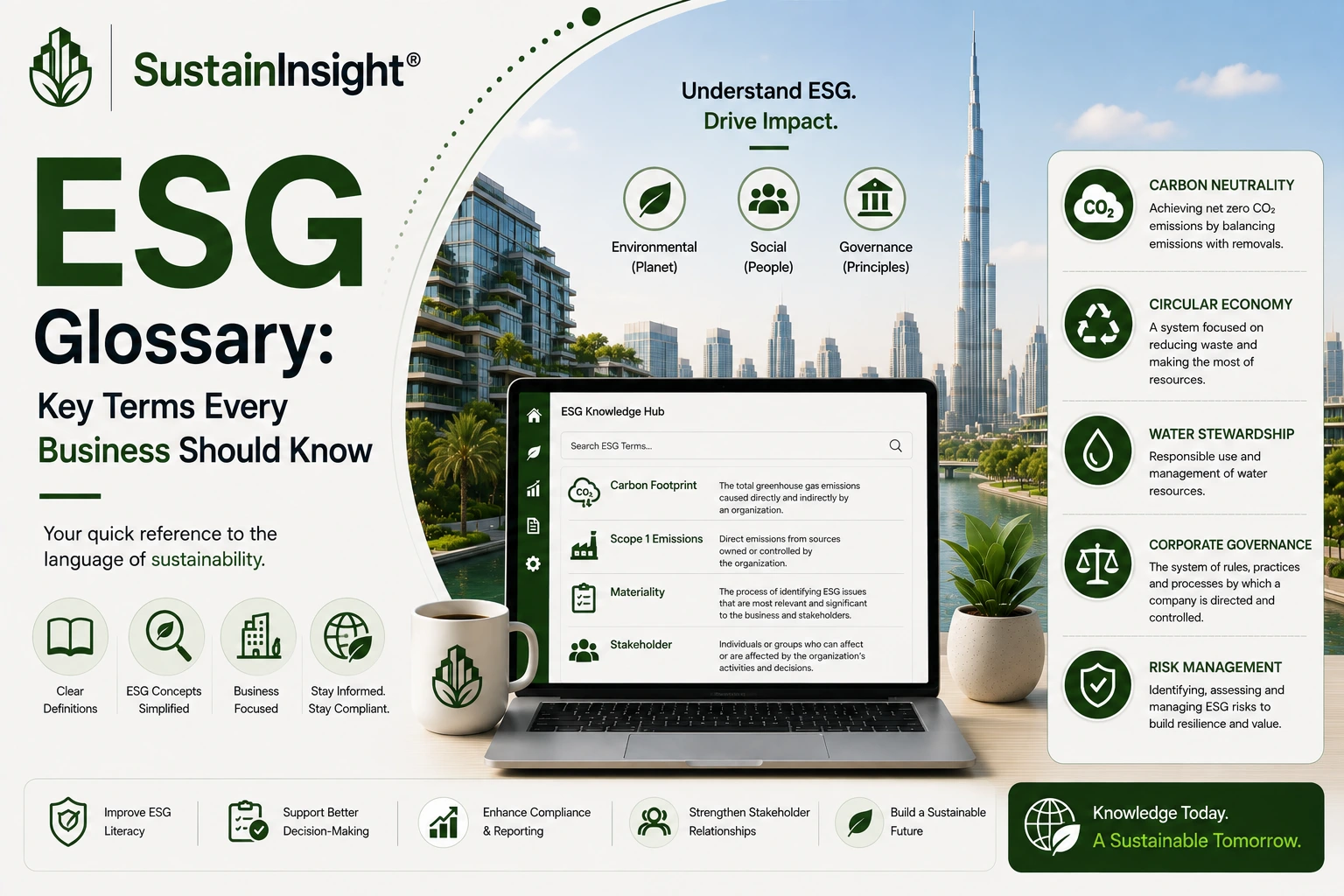
ESG and sustainability reporting come with a growing vocabulary of frameworks, acronyms, and technical terms that can be difficult to keep track of. Whether you're preparing your first sustainability report or evaluating ESG reporting software, understanding these terms is the first step toward confident, accurate reporting. This glossary breaks down the key ESG terms every UAE and global business should know.
Core ESG Concepts
ESG (Environmental, Social, and Governance)
A framework for evaluating a company's sustainability performance and ethical business practices across three pillars: environmental impact, social responsibility, and corporate governance.
Sustainability Report
A public disclosure documenting a company's ESG performance, typically covering emissions, social impact, and governance practices over a reporting period.
Materiality Assessment
A process for identifying which sustainability topics are most significant to a business and its stakeholders, used to focus reporting on the issues that matter most.
Double Materiality
An assessment approach used under frameworks like CSRD that evaluates sustainability topics from two angles: how they affect the business financially, and how the business affects the environment and society.
Greenwashing
Misleading or exaggerated claims about a company's environmental practices or products, increasingly scrutinized by regulators and investors as ESG disclosure requirements tighten.
ESG Rating
A score assigned by ratings agencies evaluating a company's ESG performance relative to peers, often used by investors in decision-making.
Emissions and Carbon Accounting Terms
Carbon Footprint
The total greenhouse gas emissions caused directly or indirectly by an organization, product, or activity, usually expressed in tonnes of CO2 equivalent.
GHG Protocol
The most widely used international standard for measuring and reporting greenhouse gas emissions, dividing emissions into Scope 1, 2, and 3 categories.
Scope 1 Emissions
Direct emissions from sources a company owns or controls, such as company vehicles or on-site fuel combustion.
Scope 2 Emissions
Indirect emissions from the generation of purchased electricity, steam, heating, or cooling consumed by a company.
Scope 3 Emissions
All other indirect emissions across a company's value chain, including supplier emissions, business travel, and product use — typically the largest and hardest category to measure.
Carbon Neutral
A state in which a company's greenhouse gas emissions are balanced by an equivalent amount of carbon removal or offsetting.
Net Zero
A more rigorous commitment than carbon neutrality, requiring companies to reduce emissions as close to zero as possible, with any remaining emissions balanced by permanent carbon removal.
Science Based Targets (SBTi)
Emissions reduction targets that are considered "science-based" if they align with the level of decarbonization required to limit global warming in line with the Paris Agreement.
Reporting Frameworks and Standards
GRI (Global Reporting Initiative)
A widely used international standard for sustainability reporting, covering a broad range of ESG topics.
CSRD (Corporate Sustainability Reporting Directive)
An EU regulation requiring detailed, standardized, and externally assured sustainability disclosures from large and listed companies, including many non-EU companies with EU operations.
ISSB (International Sustainability Standards Board)
A global standard-setting body developing consistent sustainability disclosure standards, building on and consolidating earlier frameworks like TCFD.
TCFD (Task Force on Climate-related Financial Disclosures)
A framework for disclosing how climate change could affect a company's financial performance, now largely incorporated into ISSB standards.
SASB (Sustainability Accounting Standards Board)
Industry-specific sustainability accounting standards, now part of the ISSB's framework, focused on financially material ESG topics.
SFDR (Sustainable Finance Disclosure Regulation)
An EU regulation requiring financial market participants to disclose how they integrate sustainability risks into investment decisions.
CBAM (Carbon Border Adjustment Mechanism)
An EU mechanism that places a carbon price on certain imported goods, intended to prevent "carbon leakage" from countries with less stringent climate policies.
EU Taxonomy
A classification system defining which economic activities can be considered environmentally sustainable under EU law.
ISO 14064
An international standard providing methodology for quantifying and reporting greenhouse gas emissions at the organizational and project level.
Compliance and Assurance Terms
Assurance (Limited vs. Reasonable)
Independent verification of reported ESG data. Limited assurance offers moderate confidence based on review procedures; reasonable assurance involves more extensive testing, offering a higher level of confidence, similar to a financial audit.
Audit-Ready Reporting
Sustainability data and documentation prepared to withstand third-party verification, increasingly required as ESG assurance requirements expand globally.
ESG Due Diligence
The process of assessing a company's or supplier's ESG risks and performance, often used in investment, procurement, or M&A decisions.
Why These Terms Matter for UAE Businesses
As the UAE advances its Net Zero 2050 strategy and international frameworks like CSRD and ISSB extend their reach to companies with UAE operations or trading relationships, understanding this vocabulary is becoming essential — not just for sustainability teams, but for finance, procurement, and leadership functions across the business.
How SustainInsight Helps
SustainInsight is an AI-powered ESG and sustainability platform that helps UAE and GCC businesses put these concepts into practice — automating Scope 1, 2 & 3 emissions tracking, supporting double materiality assessments, and aligning reporting with GRI, ISSB, CSRD, TCFD, ISO 14064-1, and the GHG Protocol, all within audit-ready reports.
Conclusion
ESG reporting comes with a dense vocabulary, but understanding these core terms is the foundation for accurate, confident sustainability reporting. As frameworks like CSRD and ISSB continue to shape expectations for UAE and global businesses, having a shared understanding of these concepts across your organization makes compliance far more manageable.