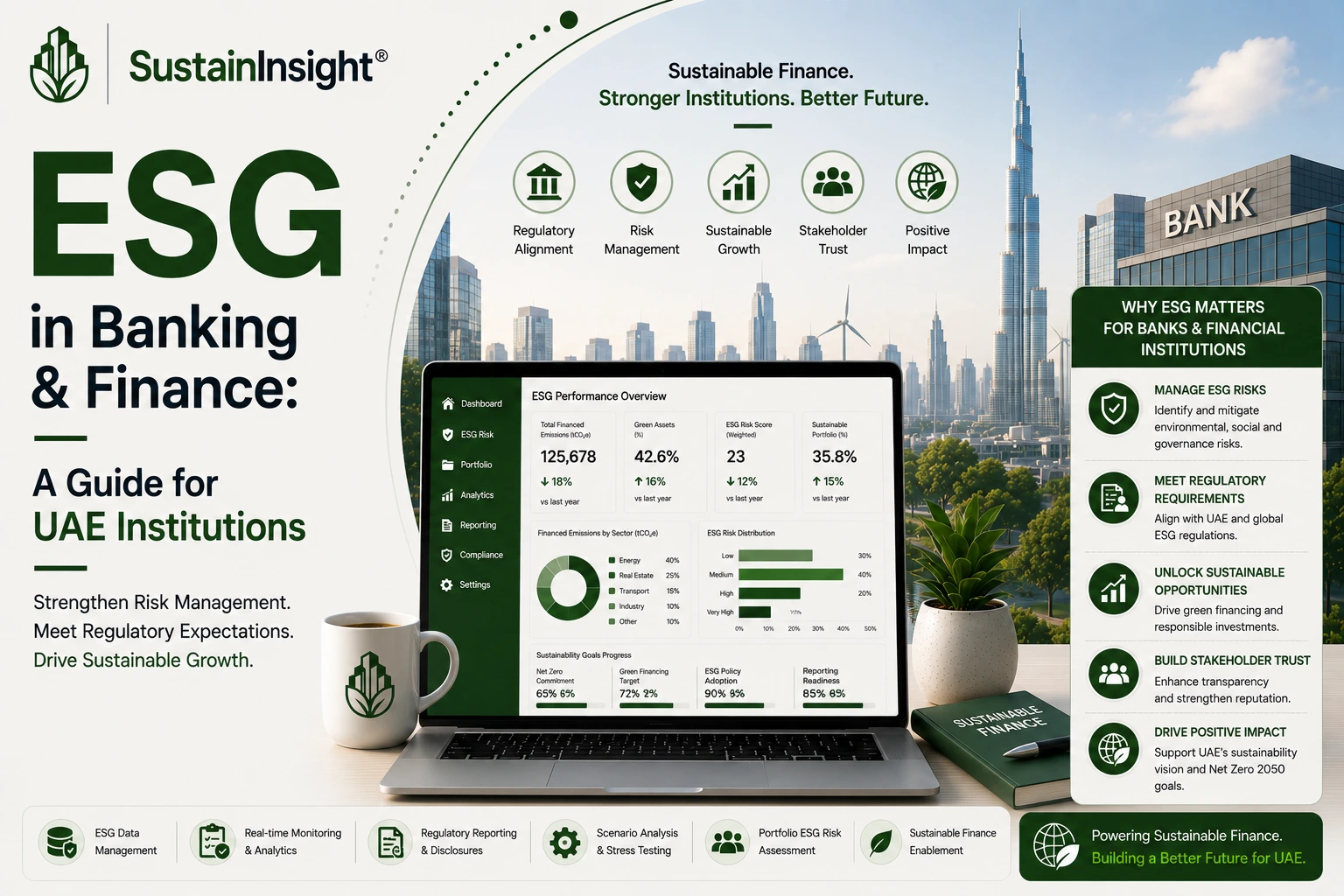
Financial institutions occupy a unique position in the ESG landscape: they must manage their own operational sustainability performance while also accounting for the emissions and ESG risk embedded in their lending and investment portfolios. As the UAE's Sustainable Finance Framework matures and regulators like the Central Bank of the UAE, DFSA, and ADGM raise expectations around climate risk and disclosure, ESG in banking and finance has become a defining compliance and competitive issue for UAE institutions.
This article explains what ESG in banking means, why it matters for UAE financial institutions, and how SustainInsight helps banks and financial services companies simplify sustainability reporting.
What Is ESG in Banking & Finance?
ESG in banking and finance covers two distinct but related dimensions: an institution's own operational sustainability (offices, energy use, workforce practices) and the ESG performance embedded in its lending, investment, and financing activities — often referred to as financed emissions.
Environmental
-
Operational energy use and emissions
-
Financed emissions across loan and investment portfolios
-
Green financing and sustainable lending products
-
Climate-related financial risk exposure
Social
-
Financial inclusion and responsible lending
-
Employee wellbeing and workforce practices
-
Data privacy and cybersecurity governance
-
Community investment
Governance
-
Regulatory compliance and disclosure
-
Board oversight of climate and ESG risk
-
Ethical lending and investment practices
-
Risk management frameworks
Why ESG in Banking Matters More Than Ever in the UAE?
Several forces are pushing ESG up the priority list for UAE financial institutions:
-
The UAE's Sustainable Finance Framework and related Central Bank guidance shaping expectations for climate risk management
-
Growing requirements from bodies like the DFSA and ADGM around sustainable finance disclosure
-
Rising demand for green bonds, sukuk, and sustainability-linked loans from corporate clients
-
International investor expectations for climate risk transparency in financial institutions
-
The complexity of measuring financed emissions across diverse loan and investment portfolios
Key Benefits of ESG in Banking & Finance
1. Strengthens Regulatory Compliance
Structured ESG data and reporting processes help institutions respond confidently to evolving Central Bank, DFSA, and ADGM sustainable finance expectations.
2. Supports Climate Risk Management
Understanding climate-related exposure across loan and investment portfolios helps institutions manage transition and physical climate risks more effectively.
3. Enables Green Financing Products
Reliable ESG data allows institutions to develop and confidently market green bonds, sukuk, and sustainability-linked loans to a growing base of sustainability-conscious corporate clients.
4. Strengthens Investor Confidence
Transparent ESG and financed emissions reporting builds credibility with international investors increasingly factoring climate risk into their assessments of financial institutions.
5. Differentiates in a Competitive Market
As sustainable finance becomes a growth area across the UAE and GCC, institutions with strong ESG data and reporting capabilities are better positioned to capture this business.
6. Prepares for Expanding Disclosure Requirements
As UAE and international sustainable finance regulation continues to mature, institutions with ESG data infrastructure already in place face lower compliance risk.
Challenges of ESG in Banking & Finance
UAE financial institutions commonly face:
-
Measuring financed emissions across diverse and complex loan and investment portfolios
-
Limited emissions data from borrowers and investee companies
-
Coordinating ESG reporting across operational and portfolio-level dimensions
-
Keeping pace with evolving Central Bank, DFSA, and ADGM guidance
-
Aligning reporting with international frameworks like PCAF alongside UAE-specific expectations
How SustainInsight Helps Financial Institutions?
SustainInsight is an AI-powered ESG and sustainability platform that helps banks and financial institutions across the UAE centralize ESG data and simplify reporting. Key capabilities include:
-
AI-powered ESG and sustainability reporting
-
Operational carbon accounting and Scope 1, 2 & 3 emissions tracking
-
Real-time ESG dashboards and KPI monitoring
-
Compliance alignment with GRI, ISSB, CSRD, TCFD, ISO 14064-1, and the GHG Protocol
-
Audit-ready reporting for regulators and investors
By centralizing ESG data, SustainInsight helps financial institutions reduce reporting effort while building the transparent sustainability data increasingly expected by regulators and clients.
Conclusion
ESG in banking and finance is becoming central to how UAE financial institutions manage risk, meet regulatory expectations, and compete for sustainability-conscious clients. Institutions that invest in reliable ESG data and reporting today will be better positioned as the UAE's Sustainable Finance Framework and related regulatory expectations continue to mature.
With SustainInsight, UAE financial institutions can simplify ESG reporting, strengthen climate risk visibility, and support the sustainable finance products increasingly in demand.