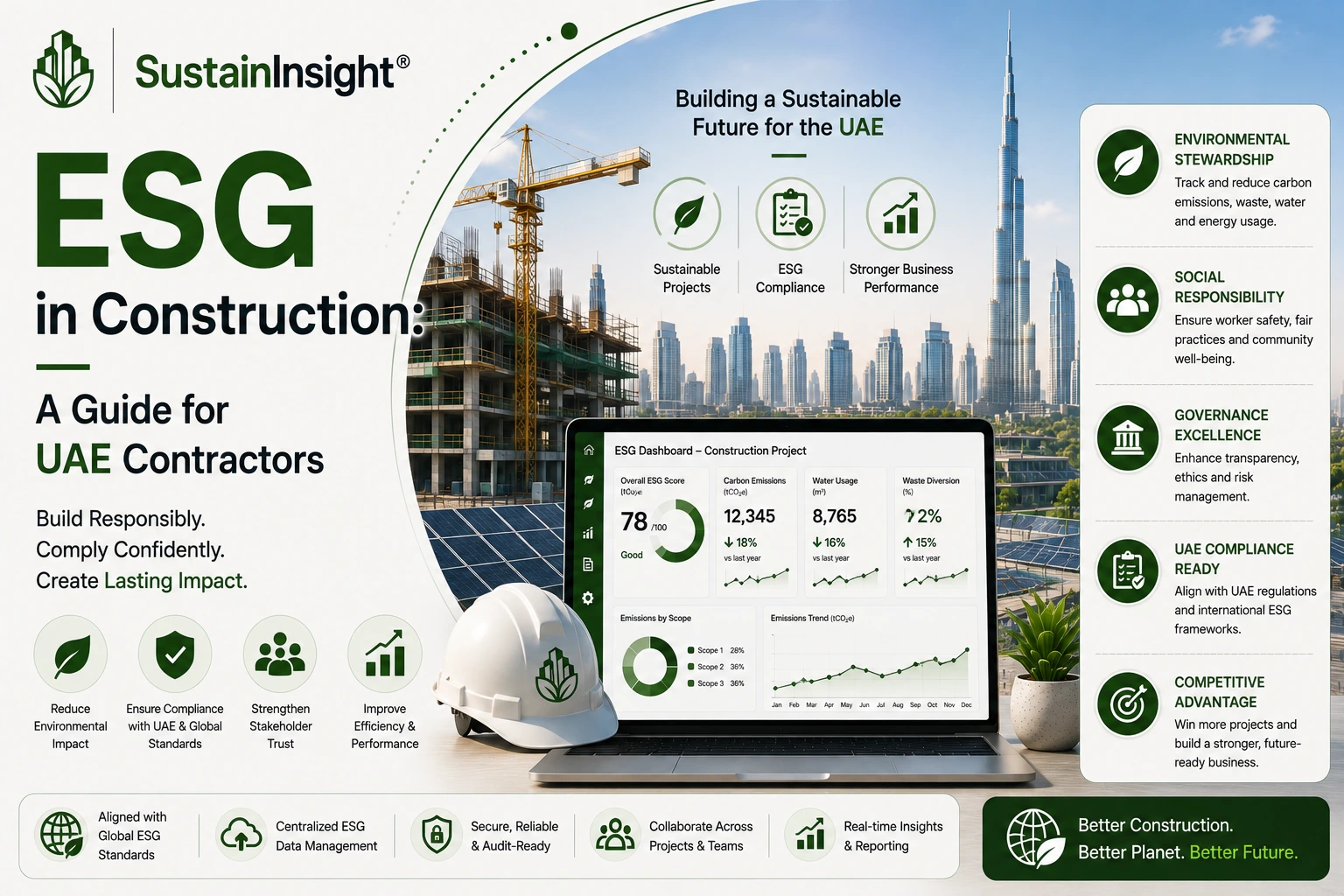
Construction is one of the most resource- and emissions-intensive sectors in the economy, from materials sourcing and energy use on-site to waste generation and long-term building performance. As the UAE accelerates toward its Net Zero 2050 goals and clients, financiers, and regulators raise expectations around sustainable building practices, ESG in construction has moved from a differentiator to an operational requirement for contractors and developers across the country.
This article explains what ESG in construction means, why it matters for UAE contractors, and how SustainInsight helps construction businesses simplify sustainability reporting and compliance.
What Is ESG in Construction?
ESG in construction refers to how contractors, developers, and project owners manage environmental impact, social responsibility, and governance practices across the project lifecycle — from design and materials sourcing through construction, operation, and eventual demolition or retrofit.
The three pillars apply directly to construction operations:
Environmental
Embodied carbon in materials
Energy and water use during construction
Construction waste and recycling rates
Site emissions and equipment fuel use
Green building certifications (LEED, Estidama, Al Sa'fat)
Social
Worker health and safety
Fair labor practices across contractors and subcontractors
Community impact of construction activity
Workforce diversity and training
Governance
Regulatory compliance
Supply chain transparency
Ethical procurement
Project risk and quality management
Why ESG in Construction Matters More Than Ever in the UAE
Several forces are pushing ESG up the priority list for UAE contractors:
Growing adoption of green building requirements and certifications (such as Dubai's Al Sa'fat and Abu Dhabi's Estidama)
Increasing demand from developers and investors for sustainability-documented projects
The UAE's Net Zero 2050 strategy driving lower-carbon construction practices
International clients and financiers requiring ESG disclosure as part of due diligence
Growing use of sustainability performance in government tender evaluation
Contractors that can demonstrate strong ESG performance are better positioned to win projects, secure financing, and meet the expectations of increasingly sustainability-conscious clients.
Key Benefits of ESG in Construction
1. Improves Project Competitiveness
Contractors with documented ESG performance are increasingly favored in tenders, particularly for government and large private-sector projects that factor sustainability into vendor selection.
2. Reduces Material and Energy Costs
Tracking embodied carbon, energy use, and waste helps construction firms identify efficiency opportunities that lower both environmental impact and operating costs.
3. Supports Access to Green Financing
Financial institutions increasingly offer preferential terms for projects that meet sustainability criteria, making ESG documentation directly relevant to project financing.
4. Strengthens Client and Investor Confidence
Transparent ESG reporting demonstrates accountability to developers, investors, and regulators evaluating a contractor's long-term reliability.
5. Improves Worker Safety and Retention
Strong social governance — safety programs, fair labor practices, and training — improves workforce retention and reduces incident-related project delays.
6. Prepares Contractors for Evolving Regulation
As green building codes and sustainability disclosure requirements expand across the UAE, contractors with ESG processes already in place face lower compliance risk.
Challenges of ESG in Construction
UAE construction firms commonly face:
Fragmented data across multiple subcontractors and sites
Difficulty tracking embodied carbon in materials
Manual, inconsistent sustainability reporting processes
Limited visibility into supply chain ESG performance
Balancing sustainability requirements against project timelines and budgets
How SustainInsight Helps Construction Companies
SustainInsight is an AI-powered ESG and sustainability platform that helps construction companies and contractors across the UAE centralize ESG data and simplify reporting. Key capabilities include:
AI-powered ESG and sustainability reporting
Carbon accounting across project sites and supply chains
Scope 1, Scope 2 & Scope 3 emissions tracking
Real-time ESG dashboards for multi-project portfolios
Compliance alignment with GRI, ISSB, CSRD, TCFD, ISO 14064-1, and the GHG Protocol
Audit-ready reporting for clients, investors, and regulators
By centralizing data across projects and subcontractors, SustainInsight helps construction businesses reduce reporting effort while building a credible sustainability track record.
Conclusion
ESG in construction is becoming a core part of how UAE contractors compete for projects, secure financing, and meet regulatory and client expectations. Firms that invest in reliable sustainability data and reporting today will be better positioned as green building requirements and ESG disclosure expectations continue to expand.
With SustainInsight, UAE construction companies can simplify ESG reporting, track carbon performance across projects, and demonstrate the sustainability credentials increasingly required to win and finance new work.