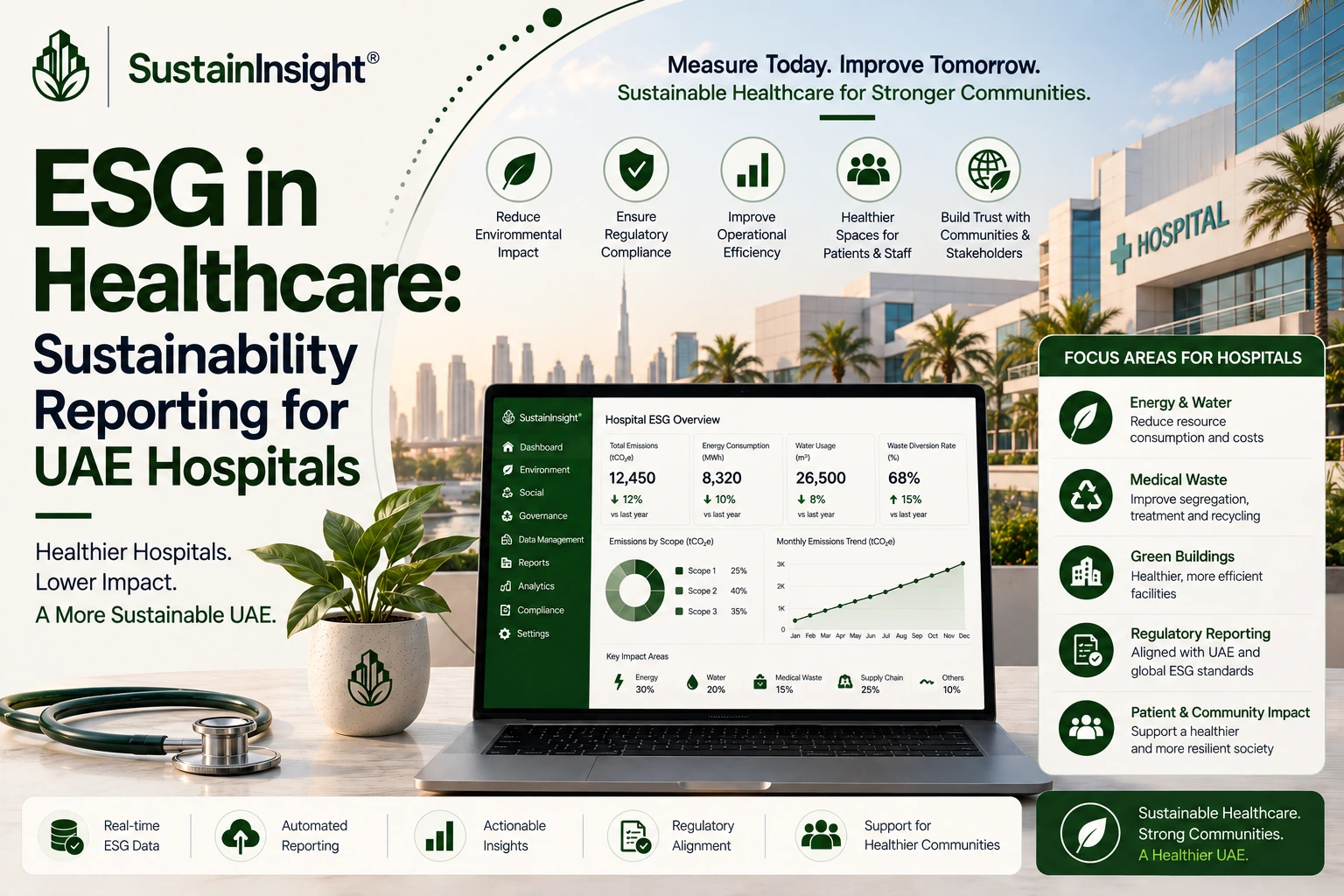
Healthcare occupies an unusual place in the ESG conversation: it's simultaneously one of the most essential social infrastructures and one of the most resource-intensive sectors to operate sustainably. UAE hospitals and clinics run energy-hungry facilities around the clock, manage complex and tightly regulated waste streams, and depend on global pharmaceutical and medical device supply chains — all while patient safety and continuity of care must always take precedence over sustainability initiatives, never compete with them. For healthcare providers across Dubai, Abu Dhabi, and the wider UAE, building credible ESG reporting means navigating this balance thoughtfully. This guide covers what ESG looks like in healthcare and how providers can approach it without compromising clinical priorities.
Why ESG Matters in Healthcare?
Healthcare facilities are among the most energy-intensive building types per square meter, driven by continuous HVAC, sterilization, imaging equipment, and 24/7 operations — making energy management a high-cost and emissions lever. Regulators, insurers, and international accreditation bodies are increasingly attentive to environmental and governance performance alongside clinical quality, and DHA, DOH, and MOHAP oversight in the UAE increasingly intersects with broader sustainability and facilities standards. Healthcare providers are also major employers and community anchors, making social impact and governance disclosure — workforce wellbeing, community health access, ethical governance — a natural and expected part of ESG reporting for the sector. And healthcare real estate and major hospital developments increasingly face green building expectations tied to UAE Net Zero 2050 ambitions and developer sustainability requirements.
What Makes Healthcare ESG Reporting Distinct?
1. Patient safety and continuity always come first
Sustainability initiatives in healthcare must be designed around, never in tension with, clinical safety and continuity of care — a constraint that shapes what's practical far more than in most other sectors.
2. Regulated waste streams add complexity
Medical and biohazard waste requires specialized handling that differs fundamentally from general commercial waste management, and disclosure needs to separate clinical waste compliance from broader waste-reduction sustainability metrics.
3. Anesthetic gases and medical emissions
Certain anesthetic gases used in surgical settings are potent greenhouse gases, an emissions source specific to healthcare that's increasingly tracked by sustainability-forward hospital systems internationally.
4. Energy intensity is structural, not optional
Unlike an office building that can meaningfully reduce energy use through occupancy changes, hospitals require continuous critical-system power, limiting how far energy reduction can go without new infrastructure investment.
5. Pharmaceutical and device supply chains are global and complex
Much of a healthcare provider's Scope 3 footprint sits with pharmaceutical manufacturing, medical device production, and cold-chain logistics — categories largely outside the provider's direct control.
6. Single-use plastics serve a safety function
Reducing single-use medical plastics has to be weighed carefully against infection control requirements, unlike single-use plastic reduction in retail or hospitality.
Core Reporting Areas for UAE Healthcare Providers
1. Facility energy and emissions
Scope 1 and 2 emissions from hospital and clinic operations, including progress on energy efficiency retrofits and, where feasible, renewable energy integration.
2. Medical and clinical waste management
Compliant handling and disclosure of biohazard, pharmaceutical, and general medical waste, alongside broader facility waste reduction and recycling initiatives.
3. Water use and management
Water consumption for sterilization, facilities, and clinical processes, an area of growing scrutiny given the UAE's water scarcity context.
4. Supply chain and procurement
Sustainable procurement practices for pharmaceuticals, medical devices, and consumables, including engagement with suppliers on packaging and emissions data where feasible.
5. Workforce and community impact
Healthcare worker wellbeing, safety, and retention; community health access and outreach programs; patient experience and safety governance.
6. Governance and compliance
Alignment with DHA, DOH, and MOHAP regulatory expectations alongside international frameworks like GRI, TCFD-aligned climate disclosure, and increasingly ISSB-aligned reporting for larger, listed, or internationally accredited healthcare groups.
Common Challenges in Healthcare ESG Reporting
1. Balancing sustainability with clinical priority
Any sustainability initiative needs clear sign-off that it doesn't compromise infection control, patient safety, or continuity of critical care — slowing implementation compared to lower-stakes sectors.
2. Energy reduction limits
Structural energy intensity from critical systems means efficiency gains often require capital investment (equipment upgrades, building retrofits) rather than operational changes alone.
3. Fragmented data across clinical and facilities systems
Energy, waste, and supply chain data often live in entirely separate systems from clinical operations, making consolidated ESG reporting a genuine data integration challenge.
4. Limited supplier visibility into pharmaceutical and device emissions
Much of the sector's Scope 3 footprint depends on manufacturer disclosure that individual healthcare providers have limited leverage to influence.
How SustainInsight Helps UAE Healthcare Providers?
-
Facility-level energy and emissions tracking built for continuous, multi-building healthcare operations, distinguishing critical-system loads from areas with reduction potential
-
Waste stream data management that separates regulated medical/biohazard waste compliance tracking from general sustainability waste-reduction metrics
-
Supply chain data collection for pharmaceutical and medical device procurement, supporting Scope 3 estimation even where supplier data is limited
-
AI-assisted report generation mapped to DHA/DOH/MOHAP-relevant expectations alongside GRI, TCFD, and ISSB-aligned frameworks
-
Multi-facility consolidation for hospital groups and clinic networks managing ESG data across multiple sites and business units
-
Audit-ready data trails supporting both regulatory compliance and voluntary sustainability disclosure without adding burden to clinical teams
Conclusion
ESG reporting in healthcare asks UAE hospitals and clinics to manage real complexity — energy-intensive facilities, regulated waste, global pharmaceutical supply chains — while never letting sustainability initiatives compromise patient care. Providers that build the right data infrastructure can meet this challenge without forcing false trade-offs between clinical priority and environmental responsibility, strengthening their position with regulators, accreditation bodies, and the communities they serve. SustainInsight's platform is designed to handle this sector's specific data complexity so healthcare teams can focus on care delivery.