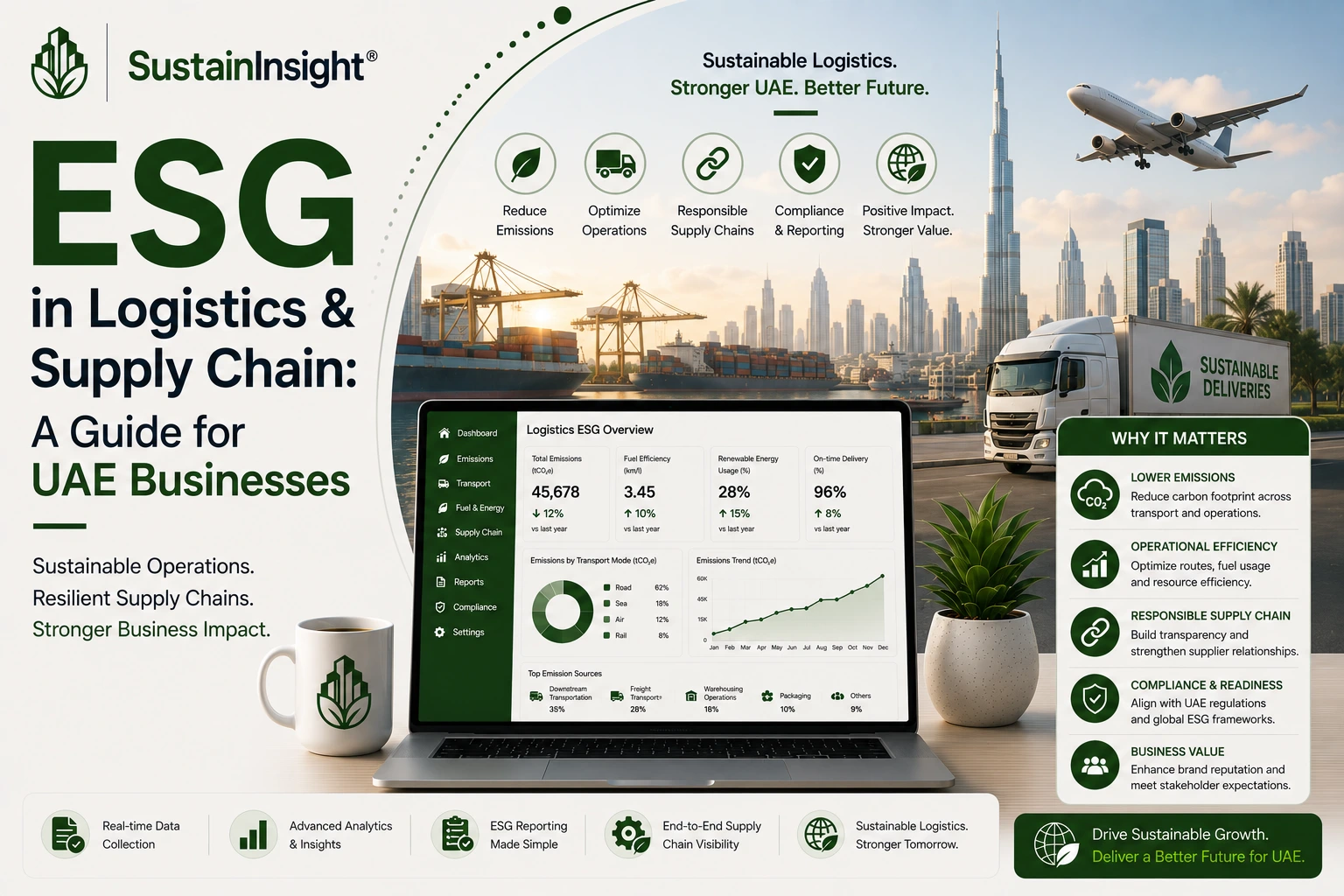
As a global trade and logistics hub anchored by ports like Jebel Ali and a dense network of free zones, the UAE's logistics sector sits at the center of increasingly demanding ESG expectations — both as an operator managing its own emissions and as the critical link in global supply chains under growing scrutiny from international customers and regulators. ESG in logistics now touches everything from freight emissions and warehouse energy use to last-mile delivery and supplier transparency.
This article explains what ESG in logistics and supply chain means, why it matters for UAE businesses, and how SustainInsight helps logistics operators simplify sustainability reporting.
What Is ESG in Logistics & Supply Chain?
ESG in logistics covers how freight, warehousing, and supply chain businesses manage environmental impact, social responsibility, and governance practices across transportation, storage, and distribution operations.
Environmental
-
Freight and fleet emissions (road, sea, air)
-
Warehouse energy consumption and efficiency
-
Packaging waste and circularity
-
Fuel efficiency and alternative fuel adoption
-
Last-mile delivery emissions
Social
-
Driver and warehouse worker safety
-
Fair labor practices across contracted fleets
-
Workforce training and welfare
-
Community impact of logistics operations
Governance
-
Supply chain transparency and traceability
-
Regulatory and customs compliance
-
Data security across logistics platforms
-
Ethical procurement practices
Why ESG in Logistics Matters More Than Ever in the UAE?
Several forces are pushing ESG up the priority list for UAE logistics and supply chain businesses:
-
The UAE's role as a global trade hub means international customers increasingly expect supply chain emissions transparency
-
Mechanisms like the EU's CBAM place carbon costs on certain goods, making freight and logistics emissions data commercially relevant
-
Growing Scope 3 reporting requirements are pushing shippers to request emissions data from their logistics partners
-
The UAE's Net Zero 2050 strategy is shaping expectations across transportation and freight
-
Multinational supply chain partners increasingly requiring ESG data as part of vendor qualification
Key Benefits of ESG in Logistics & Supply Chain
1. Wins Business from ESG-Conscious Shippers
As shippers face their own Scope 3 emissions reporting requirements, logistics providers with strong emissions data become preferred partners over competitors without it.
2. Reduces Fuel and Operating Costs
Tracking fleet and warehouse energy use helps logistics operators identify efficiency opportunities that lower both emissions and operating costs.
3. Improves Supply Chain Resilience
Strong governance and transparency practices help logistics businesses better manage disruption risk and maintain customer trust during supply chain challenges.
4. Supports Access to Financing
Financial institutions increasingly factor sustainability performance into financing decisions for fleet expansion and infrastructure investment.
5. Strengthens Customer and Partner Confidence
Transparent ESG reporting demonstrates reliability to shippers, regulators, and investors evaluating a logistics provider's long-term viability.
6. Prepares for Evolving Regulation
As carbon border mechanisms and supply chain due diligence requirements expand globally, logistics businesses with ESG data infrastructure in place face lower compliance risk.
Challenges of ESG in Logistics
UAE logistics and supply chain businesses commonly face:
-
Fragmented emissions data across owned and contracted fleets
-
Difficulty measuring emissions across multi-modal transport (road, sea, air)
-
Limited visibility into subcontractor and partner ESG performance
-
Balancing sustainability investment against margin pressure in a competitive sector
-
Responding to varying ESG data requests from different shippers and partners
How SustainInsight Helps Logistics Businesses?
SustainInsight is an AI-powered ESG and carbon accounting platform that helps logistics and supply chain businesses across the UAE centralize emissions data and simplify reporting. Key capabilities include:
-
AI-powered ESG and sustainability reporting
-
Carbon accounting across fleets, warehouses, and multi-modal transport
-
Scope 1, Scope 2 & Scope 3 emissions tracking
-
Real-time ESG dashboards for operations spanning multiple sites
-
Compliance alignment with GRI, ISSB, CSRD, TCFD, ISO 14064-1, and the GHG Protocol
-
Audit-ready reporting for shippers, regulators, and investors
By centralizing data across fleets and facilities, SustainInsight helps logistics businesses respond quickly and credibly to the growing volume of ESG data requests from shippers and partners.
Conclusion
ESG in logistics and supply chain is becoming central to how UAE freight, warehousing, and distribution businesses compete for shipper business, manage costs, and meet the sustainability expectations of global trade partners. Operators that invest in reliable emissions data today will be better positioned as Scope 3 requirements and carbon border mechanisms continue to expand.
With SustainInsight, UAE logistics businesses can simplify ESG reporting, track emissions across fleets and facilities, and respond confidently to shipper ESG data requests.