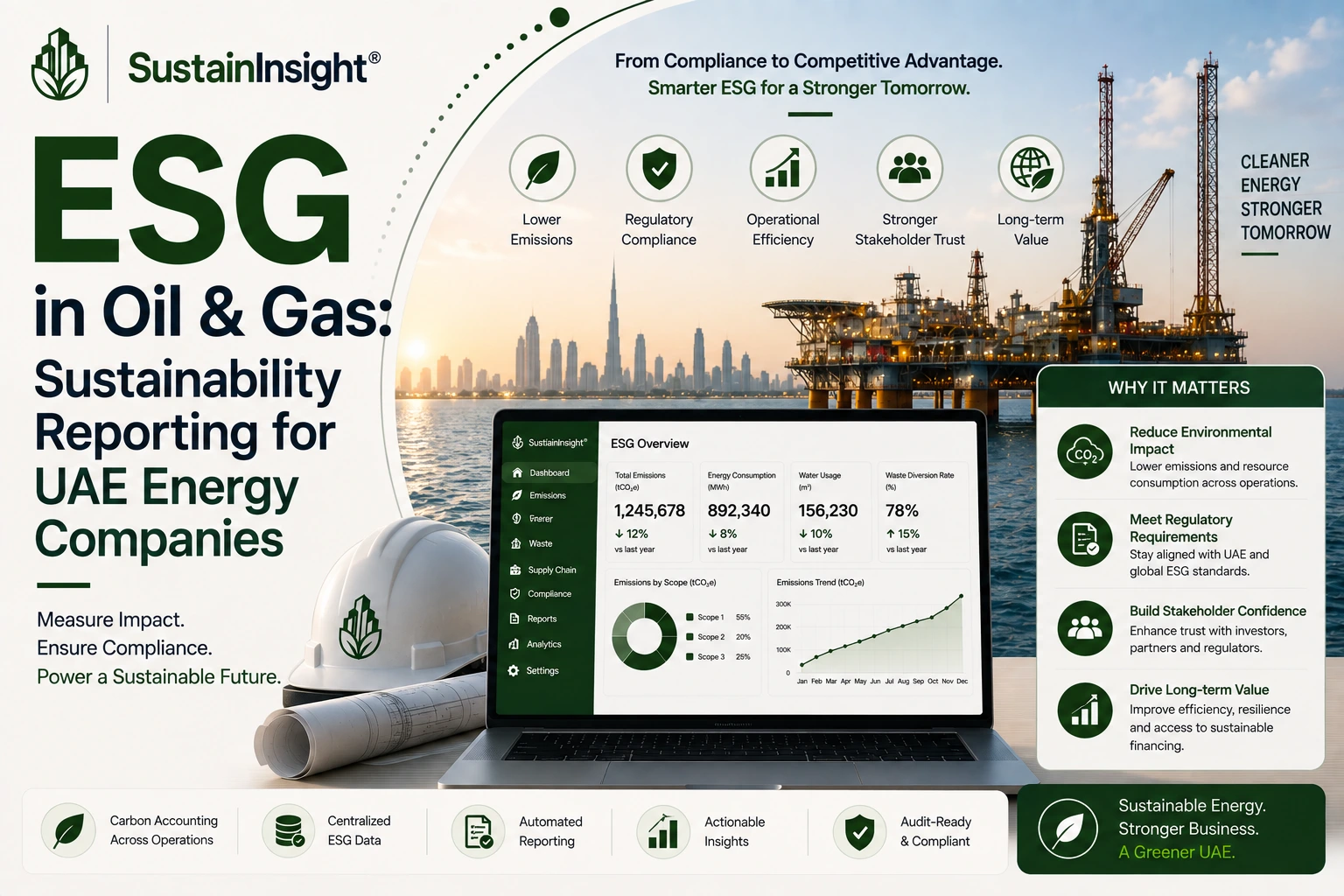
Few sectors face a sharper ESG spotlight than oil and gas — and few regions carry that spotlight with as much weight as the UAE, one of the world's major hydrocarbon producers, now also positioning itself as a regional leader on energy transition and climate ambition. UAE energy companies operate at the center of this tension: continuing to meet global energy demand while facing mounting pressure from investors, regulators, and international partners to disclose credible emissions data, methane performance, and transition strategy. This guide covers what ESG reporting looks like in the oil and gas sector, why it's uniquely demanding, and how UAE energy companies can build a reporting process that holds up to scrutiny.
Why ESG Matters in Oil & Gas?
Investors and lenders increasingly apply climate-related screening to energy sector financing, meaning credible ESG disclosure directly affects access to capital and cost of financing for UAE energy companies and their joint ventures. International partners and offtake customers, particularly in Europe and among IOCs (international oil companies) with net-zero commitments, are asking upstream and midstream partners for granular emissions data as a condition of continued partnership. The UAE's own climate positioning — hosting COP28, its Net Zero by 2050 strategic initiative, and the national methane reduction commitments — puts additional expectations on the country's energy sector to lead on operational emissions performance even as production continues. And regulators and rating agencies increasingly distinguish between operators who disclose granular, asset-level emissions data and those who report only high-level, aggregated figures — with real consequences for ESG ratings and reputational standing.
What Makes Oil & Gas ESG Reporting Distinct?
Scope 1 is unusually material
Unlike most sectors where Scope 3 dominates, oil and gas operators carry significant direct (Scope 1) emissions from flaring, venting, fugitive methane, and process emissions — making operational-level emissions management a core ESG lever, not just a downstream data exercise.
Methane intensity is now a headline metric
Methane's outsized near-term warming impact has made methane intensity (not just total CO2e) a specific disclosure expectation from investors, regulators, and initiatives like the Oil and Gas Methane Partnership (OGMP).
Asset-level and joint-venture complexity
UAE energy operations are frequently structured through joint ventures and concessions with multiple stakeholders, complicating consolidated ESG reporting boundaries and requiring careful allocation of operated versus non-operated emissions.
Scope 3 "use of sold products" is enormous but contested
The combustion emissions from sold oil and gas products (Scope 3 Category 11) typically dwarf a company's own operational footprint, and how — or whether — to report and target this category remains one of the most debated areas of sector ESG disclosure.
Transition strategy is now part of the ESG narrative
Investors increasingly expect energy companies to articulate a credible transition pathway — diversification into renewables, carbon capture, hydrogen — alongside core hydrocarbon reporting, not as a separate initiative.
Core Reporting Areas for UAE Energy Companies
Operational emissions (Scope 1 and 2)
Flaring and venting volumes, fugitive methane emissions, process emissions, and energy use across upstream, midstream, and downstream operations.
Methane-specific metrics
Methane intensity by production volume, leak detection and repair (LDAR) program performance, and flaring reduction progress against routine flaring commitments.
Scope 3 disclosure and transition planning
Combustion emissions from sold products, alongside a credible narrative on diversification, carbon capture and storage (CCS) investment, and low-carbon energy initiatives.
Water and land use
Water management in extraction and processing, produced water handling, and land/biodiversity impact disclosure for operational sites.
Health, safety, and community impact
A long-standing core disclosure area for the sector, covering workforce safety performance and community/social impact of operations.
Governance and framework alignment
Mapping disclosures to sector-relevant frameworks including IPIECA sustainability reporting guidance, TCFD-aligned climate risk disclosure, GRI, and increasingly ISSB-aligned standards, alongside UAE national reporting expectations.
Common Challenges in Sustainability Reporting for Energy Companies
1. Reconciling operated and non-operated emissions
Joint venture structures common in UAE upstream operations require clear methodology for what gets reported at what ownership share, and inconsistent approaches across partners can undermine data credibility.
2. Methane data quality
Accurate methane measurement (versus estimation) requires investment in monitoring technology, and many operators are still building toward measurement-based reporting rather than engineering estimates.
3. Balancing production growth with credible climate commitments
Energy companies face genuine scrutiny — including accusations of greenwashing — when growth plans and emissions reduction targets aren't presented with equal transparency.
4. Manual, fragmented data across assets
Emissions and operational data often sit in separate systems across upstream, midstream, and downstream business units, making consolidated group-level ESG reporting slow and error-prone.
How SustainInsight Helps UAE Energy Companies
-
Asset and entity-level emissions tracking that supports accurate consolidation across joint ventures and multi-asset portfolios, with clear operated/non-operated allocation
-
Methane and flaring data management structured to support both regulatory disclosure and voluntary initiative reporting (such as OGMP-aligned methane intensity metrics)
-
Scope 3 Category 11 modeling for sold-product combustion emissions, alongside space to document transition strategy and low-carbon investment alongside core figures
-
AI-assisted data capture and validation that reduces the manual reconciliation burden across upstream, midstream, and downstream reporting units
-
Framework-mapped reporting aligned to IPIECA, TCFD, GRI, and ISSB-aligned standards, letting energy companies produce investor-grade disclosures from one validated dataset
-
Audit-ready data trails supporting the credibility of both regulatory filings and public climate commitments, reducing greenwashing exposure
Conclusion
ESG reporting in oil and gas carries a different weight than in most other sectors — the operational emissions are real and material, the scrutiny is intense, and the credibility bar for transition claims keeps rising. UAE energy companies that invest in granular, asset-level emissions data, honest methane and flaring disclosure, and a transparent transition narrative will be better positioned with investors, partners, and regulators navigating an increasingly demanding ESG landscape. SustainInsight's platform is built to handle the operational complexity — joint ventures, multi-asset portfolios, methane data — that makes oil and gas ESG reporting genuinely harder than most.