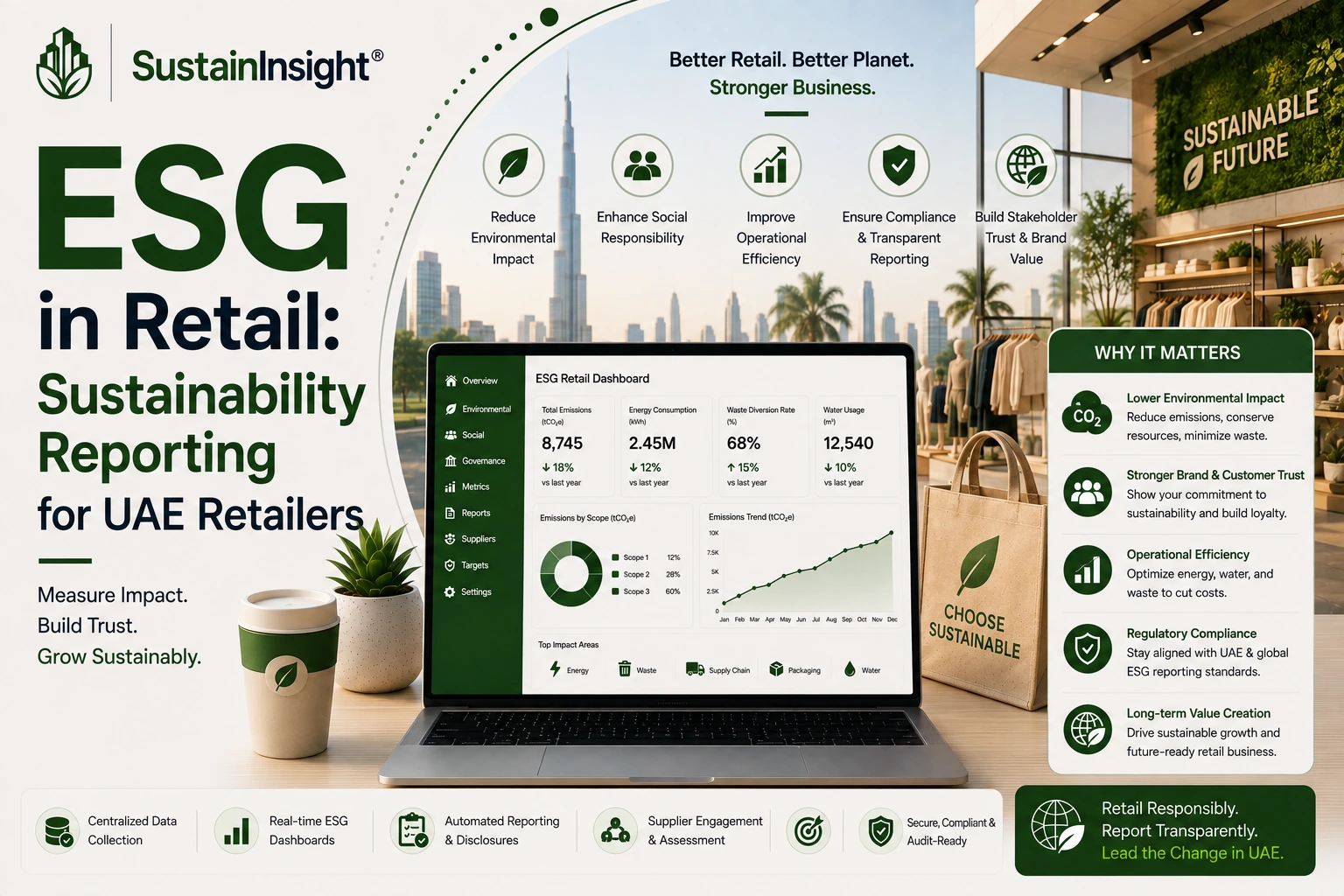
Retail is one of the most visible faces of the UAE's consumer economy — from Dubai's mega-malls to fast-growing e-commerce platforms serving the wider GCC. It's also one of the most exposed sectors when it comes to ESG scrutiny. Retailers sit at the intersection of global supply chains, high-volume packaging and logistics, energy-intensive store footprints, and increasingly sustainability-conscious shoppers. For UAE retailers, ESG reporting is no longer a back-office compliance exercise — it's becoming a factor in landlord requirements, supplier contracts, financing terms, and brand reputation.
This guide breaks down what ESG in retail actually means, why it matters specifically for UAE and GCC retailers, the core reporting challenges the sector faces, and how a platform like SustainInsight helps retailers turn a sprawling, multi-tier supply chain into a manageable reporting process.
Why ESG Matters in Retail?
Retail businesses face ESG pressure from several directions at once:
Landlords and mall operators across the UAE are increasingly building sustainability requirements into leasing terms, particularly as major developers pursue their own net-zero and green-building commitments. Retailers with a credible ESG story have an easier time negotiating space in premium developments.
Global and regional suppliers are being asked by their own retail customers — including UAE-based ones — to disclose emissions and labor practices, which means retailers need supplier-level ESG data to complete their own reporting.
Consumers, particularly younger and higher-income shoppers in Dubai and Abu Dhabi, increasingly factor sustainability claims into purchasing decisions, and regulators are tightening rules around unsubstantiated "green" marketing claims, making accurate ESG data a legal safeguard as much as a marketing asset.
Financing and insurance providers are starting to price ESG performance into lending and coverage terms for large retail groups, especially those with sizeable real estate and logistics footprints.
What Makes Retail ESG Reporting Distinct?
Retail ESG reporting has a few characteristics that set it apart from other sectors:
Scope 3 dominance
For most retailers, the overwhelming majority of emissions sit in Scope 3 — purchased goods, upstream transportation, packaging, and in many cases downstream logistics and product end-of-life. Store energy use (Scope 1 and 2) is real but typically a small fraction of the total footprint.
Multi-tier, multi-country supply chains
A single UAE retailer may source from hundreds of suppliers across dozens of countries, each with different levels of ESG maturity and data availability, making consistent data collection genuinely difficult.
High SKU turnover and seasonality
Product ranges change frequently, complicating year-over-year comparability of product-level footprint data.
Franchise and multi-brand structures
Many UAE retail groups operate multiple brands or franchise agreements, each of which may need separate or consolidated ESG disclosure depending on ownership structure and reporting boundary.
Packaging and waste visibility
Retailers are frequently the first point of scrutiny on packaging waste and plastic use, even when the packaging decision originates upstream with a supplier or brand owner.
Core Reporting Areas for UAE Retailers
Energy and emissions across the store network
Tracking Scope 1 and 2 emissions across stores, distribution centers, and offices — including energy mix disclosure for UAE grid electricity and any on-site renewables such as rooftop solar on distribution facilities.
Scope 3 supply chain emissions
Estimating and, where possible, collecting primary data on emissions from purchased goods and services, upstream transportation, and logistics — typically the largest single category for retailers.
Sustainable sourcing and supplier ESG
Documenting supplier codes of conduct, ethical sourcing commitments, and supplier-level ESG data collection processes.
Packaging and waste
Disclosing packaging material use, recyclability, and waste diversion rates across stores and distribution operations.
Labor and social practices
Covering both direct employees — a significant workforce in UAE retail — and, where relevant, supply chain labor conditions.
Governance and compliance mapping
Aligning disclosures to frameworks relevant to the retailer's investor base or parent-company reporting requirements, which for many UAE retail groups increasingly means CSRD-aligned disclosure for European-linked operations or ISSB-aligned disclosure for regional standardization.
Common Challenges in Retail ESG Reporting
Supplier data gaps
Many suppliers, particularly smaller manufacturers, don't yet track or share emissions data, forcing retailers to rely on estimates and industry-average emission factors rather than primary data.
Reconciling brand-level and group-level reporting
Multi-brand retail groups often need both consolidated group disclosure and brand-specific messaging, which can create inconsistencies if not managed centrally.
Balancing marketing claims with disclosure rigor
Sustainability claims used in stores or marketing need to be defensible against the same data used in formal ESG disclosure — a gap here creates greenwashing risk.
Manual, spreadsheet-based tracking
Retailers managing Scope 3 estimates, supplier questionnaires, and packaging data across spreadsheets face high error rates and slow turnaround at reporting time.
How SustainInsight Helps UAE Retailers?
-
Automated Scope 3 estimation using category-based emission factors for purchased goods, transportation, and logistics, reducing reliance on manual spreadsheet modeling
-
Supplier data collection workflows that make it easier to request, track, and validate ESG data from suppliers across multiple tiers and geographies
-
Multi-brand and multi-entity reporting structures that let retail groups consolidate at the group level while still producing brand-specific reports
-
AI-assisted report generation mapped to CSRD, ISSB, and other relevant frameworks, cutting the manual effort of translating raw data into disclosure-ready reports
-
Packaging and waste tracking alongside emissions data, giving retailers one place to manage the metrics most visible to regulators and consumers
-
Audit-ready data trails that support the accuracy of sustainability claims used in marketing and investor communications, reducing greenwashing exposure
Conclusion
ESG reporting in retail is fundamentally a supply chain data problem wrapped in a consumer-facing brand story. UAE retailers that get ahead of it — building real Scope 3 visibility, credible supplier data processes, and consistent group-to-brand reporting — will be better positioned for landlord negotiations, supplier partnerships, financing terms, and consumer trust as scrutiny increases across the region. Platforms like SustainInsight give retailers a practical way to manage that complexity without building an ESG data team from scratch.