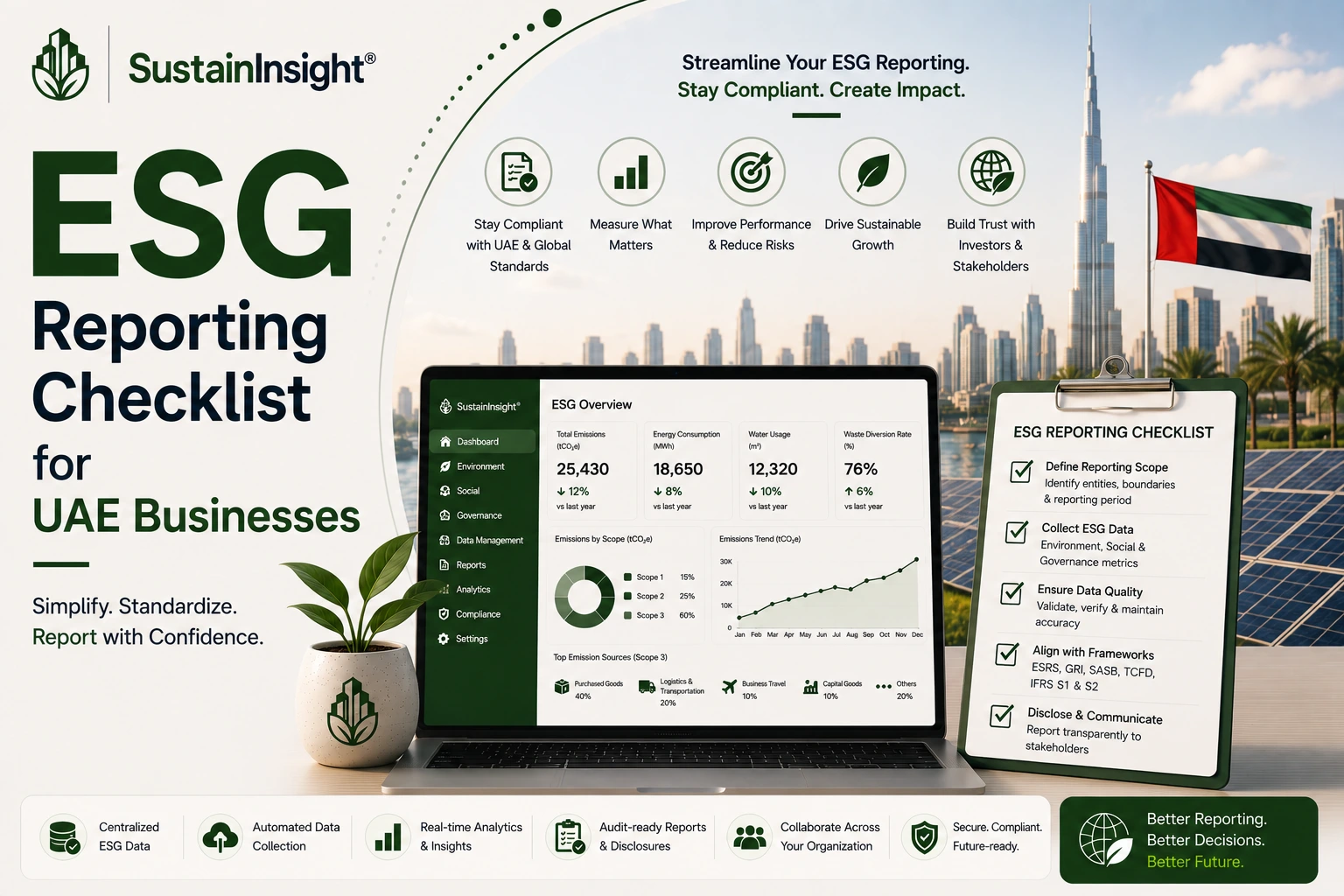
Whether you're preparing your first sustainability report or refining an existing process, ESG reporting involves a lot of moving parts — framework selection, data collection, materiality assessment, and increasingly, third-party assurance. This checklist breaks the process into practical phases to help UAE businesses build (or improve) their ESG reporting with confidence.
5 Phases ESG Reporting Checklist for UAE Businesses
Phase 1: Foundation & Planning
-
Identify which ESG frameworks apply to your business (GRI, ISSB, CSRD, TCFD) based on size, listing status, and international operations
-
Conduct a materiality assessment to identify which sustainability topics are most relevant to your business and stakeholders
-
Assign clear internal ownership for ESG reporting, ideally with executive sponsorship
-
Set a reporting timeline aligned with your framework's disclosure deadlines
-
Review UAE-specific expectations relevant to your sector (Net Zero 2050 alignment, Dubai Sustainable Tourism, sector-specific regulatory guidance)
Phase 2: Data Collection
-
Map all internal data sources needed for reporting (finance, HR, facilities, procurement)
-
Set up Scope 1 emissions tracking (direct emissions from owned or controlled sources)
-
Set up Scope 2 emissions tracking (emissions from purchased electricity, heating, and cooling)
-
Begin Scope 3 emissions data collection across relevant value chain categories
-
Establish a process for collecting social metrics (workforce data, safety incidents, training hours)
-
Document governance practices and policies relevant to your material topics
-
Standardize data collection templates across business units or facilities to ensure consistency
Phase 3: Reporting & Disclosure
-
Map collected data to your chosen framework's specific disclosure requirements
-
Draft narrative sections explaining strategy, targets, and progress alongside quantitative data
-
Set measurable sustainability targets where your framework requires forward-looking commitments
-
Review disclosures for consistency with prior reporting periods
-
Prepare a clear methodology section explaining how emissions and other metrics were calculated
-
Have the report reviewed internally by finance, legal, and sustainability stakeholders before publication
Phase 4: Assurance & Continuous Improvement
-
Determine whether your framework requires third-party assurance, and at what level (limited or reasonable)
-
Prepare supporting documentation and audit trails in advance of any assurance engagement
-
Publish the report through appropriate channels (website, regulatory filing, investor communications)
-
Gather feedback from investors, customers, and other stakeholders on the report
-
Set up ongoing data monitoring so next year's reporting doesn't start from zero
-
Review evolving regulatory requirements annually, since frameworks and thresholds continue to change
Why This ESG Checklist Matters for UAE Businesses?
As UAE businesses face a growing set of overlapping expectations — from the UAE's own Net Zero 2050 strategy to international frameworks like CSRD and ISSB extending their reach — a structured approach to ESG reporting reduces the risk of gaps, inconsistencies, and last-minute scrambles as deadlines approach.
How SustainInsight Helps You Work Through This Checklist?
SustainInsight is an AI-powered ESG and sustainability platform built to support UAE and GCC businesses through every phase of this checklist. Key capabilities include:
-
AI-powered ESG data collection and reporting
-
Automated Scope 1, Scope 2 & Scope 3 emissions tracking
-
Real-time ESG dashboards for ongoing monitoring
-
Compliance alignment with GRI, ISSB, CSRD, TCFD, ISO 14064-1, and the GHG Protocol
-
Audit-ready reporting built for third-party assurance
By automating data collection and framework mapping, SustainInsight helps businesses move through this checklist faster and with greater confidence in the accuracy of their reporting.
Conclusion
ESG reporting doesn't have to be overwhelming when broken into clear phases: foundation and planning, data collection, reporting and disclosure, and assurance and continuous improvement. UAE businesses that work through this checklist systematically are better positioned to produce accurate, credible reports and to keep improving their process year over year.