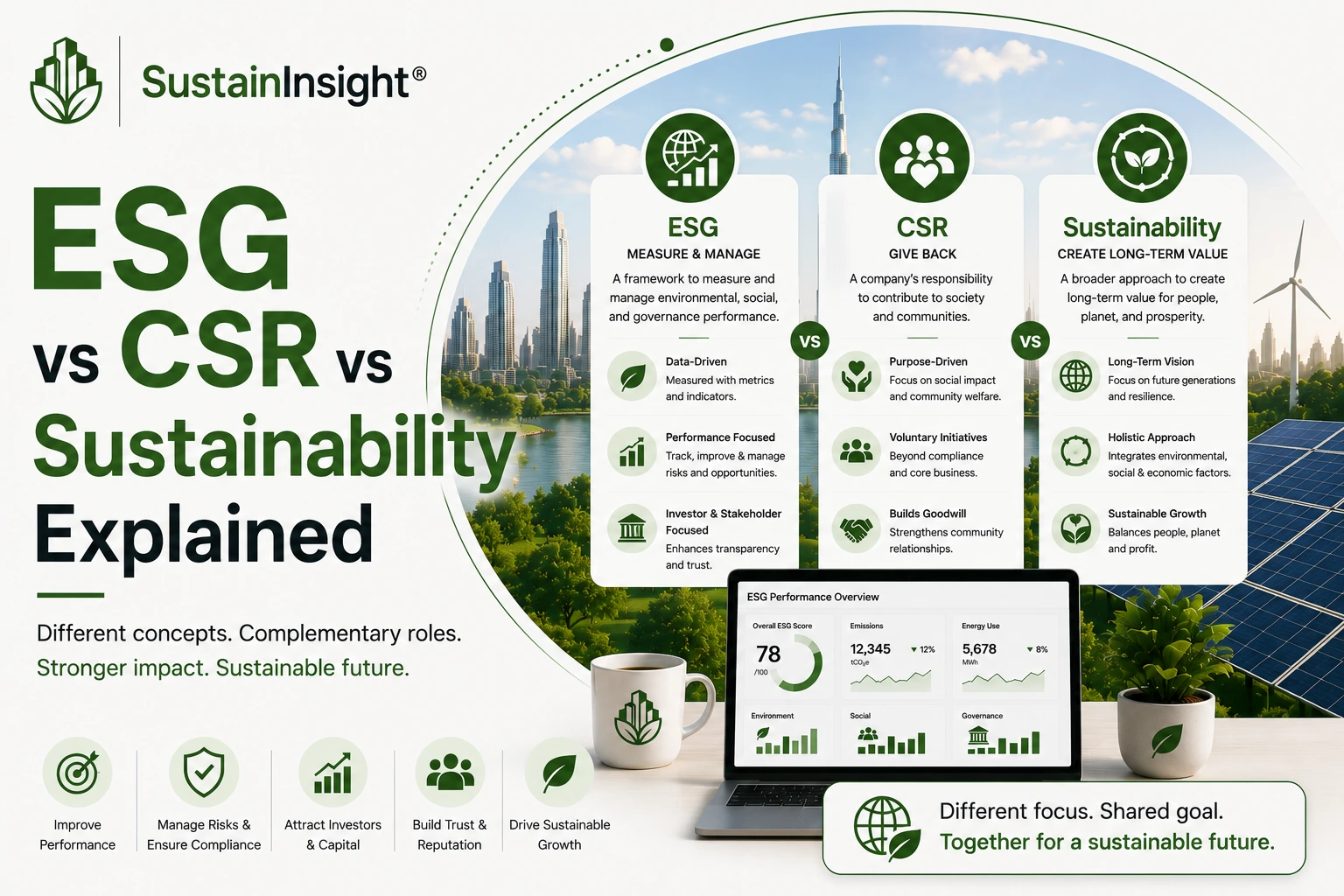
Businesses today face increasing expectations from investors, regulators, and consumers to operate responsibly. Terms like ESG, CSR, and sustainability are often used interchangeably, but they represent different approaches to responsible business practices.
Understanding the difference between ESG vs CSR vs sustainability is important for organizations that want to build long-term strategies for responsible growth.
While corporate social responsibility (CSR) traditionally focused on voluntary initiatives and philanthropy, ESG frameworks introduce measurable metrics and accountability. Sustainability, on the other hand, represents the broader concept of balancing environmental, social, and economic impact.
In this guide, we will explain how ESG, CSR, and sustainability differ and how they work together in modern business strategy.
What Is Corporate Social Responsibility (CSR)?
Corporate Social Responsibility (CSR) refers to voluntary initiatives taken by companies to contribute positively to society and the environment.
CSR programs typically focus on:
Community development
Charitable contributions
Employee volunteer programs
Environmental initiatives
Ethical business practices
The concept of corporate social responsibility became popular in the early 2000s when companies began investing in social initiatives to improve their brand image and public trust.
However, CSR initiatives were often informal and difficult to measure, which limited their effectiveness in evaluating corporate impact.
What Is ESG?
Environmental, Social, and Governance (ESG) is a framework used to evaluate how companies manage environmental and social risks while maintaining strong governance practices. Unlike CSR, ESG focuses on measurable performance indicators and is widely used by investors, regulators, and financial institutions. The ESG framework includes three key pillars.
Environmental
Environmental factors evaluate how companies impact the natural environment. Examples include:
Carbon emissions
Energy efficiency
Resource management
Waste reduction
Climate risk management
Social
The social pillar focuses on how companies manage relationships with employees, communities, and stakeholders. Examples include:
Employee wellbeing
Diversity and inclusion
Human rights
Workplace safety
Supply chain responsibility
Governance
Governance measures how companies manage leadership, transparency, and ethical practices. Examples include:
Board independence
Anti-corruption policies
Executive compensation
Regulatory compliance
Data transparency
ESG frameworks allow investors to assess long-term risks and sustainability performance when evaluating companies.
What Is Sustainability?
Sustainability is the broader concept that underpins both ESG and CSR. It refers to the ability of businesses to operate in a way that meets current needs without compromising the ability of future generations to meet their own needs.
Corporate sustainability strategies focus on balancing three major factors:
Environmental protection
Social responsibility
Economic growth
Companies often build sustainability programs around goals such as:
Reducing carbon emissions
Improving supply chain sustainability
Promoting ethical labor practices
Supporting long-term economic development
Sustainability serves as the strategic foundation, while ESG provides the measurement framework, and CSR often represents specific initiatives or programs.
ESG vs CSR: Key Differences
Although both concepts focus on responsible business practices, ESG and CSR serve different purposes.
ESG vs Sustainability: Understanding the Relationship
The relationship between ESG and sustainability often creates confusion. The simplest way to understand it is:
Sustainability = Long-term business philosophy
ESG = Measurement and reporting framework
Sustainability represents the strategic goal, while ESG provides the tools and metrics to evaluate progress. For example: A company may commit to sustainability by reducing carbon emissions. ESG reporting frameworks then track progress through measurable metrics such as emission reductions and energy usage.
Why Businesses Are Shifting from CSR to ESG
Many organizations are transitioning from traditional corporate social responsibility programs to structured ESG strategies. Several factors are driving this shift.
Investor Expectations
Regulatory Pressure
Risk Management
Data-Driven Decision Making
Investors now consider ESG performance when making investment decisions. Governments worldwide are introducing sustainability disclosure requirements and ESG reporting standards.
ESG frameworks help companies identify climate risks, supply chain risks, and governance issues before they become major challenges. Unlike CSR initiatives, ESG strategies rely on measurable data and performance indicators, allowing organizations to track progress, improve transparency, and demonstrate accountability.
How Businesses Can Integrate ESG and CSR
While ESG and CSR are different, they can work together effectively. Organizations can combine both approaches by:
Aligning CSR initiatives with ESG goals
Measuring CSR impact through ESG metrics
Integrating sustainability into corporate strategy
Reporting social and environmental progress transparently
By doing so, companies create a comprehensive sustainability framework that addresses both impact and accountability.
The Future of Responsible Business Practices
Responsible business practices are evolving rapidly. Companies are moving beyond traditional CSR programs toward integrated sustainability and ESG strategies that influence every aspect of business operations. Future trends include:
Greater ESG disclosure requirements
Stronger climate regulations
Increased investor focus on ESG metrics
More transparent sustainability reporting
Greater accountability for corporate impact
Businesses that understand the relationship between ESG, CSR, and sustainability will be better prepared to navigate these changes and build resilient long-term strategies.
Conclusion
Understanding the difference between ESG vs CSR vs sustainability is essential for modern organizations. CSR initiatives help companies contribute to social causes and community development. Sustainability provides the long-term vision for responsible growth. ESG frameworks introduce measurable metrics that allow companies to track performance and manage risks.
By integrating these concepts effectively, organizations can build responsible, transparent, and future-ready businesses.