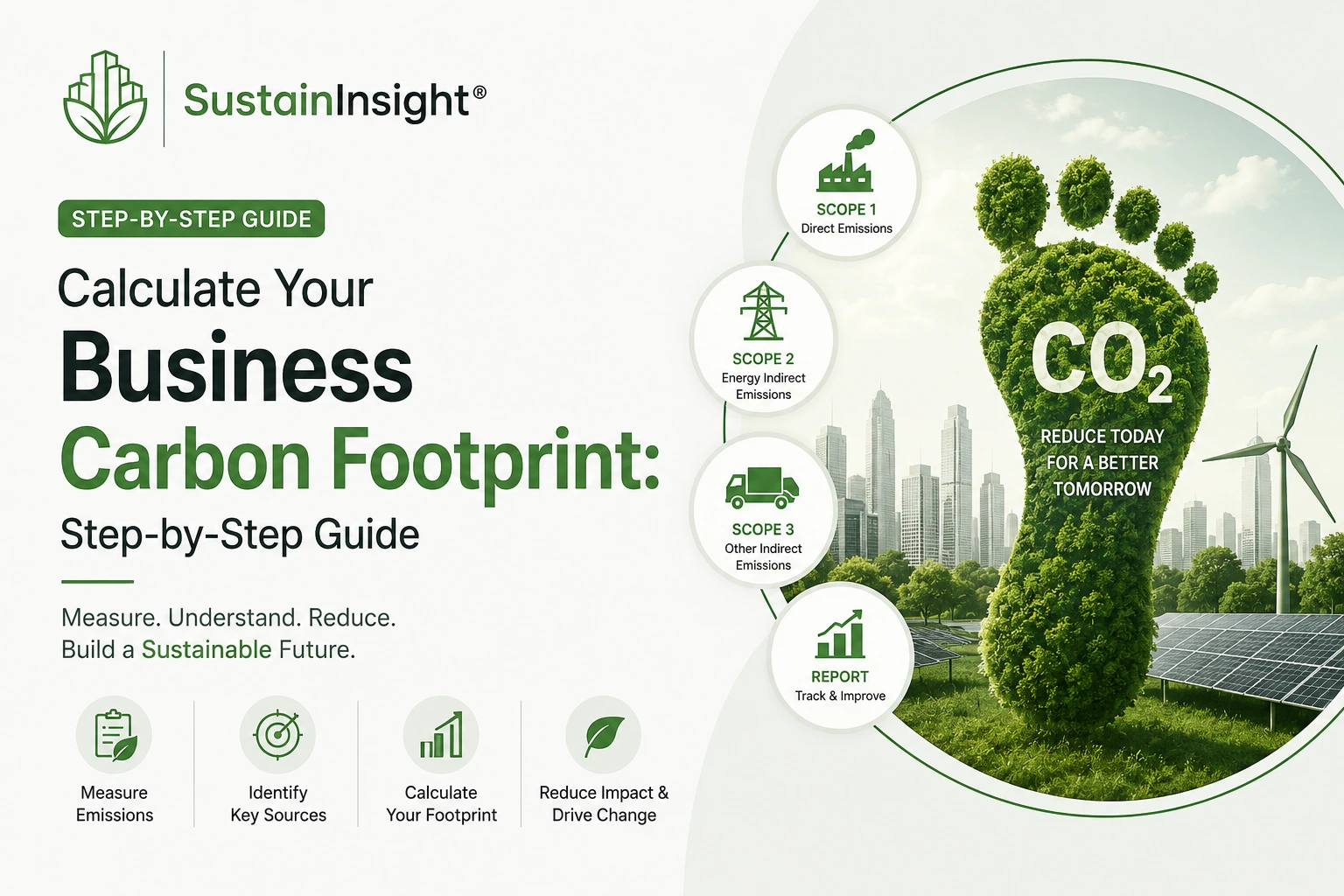
Businesses across the UAE are under increasing pressure to reduce greenhouse gas (GHG) emissions, improve sustainability performance, and comply with evolving ESG expectations. Whether driven by investors, customers, regulators, or the UAE's Net Zero ambitions, understanding how to calculate your carbon footprint for your business has become a critical step toward sustainable growth.
A business carbon footprint isn't just a compliance metric—it's a powerful tool for identifying operational inefficiencies, reducing costs, and building long-term resilience. In this guide, you'll learn how to calculate your company's carbon footprint, understand the different emission scopes, and discover how AI-powered platforms like SustainInsight simplify carbon accounting and ESG reporting.
What Is a Business Carbon Footprint?
A business carbon footprint is the total amount of greenhouse gas (GHG) emissions generated by an organization's operations over a specific period, usually measured in carbon dioxide equivalent (CO₂e).
These emissions come from activities such as:
Electricity consumption
Fuel used in company vehicles
Business travel
Manufacturing processes
Waste disposal
Purchased goods and services
Logistics and transportation
Measuring your carbon footprint provides a baseline that helps businesses set emission reduction targets and demonstrate sustainability performance through ESG reporting.
Why Is Carbon Footprint Calculation Important?
Calculating your business carbon footprint delivers benefits beyond environmental responsibility.
Organizations that measure emissions can:
Improve ESG reporting
Meet regulatory and investor expectations
Identify opportunities to reduce operational costs
Support Net Zero strategies
Improve sustainability ratings
Strengthen brand reputation
Win environmentally conscious customers
For UAE businesses, carbon accounting is becoming an essential part of corporate sustainability and long-term business strategy.
Understanding Scope 1, Scope 2, and Scope 3 Emissions
Before calculating emissions, businesses need to understand the three categories defined by the GHG Protocol.
Scope 1 Emissions
These are direct emissions from sources owned or controlled by your organization.
Examples include:
Company vehicles
Fuel combustion
Manufacturing equipment
Backup generators
Scope 2 Emissions
These are indirect emissions from purchased energy.
Examples include:
Electricity
District heating
Cooling
Steam
Although your company doesn't directly generate these emissions, they result from the energy you consume.
Scope 3 Emissions
Scope 3 covers all other indirect emissions across your value chain.
Examples include:
Employee commuting
Business travel
Purchased materials
Supplier activities
Waste management
Transportation and distribution
Product lifecycle emissions
For many organizations, Scope 3 emissions represent the largest share of their overall carbon footprint.
How to Calculate Your Business Carbon Footprint
Step 1: Define Your Organizational Boundary
Start by identifying which business units, facilities, subsidiaries, and operations will be included in your carbon inventory.
A clear organizational boundary ensures consistency and accuracy throughout the reporting process.
Step 2: Collect Activity Data
Gather operational data from across your business, including:
Electricity bills
Fuel purchases
Water consumption
Business travel records
Waste disposal reports
Procurement data
Transportation logs
The more complete your data, the more accurate your carbon footprint calculation will be.
Step 3: Categorize Emissions
Assign each activity to the appropriate category:
Scope 1
Scope 2
Scope 3
This step aligns your reporting with internationally recognized standards such as the GHG Protocol.
Step 4: Apply Emission Factors
Convert operational activity into CO₂e emissions using verified emission factors.
For example:
Liters of diesel consumed
Kilowatt-hours (kWh) of electricity used
Air travel distance
Waste sent to landfill
Emission factors translate these activities into measurable greenhouse gas emissions.
Step 5: Calculate Total Carbon Emissions
Add together emissions across all three scopes to determine your organization's total carbon footprint.
This provides the baseline needed for:
ESG reporting
Sustainability reporting
Carbon reduction planning
Net Zero roadmaps
Step 6: Analyze and Reduce Emissions
After calculating your footprint, identify the largest emission sources.
Common reduction opportunities include:
Improving energy efficiency
Transitioning to renewable energy
Optimizing logistics
Reducing business travel
Working with sustainable suppliers
Minimizing operational waste
Continuous monitoring allows businesses to track progress over time.
Challenges Businesses Face in Carbon Accounting
Many organizations still rely on spreadsheets to manage carbon data, leading to:
Manual errors
Inconsistent calculations
Missing supplier information
Difficult Scope 3 reporting
Time-consuming ESG reporting
As sustainability regulations become more complex, businesses are increasingly adopting digital carbon accounting software to improve data quality and reporting efficiency.
How SustainInsight Simplifies Carbon Footprint Calculation
Managing emissions data across multiple departments can be complex. SustainInsight helps organizations automate the entire carbon accounting process through its AI-powered ESG platform.
The platform enables businesses to:
Calculate Scope 1, Scope 2 & Scope 3 emissions
Automate carbon footprint calculations
Generate AI-powered ESG reports
Track sustainability KPIs in real time
Manage compliance with GRI, ISSB, CSRD, TCFD, ISO 14064, and the GHG Protocol
Access interactive dashboards and analytics
Improve audit readiness with data verification
By transforming raw operational data into accurate, audit-ready sustainability insights, SustainInsight helps UAE organizations streamline ESG reporting, reduce manual effort, and make informed sustainability decisions.
Conclusion
Learning how to calculate your carbon footprint for your business is the foundation of a successful sustainability strategy. By measuring Scope 1, Scope 2, and Scope 3 emissions, organizations gain the visibility needed to reduce environmental impact, improve operational efficiency, and meet growing ESG expectations.
For businesses in the UAE, adopting AI-powered solutions like SustainInsight makes carbon accounting faster, more accurate, and aligned with global reporting frameworks—helping organizations accelerate their journey toward sustainable growth and Net Zero goals.