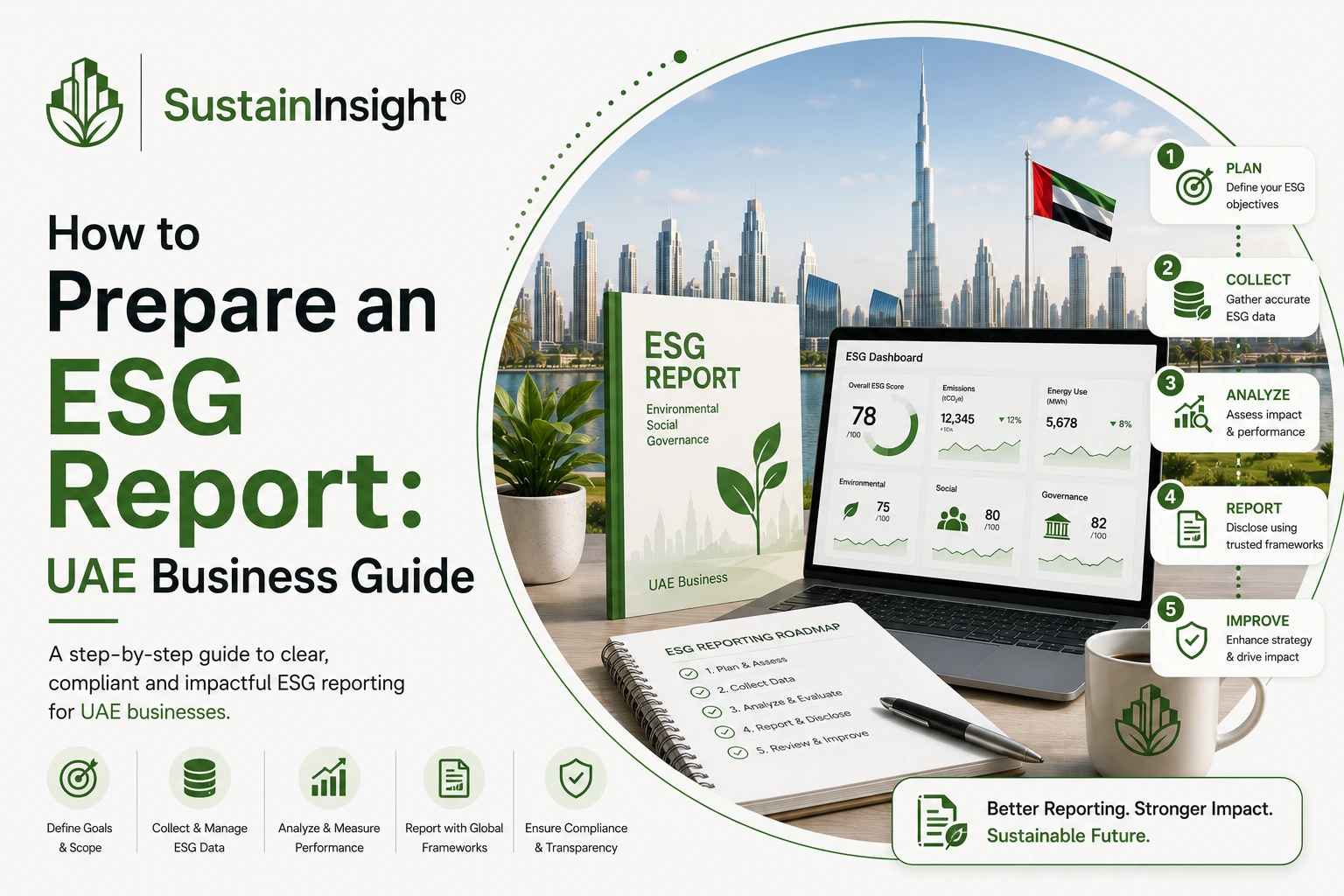
As sustainability becomes a core business priority, organizations across the UAE are increasingly expected to publish transparent and credible ESG reports. Investors, regulators, customers, and business partners want clear evidence of how companies manage their Environmental, Social, and Governance (ESG) performance. This makes understanding how to prepare an ESG report an essential capability for businesses of all sizes.
An effective ESG report is more than a compliance document—it is a strategic communication tool that demonstrates accountability, strengthens stakeholder trust, and showcases an organization's commitment to sustainable growth. By following a structured reporting process and aligning with globally recognized frameworks, businesses can improve reporting accuracy, support informed decision-making, and enhance long-term value creation.
In this guide, you'll learn how to prepare an ESG report, the key steps involved, common challenges, and how SustainInsight simplifies ESG reporting through AI-powered automation.
What is an ESG Report?
An ESG report is a document that communicates an organization's performance across Environmental, Social, and Governance (ESG) factors. It provides stakeholders with measurable insights into sustainability initiatives, climate-related risks, governance practices, workforce performance, and corporate responsibility.
A comprehensive ESG report typically includes:
- Carbon emissions and greenhouse gas (GHG) data
- Energy and water consumption
- Waste management performance
- Employee diversity and well-being
- Health and safety metrics
- Corporate governance practices
- Ethics and compliance initiatives
- Sustainability goals and future commitments
Publishing an ESG report improves transparency while helping organizations demonstrate alignment with leading sustainability frameworks.
Why ESG Reporting Matters for UAE Businesses
The UAE continues to strengthen its commitment to sustainability through ambitious climate initiatives and evolving ESG expectations. Businesses are increasingly encouraged to improve transparency, measure environmental impact, and disclose sustainability performance.
Preparing a robust ESG report helps organizations:
- Build investor confidence
- Improve stakeholder trust
- Strengthen brand reputation
- Support regulatory compliance
- Enhance operational efficiency
- Contribute to long-term sustainability goals
As sustainability reporting becomes more data-driven, businesses that establish structured ESG reporting processes gain a significant competitive advantage.
How to Prepare an ESG Report: Step-by-Step
1. Define Your ESG Objectives
The first step in preparing an ESG report is identifying why your organization is reporting.
Common objectives include:
- Meeting investor expectations
- Supporting sustainability strategies
- Improving transparency
- Tracking ESG performance
- Preparing for regulatory requirements
Clear objectives help determine the report's scope, audience, and reporting priorities.
2. Choose the Right ESG Reporting Framework
Selecting an appropriate reporting framework ensures consistency and comparability.
Popular frameworks include:
- GRI (Global Reporting Initiative)
- ISSB (IFRS S1 & S2)
- TCFD
- CSRD
- GHG Protocol
- ISO 14064-1
Aligning with recognized frameworks improves reporting credibility and simplifies compliance with international best practices.
3. Conduct a Materiality Assessment
A materiality assessment identifies the ESG topics that matter most to your business and stakeholders.
Examples include:
- Climate change
- Carbon emissions
- Employee well-being
- Supply chain sustainability
- Corporate governance
- Data privacy
Focusing on material topics ensures the ESG report addresses the issues with the greatest business impact.
4. Collect Reliable ESG Data
Accurate data is the foundation of effective ESG reporting.
Organizations should collect information from departments such as:
- Finance
- Operations
- Human Resources
- Procurement
- Facilities
- Compliance
Key metrics include:
- Energy consumption
- Water usage
- Waste generation
- Diversity metrics
- Governance KPIs
- Carbon emissions
Reliable ESG data improves report quality and supports informed decision-making.
5. Measure Carbon Emissions
Carbon accounting is one of the most critical components of an ESG report.
Businesses should measure:
- Scope 1 emissions (direct emissions)
- Scope 2 emissions (purchased electricity)
- Scope 3 emissions (value chain emissions)
Tracking emissions helps organizations identify reduction opportunities and support Net Zero commitments.
6. Analyze Performance and Set ESG Goals
An ESG report should not only present current performance but also define measurable improvement targets.
Organizations can establish goals such as:
- Reducing greenhouse gas emissions
- Increasing renewable energy usage
- Improving workforce diversity
- Enhancing governance practices
- Reducing operational waste
Clear ESG targets demonstrate long-term commitment and accountability.
7. Prepare and Review the ESG Report
Once data has been collected and analyzed, prepare the report using clear language, visual dashboards, and structured disclosures aligned with your chosen framework.
Before publication:
- Verify ESG data
- Review calculations
- Validate supporting evidence
- Ensure consistency across disclosures
Strong governance and internal reviews improve report credibility and audit readiness.
Common Challenges in ESG Reporting
Many organizations face obstacles when preparing ESG reports, including:
- Manual data collection
- Disconnected reporting systems
- Inconsistent ESG metrics
- Difficulty measuring Scope 3 emissions
- Complex reporting frameworks
- Limited sustainability expertise
These challenges often increase reporting time and reduce data accuracy.
How SustainInsight Simplifies ESG Reporting
Preparing an ESG report manually can be time-consuming and resource-intensive. SustainInsight is an AI-powered ESG and sustainability platform that helps organizations automate ESG reporting, carbon accounting, and sustainability data management.
Key capabilities include:
- AI-powered ESG report generation
- Automated sustainability reporting
- Carbon accounting
- Scope 1, Scope 2 & Scope 3 emissions tracking
- Real-time ESG dashboards
- Data verification and audit readiness
- Predictive sustainability analytics
- Framework-aligned reporting for GRI, ISSB, CSRD, TCFD, ISO 14064-1, and the GHG Protocol
By centralizing enterprise-wide ESG data and automating report generation, SustainInsight enables businesses across the UAE to reduce manual effort, improve reporting accuracy, and meet global sustainability reporting requirements with confidence.
Conclusion
Learning how to prepare an ESG report is essential for organizations seeking to improve transparency, strengthen stakeholder trust, and support sustainable business growth. By defining clear objectives, selecting the right reporting framework, collecting reliable ESG data, measuring carbon emissions, and setting measurable goals, businesses can create reports that deliver real value.
For organizations looking to simplify the reporting process, SustainInsight provides an intelligent, AI-powered platform that automates ESG reporting, carbon accounting, and compliance—helping businesses build credible, audit-ready sustainability reports while accelerating their ESG journey.