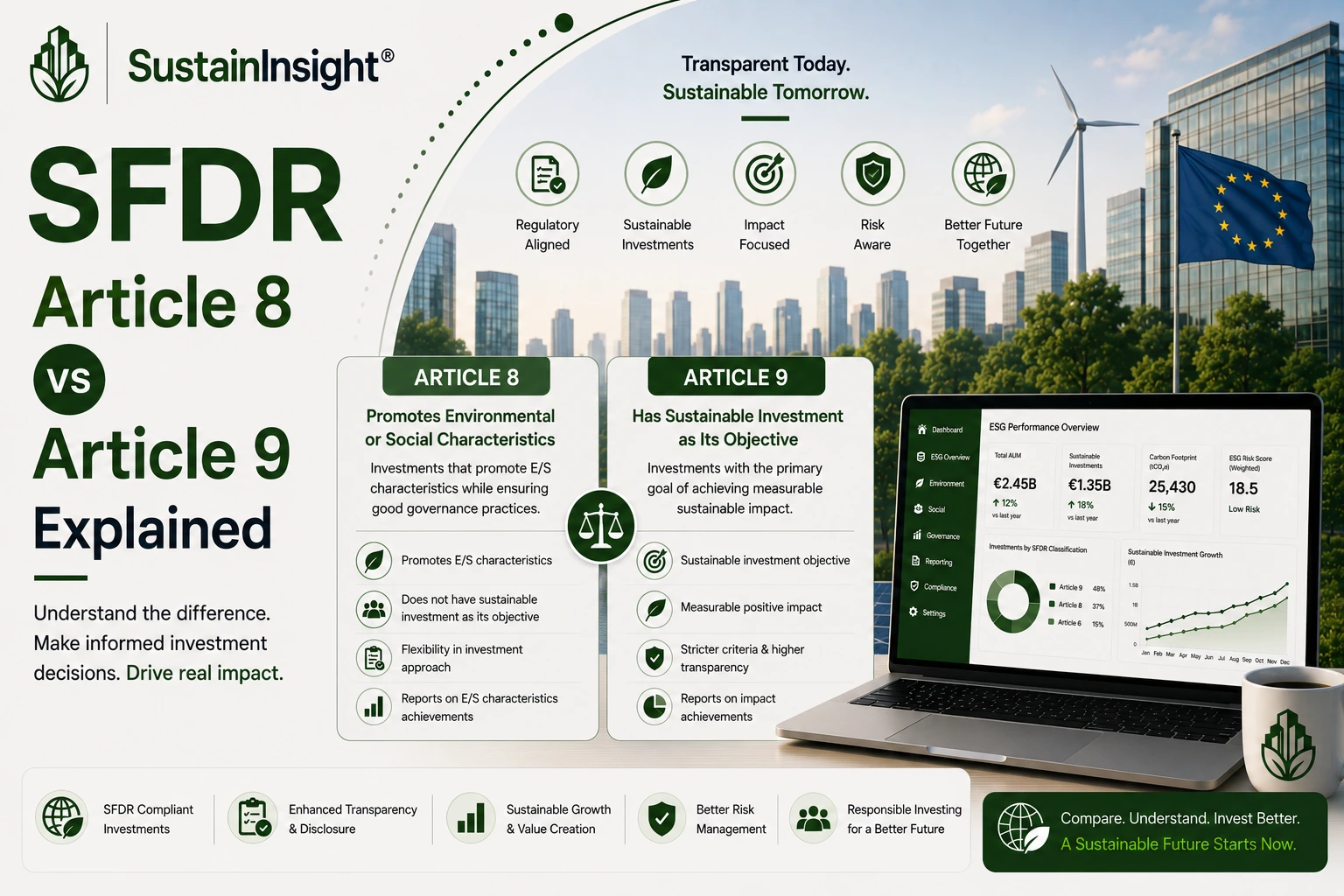
If your business is seeking investment from European asset managers, or you're evaluating EU-domiciled funds as part of a treasury or investment strategy, you've likely encountered the terms "Article 8" and "Article 9." These classifications come from the EU's Sustainable Finance Disclosure Regulation (SFDR) and shape how funds describe their sustainability characteristics — and understanding the difference matters for UAE and GCC businesses on both sides of that relationship.
What Is SFDR?
The Sustainable Finance Disclosure Regulation (SFDR) is an EU regulation requiring financial market participants — asset managers, pension funds, and other financial institutions — to disclose how they integrate sustainability risks and impacts into their investment decisions and products. SFDR classifies financial products into three broad categories, commonly referred to by their article numbers.
The Three SFDR Product Categories
Article 6 Products
The baseline category. These products may still consider sustainability risks in a general risk-management sense but don't promote environmental or social characteristics as a defining feature.
Article 8 Products
Often called "light green" funds, Article 8 products promote environmental or social characteristics, provided the companies they invest in follow good governance practices. Sustainability isn't necessarily the fund's core objective, but it's a meaningful factor in how the fund is marketed and managed.
Article 9 Products
Often called "dark green" funds, Article 9 products have sustainable investment as their explicit objective. These funds must demonstrate that underlying investments contribute to a specific environmental or social objective, meet a "do no significant harm" standard, and follow good governance practices.
Key Differences Between Article 8 and Article 9
|
|
Article 8 |
Article 9 |
|
Sustainability objective |
Promotes characteristics, not required as core objective |
Sustainable investment as explicit objective |
|
Investment threshold |
No mandated minimum sustainable investment proportion |
Generally expected to invest predominantly in sustainable investments |
|
Do No Significant Harm (DNSH) |
Not always formally required |
Required for underlying investments |
|
Disclosure burden |
Moderate |
Higher — more detailed reporting on how the objective is met |
|
Common nickname |
"Light green" |
"Dark green" |
Why the Distinction Has Become More Scrutinized?
Following concerns about greenwashing, EU regulators and supervisory bodies have applied increasing scrutiny to how funds classify themselves, leading a number of asset managers to reclassify products from Article 9 to Article 8 rather than risk non-compliance with the higher Article 9 bar. This has made fund classification a more carefully considered decision than it was in SFDR's early years, and it's a useful signal for anyone evaluating a fund's actual sustainability rigor rather than just its label.
Why This Matters for UAE and GCC Businesses?
For UAE and GCC companies, this distinction is relevant in two directions. If your business is seeking capital from Article 8 or Article 9 EU funds, understanding what these classifications require helps you anticipate the sustainability data and disclosures those investors will expect. If your organization manages investments or treasury allocations involving EU funds, understanding the difference helps you evaluate whether a fund's sustainability claims match its actual classification and requirements.
How SustainInsight Helps Businesses Prepare?
SustainInsight is an AI-powered ESG and sustainability platform that helps UAE and GCC businesses build the sustainability data and reporting infrastructure increasingly expected by EU investors, including those managing Article 8 and Article 9 funds. Key capabilities include:
-
AI-powered ESG and sustainability reporting
-
Automated Scope 1, Scope 2 & Scope 3 emissions tracking
-
Compliance alignment with GRI, ISSB, CSRD, TCFD, ISO 14064-1, and the GHG Protocol
-
Audit-ready reporting for investor due diligence
-
Real-time ESG dashboards for ongoing performance monitoring
By building credible, well-documented sustainability data, businesses are better positioned to meet the expectations of sustainability-focused EU investors, regardless of which SFDR classification their fund falls under.
Conclusion
Article 8 and Article 9 represent two different levels of sustainability commitment under the EU's SFDR framework — Article 8 promotes sustainability characteristics, while Article 9 requires sustainable investment as an explicit objective with stricter disclosure requirements. For UAE and GCC businesses engaging with EU capital markets in either direction, understanding this distinction helps set realistic expectations for the sustainability data and reporting that will be required.