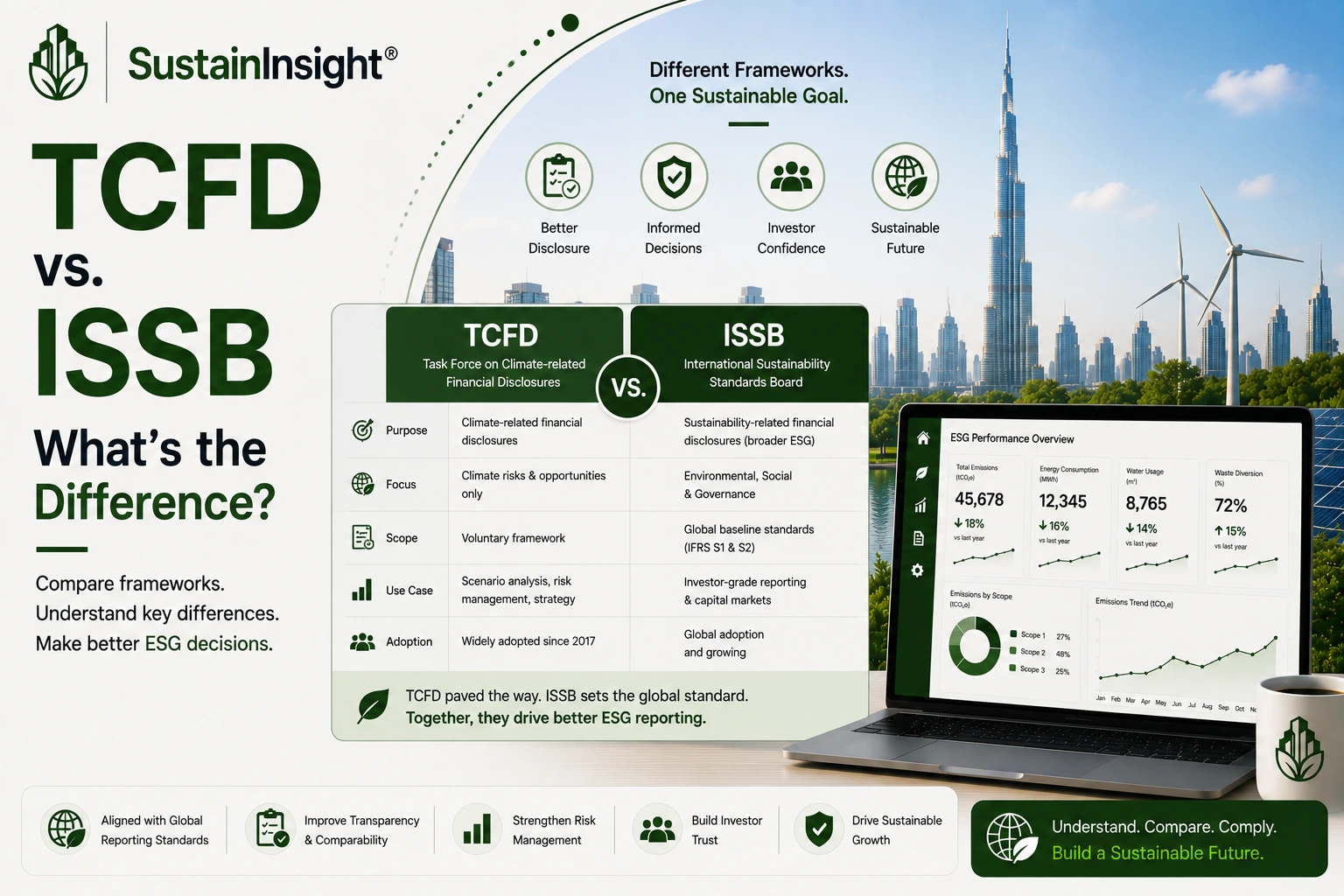
For years, TCFD was the reference point for climate-related financial disclosure. Today, most businesses preparing climate reports are being pointed toward ISSB standards instead. The two are closely related — ISSB didn't replace TCFD so much as absorb and formalize it — but understanding the relationship matters for any UAE or global business trying to figure out which framework to follow.
What Is TCFD?
TCFD (Task Force on Climate-related Financial Disclosures) was established by the Financial Stability Board to develop voluntary recommendations for disclosing climate-related financial risk. Published in 2017, the TCFD framework organized disclosures around four pillars: governance, strategy, risk management, and metrics and targets. It became the most widely referenced voluntary climate disclosure framework globally, adopted by thousands of organizations and embedded into many national reporting requirements.
What Is ISSB?
ISSB (International Sustainability Standards Board) is a standard-setting body established by the IFRS Foundation to create a global baseline for sustainability disclosure. Its flagship standards, IFRS S1 (general sustainability-related disclosures) and IFRS S2 (climate-related disclosures), were designed to consolidate and build on earlier voluntary frameworks — including TCFD and SASB — into a single, more rigorous, and increasingly mandatory reporting standard.
How TCFD and ISSB Relate to Each Other?
Rather than being a separate competing framework, ISSB's IFRS S2 was built to fully incorporate the TCFD's four-pillar structure and recommendations. As ISSB standards matured, the Financial Stability Board asked the IFRS Foundation to take over monitoring companies' climate disclosure progress, and the TCFD task force wound down after fulfilling its original mandate. In practice, this means TCFD-aligned reporting is increasingly being succeeded by ISSB-aligned reporting as the global reference standard — though many companies still describe their reports as "TCFD-aligned" given how familiar the framework remains.
Key Differences Between TCFD and ISSB
|
|
TCFD |
ISSB (IFRS S1 & S2) |
|
Status |
Voluntary recommendations; task force wound down |
Formal accounting-adjacent standard, increasingly mandated by regulators |
|
Scope |
Climate-related financial risk only |
IFRS S1 covers all sustainability topics; IFRS S2 covers climate specifically |
|
Structure |
Four pillars: governance, strategy, risk management, metrics & targets |
Builds on the same four pillars, with more detailed and prescriptive requirements |
|
Industry metrics |
General guidance |
Incorporates SASB industry-specific metrics |
|
Scope 3 emissions |
Recommended |
Required disclosure under IFRS S2 |
|
Adoption |
Widely referenced voluntarily, embedded in some regulations |
Increasingly adopted as the mandatory baseline by regulators globally |
Why This Matters for UAE and GCC Businesses?
As global regulators move toward ISSB as the reference standard for climate disclosure, UAE and GCC businesses that have been reporting on a TCFD-aligned basis should expect a transition toward ISSB-aligned reporting — particularly as international investors, lenders, and trading partners increasingly expect disclosures framed around IFRS S1 and S2 rather than the original TCFD recommendations alone.
Preparing for the Transition from TCFD to ISSB
Businesses already reporting under TCFD have a head start, since ISSB's climate standard builds directly on that structure. Key steps to prepare include:
-
Reviewing existing TCFD-aligned disclosures against IFRS S2's more detailed requirements
-
Building out Scope 3 emissions data collection, now a required disclosure under ISSB
-
Incorporating industry-specific metrics drawn from SASB standards
-
Aligning governance and risk management disclosures with ISSB's more prescriptive structure
How SustainInsight Helps with TCFD and ISSB Reporting?
SustainInsight is an AI-powered ESG and sustainability platform that helps businesses transition confidently between climate disclosure frameworks. Key capabilities include:
-
AI-powered ESG and climate disclosure reporting
-
Automated Scope 1, Scope 2 & Scope 3 emissions tracking
-
Compliance alignment with GRI, ISSB, CSRD, TCFD, ISO 14064-1, and the GHG Protocol
-
Real-time ESG dashboards for tracking governance, strategy, and risk metrics
-
Audit-ready reporting built for evolving disclosure standards
By centralizing climate and sustainability data, SustainInsight helps businesses report confidently whether they're maintaining TCFD-aligned disclosures or transitioning to the ISSB standard.
Conclusion
TCFD and ISSB aren't competing frameworks — ISSB's IFRS S2 formalizes and extends TCFD's four-pillar structure into a more detailed, increasingly mandatory global standard. Businesses that understand this relationship, including many across the UAE and GCC, are better positioned to transition their climate disclosures smoothly as regulators worldwide converge on ISSB as the reference baseline.