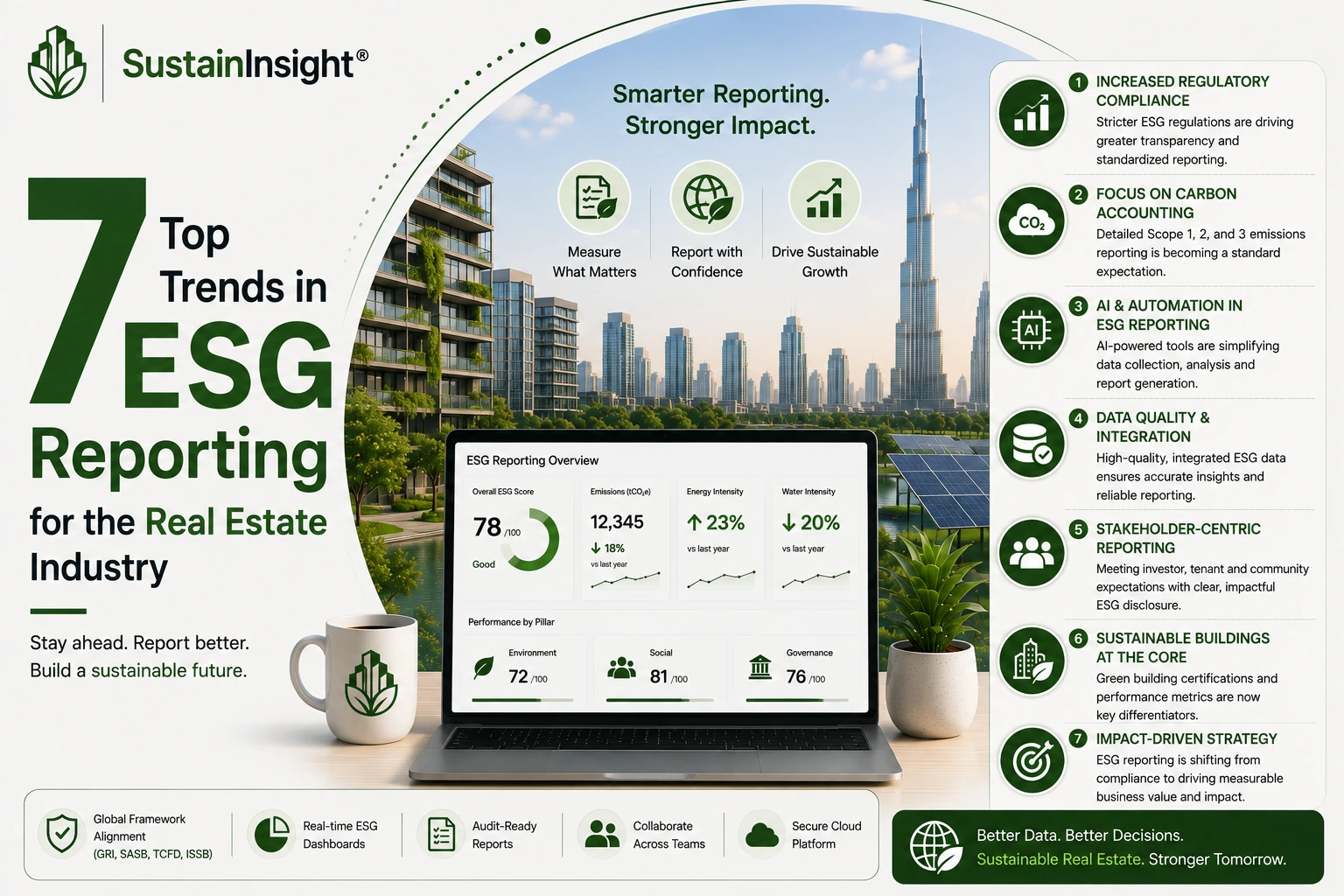
The real estate industry is entering a new phase of sustainability reporting. Investors, regulators, tenants, lenders, and other stakeholders increasingly want clear and reliable information about how properties manage environmental, social, and governance risks. For UAE developers, property owners, and asset managers, ESG reporting in real estate is becoming an important part of demonstrating long-term business value.
The shift is not simply about publishing an annual sustainability report. Companies are now expected to provide better data, measure carbon emissions, monitor climate-related risks, and show measurable progress against sustainability targets. This makes technology and reliable ESG data increasingly important.
For UAE businesses, the growing focus on sustainable development also creates an opportunity to improve building efficiency, reduce operating costs, attract responsible investment, and strengthen portfolio resilience.
In this article, we explore the key trends shaping ESG reporting in real estate and explain how businesses can prepare for the changing reporting landscape.
Why ESG Reporting Matters for Real Estate
Real estate companies manage assets with significant energy, water, material, and operational requirements. As a result, their environmental performance can have a direct effect on operating costs and asset value.
Effective real estate ESG reporting helps companies understand their environmental footprint while also evaluating social and governance performance.
Key areas include:
-
Energy and water consumption
-
Greenhouse gas emissions
-
Waste management
-
Building certifications
-
Employee health and safety
-
Tenant wellbeing
-
Governance and compliance
-
Climate-related risks
For UAE property companies, reliable ESG data can also support better investment decisions and help demonstrate progress toward corporate sustainability objectives.
7 Key Trends in ESG Reporting for Real Estate
1. Greater Focus on Scope 1, 2 and 3 Emissions
One of the most important developments in ESG reporting in real estate is the increasing focus on greenhouse gas emissions.
Real estate companies are moving beyond basic energy reporting and measuring their:
-
Scope 1 emissions from directly controlled sources
-
Scope 2 emissions from purchased energy
-
Scope 3 emissions across the value chain
For property portfolios, Scope 3 can include construction materials, purchased services, tenant-related activities, waste, transportation, and other indirect sources.
Better emissions data allows organizations to identify high-impact areas and create more practical carbon-reduction strategies.
2. AI and Automation Are Transforming ESG Reporting
Manual ESG reporting can involve collecting information from spreadsheets, utility bills, property management systems, suppliers, and multiple internal teams.
Artificial intelligence is changing this process.
Modern ESG technology can capture and analyze sustainability information from different sources, identify gaps, support data verification, and help generate reports.
This makes ESG reporting software for real estate increasingly valuable for organizations managing multiple buildings or large property portfolios.
Automation also allows sustainability teams to spend less time preparing data and more time acting on sustainability insights.
3. Real-Time ESG Data Is Replacing Annual Reporting
Traditional sustainability reporting often provides a snapshot of performance once a year. However, businesses increasingly need more frequent visibility into sustainability KPIs.
Real-time dashboards can help property teams monitor:
-
Energy consumption
-
Carbon emissions
-
Water usage
-
Waste
-
ESG targets
-
Sustainability performance
This shift toward continuous monitoring is an important trend in real estate ESG reporting because decision-makers can identify problems earlier and take corrective action.
For example, a property manager could identify an unusual increase in energy consumption and investigate the issue before it significantly affects operating costs.
4. Climate Risk Is Becoming a Core Reporting Priority
Climate change can create physical and financial risks for real estate assets. Extreme heat, flooding, water stress, and other climate-related events can affect buildings, infrastructure, insurance costs, and property valuations.
As a result, climate risk assessment is becoming a more important component of ESG reporting in real estate.
UAE real estate companies can benefit from assessing climate risks at both asset and portfolio levels. This can help organizations understand which properties may be more vulnerable and where adaptation measures may be required.
Climate risk reporting also helps investors understand the resilience of real estate portfolios over the long term.
5. ESG Data Verification and Audit Readiness
As ESG disclosures become more important, data quality is becoming just as important as the report itself.
Companies need to demonstrate where their sustainability data came from, how calculations were performed, and whether information has been reviewed or verified.
This is why real estate ESG software increasingly includes data verification and audit-readiness capabilities.
A strong reporting process should include:
-
Defined data owners
-
Consistent calculation methodologies
-
Supporting documentation
-
Data validation
-
Clear reporting boundaries
-
Audit trails
Better data governance reduces the risk of inaccurate disclosures and increases stakeholder confidence.
6. ESG Reporting Is Becoming More Connected to Financial Performance
Another major trend is the growing connection between sustainability performance and financial decision-making.
Real estate businesses are increasingly examining how ESG factors influence:
-
Operating costs
-
Asset value
-
Tenant demand
-
Financing
-
Insurance
-
Investment decisions
-
Long-term risk
This means ESG reporting software for real estate is evolving from a compliance tool into a business intelligence solution.
When sustainability and financial information are connected, management teams can make more informed decisions about property upgrades, energy efficiency investments, and portfolio strategy.
7. Framework Alignment Is Becoming More Important
Real estate companies may need to manage information across multiple sustainability frameworks and disclosure requirements.
Depending on the organization's size, location, and reporting requirements, relevant frameworks can include:
-
GRI
-
ISSB
-
TCFD
-
GHG Protocol
-
ISO 14064-1
-
CSRD
Using consistent frameworks helps companies structure their sustainability information and make disclosures easier for stakeholders to understand.
For organizations operating across multiple markets, technology can make framework mapping and reporting considerably more efficient.
How SustainInsight Supports Modern ESG Reporting
As ESG reporting becomes more data-driven, real estate businesses need technology that can manage sustainability information efficiently.
SustainInsight positions its platform as an AI-powered, cloud-based ESG data and sustainability solution. Its current platform includes automated sustainability reporting, AI-powered data capture, data verification, Scope 1, 2 and 3 emissions tracking, predictive analytics, sustainability ratings, and interactive dashboards.
For real estate organizations, these capabilities can help bring sustainability information together in one environment.
SustainInsight can help businesses:
-
Track Scope 1, 2, and 3 emissions
-
Automate sustainability reporting
-
Capture ESG data from multiple sources
-
Verify sustainability data
-
Monitor ESG metrics through dashboards
-
Use predictive analytics for sustainability performance
-
Prepare compliance-ready sustainability information
This approach can be particularly useful for UAE businesses managing multiple properties, assets, or operational teams.
How UAE Real Estate Businesses Can Prepare
To stay ahead of emerging ESG expectations, real estate organizations should start with a strong data foundation.
A practical approach includes:
1. Define ESG priorities: Identify the environmental, social, and governance issues most relevant to your properties.
2. Establish reliable data collection: Create clear processes for gathering energy, emissions, water, waste, social, and governance information.
3. Measure Scope 1, 2, and 3 emissions: Build a complete picture of your organization's carbon footprint.
4. Set measurable targets: Establish realistic sustainability KPIs and timelines.
5. Automate reporting: Use technology to reduce manual processes and improve data quality.
6. Verify data: Maintain supporting evidence and clear audit trails.
7. Monitor performance continuously: Use dashboards and analytics to identify trends and improvement opportunities.
Conclusion
The future of ESG reporting in real estate is moving toward greater transparency, automation, data quality, and continuous performance management. Carbon accounting, AI-powered data capture, real-time dashboards, climate risk assessment, data verification, and framework alignment are all becoming increasingly important.
For UAE real estate companies, adopting these practices can do more than improve sustainability reporting. It can help reduce operational risks, identify efficiency opportunities, improve stakeholder confidence, and support long-term asset resilience.
With an AI-powered platform such as SustainInsight, businesses can centralize sustainability data, track emissions, automate reporting, verify information, and turn ESG data into actionable insights.
The organizations that build reliable ESG data processes today will be better prepared for the increasingly data-driven sustainability requirements of tomorrow.