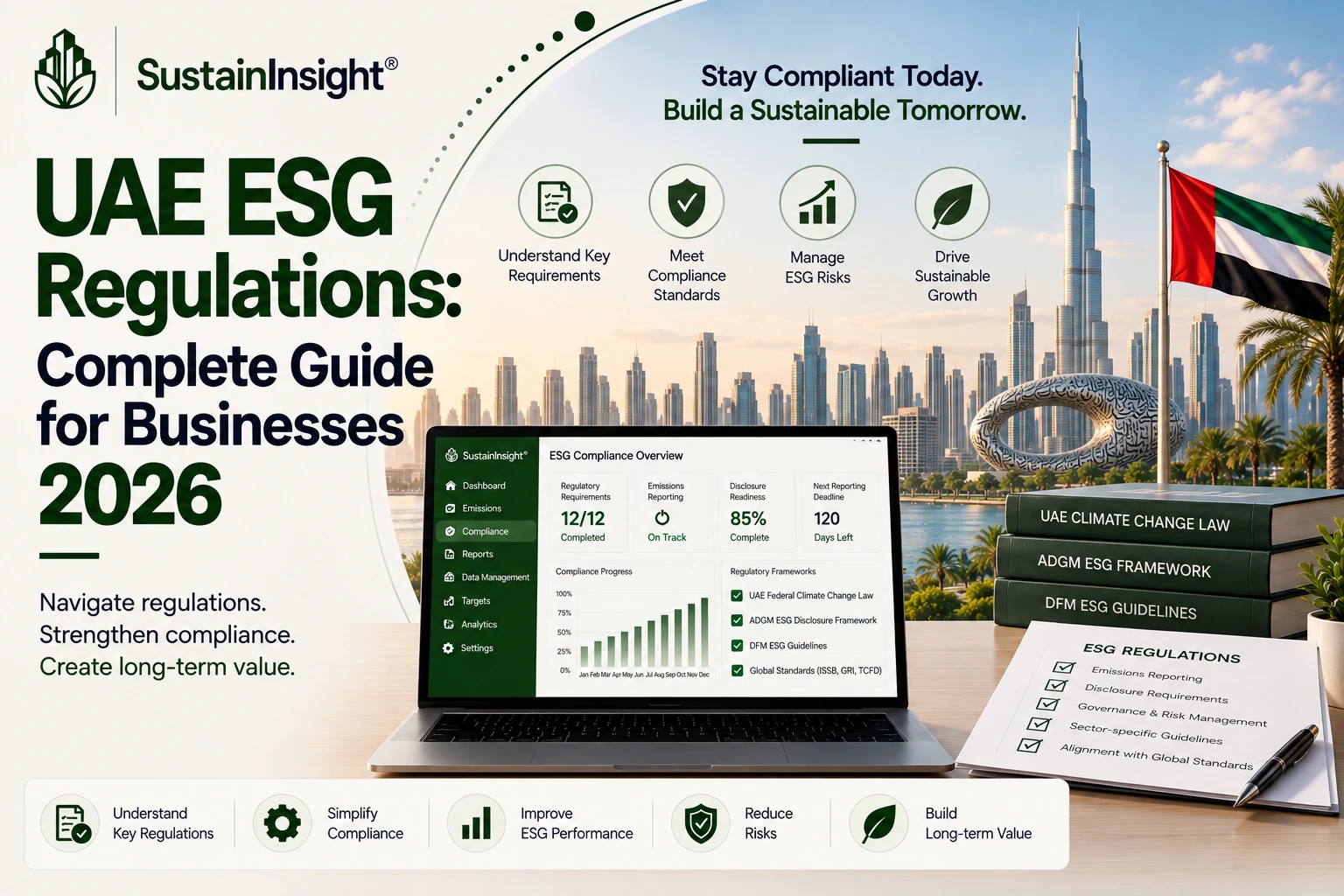
The UAE's ESG regulatory landscape has matured quickly. What began as voluntary guidance for listed companies has expanded into a more structured set of expectations spanning securities regulation, federal climate law, exchange-level requirements, and sector-specific rules — layered on top of international regulations that increasingly reach UAE businesses through trade and investment relationships. For any business operating in the UAE, understanding this landscape is no longer optional groundwork for sustainability teams alone; it's increasingly relevant to finance, legal, and executive leadership. This guide brings together the key UAE ESG regulations and requirements businesses need to know in 2026.
The UAE's Regulatory Approach
Unlike jurisdictions with a single, sweeping ESG disclosure law, the UAE's framework is built from several coordinated pieces: securities regulator guidance for listed companies, exchange-level reporting requirements, national climate legislation, and strategic initiatives like the UAE Net Zero 2050 strategy that shape expectations even where formal mandates haven't yet caught up. Businesses trading internationally also face a second layer — regulations from other jurisdictions, particularly the EU, that apply indirectly through supply chains and customer relationships.
Securities and Commodities Authority (SCA) ESG Disclosure Guidance
The UAE Securities and Commodities Authority has issued ESG disclosure guidance for public joint stock companies, encouraging (and in various forms requiring) listed entities to report on environmental, social, and governance performance aligned with recognized international frameworks. The guidance generally points listed companies toward globally recognized standards — such as GRI, TCFD-aligned climate disclosure, and increasingly ISSB-aligned reporting — rather than prescribing a UAE-specific format, giving companies flexibility in framework choice while still expecting substantive, comparable disclosure.
Exchange-Level Requirements (DFM and ADX)
Both the Dubai Financial Market (DFM) and Abu Dhabi Securities Exchange (ADX) have introduced ESG disclosure guidance and reporting expectations for listed companies, building on the SCA's broader guidance. These typically encourage annual ESG or sustainability reporting, disclosure of material ESG metrics, and increasing alignment with international reporting frameworks — reflecting the exchanges' own ambitions to be recognized as ESG-forward capital markets regionally and internationally.
UAE Federal Climate Change Law
The UAE has advanced federal climate legislation establishing a legal framework for climate action, including provisions relevant to emissions reporting, adaptation planning, and alignment with the UAE's national climate commitments. For businesses, this signals a direction of travel: climate-related obligations are increasingly being formalized in law rather than remaining purely voluntary or strategic guidance, and companies with material emissions exposure should expect this trend to continue.
UAE Net Zero 2050 Strategic Initiative
While not a regulation in the traditional sense, the UAE's Net Zero by 2050 strategic initiative shapes expectations across the public and private sector, driving sector-specific decarbonization roadmaps, government procurement preferences that favor lower-carbon suppliers, and a broader business environment where credible sustainability performance increasingly affects competitiveness — from real estate development approvals to public sector contracting.
Sector-Specific and Emirate-Level Requirements
Beyond federal and exchange-level rules, individual emirates and sectors carry their own overlapping expectations — including green building and energy efficiency requirements tied to major developers and municipal authorities in Dubai and Abu Dhabi, sustainability requirements embedded in free zone and government tender processes, and central bank guidance encouraging UAE financial institutions to integrate climate risk into lending and disclosure practices.
International Regulations Reaching UAE Businesses
UAE businesses trading with or supplying into other markets increasingly face international ESG regulation indirectly:
EU CSRD (Corporate Sustainability Reporting Directive)
UAE subsidiaries of EU-listed parent companies, or UAE suppliers to CSRD-covered European businesses, may need to provide CSRD-aligned data as part of that reporting chain, even without being directly subject to the law.
EU CBAM (Carbon Border Adjustment Mechanism)
UAE exporters of covered goods (such as steel, aluminum, cement, and certain other carbon-intensive products) into the EU face direct reporting and, eventually, cost obligations tied to embedded emissions.
US climate disclosure rules
UAE companies with US listings, significant US operations, or as suppliers to US-listed companies may face indirect pressure to align with evolving SEC climate disclosure expectations.
ISSB-aligned global baseline standards
As more jurisdictions adopt ISSB-based sustainability disclosure standards, UAE companies benchmarking against international peers or preparing for eventual formal adoption benefit from aligning early.
What This Means for UAE Businesses?
Even where a specific regulation doesn't yet directly apply, the overall direction is clear: ESG disclosure expectations in the UAE are moving from voluntary to increasingly formalized, and businesses with international trade or investment relationships face compounding pressure from regulations outside the UAE as well. Practically, this means building reporting capability now — rather than waiting for a specific mandate — puts businesses ahead of both regulatory timelines and customer/investor expectations.
Common Compliance Challenges
Tracking a moving regulatory landscape
With guidance evolving across multiple regulators and frameworks, keeping compliance obligations current requires ongoing monitoring rather than a one-time assessment.
Framework fragmentation
Businesses navigating SCA guidance, exchange requirements, and international frameworks like CSRD or ISSB simultaneously often end up managing overlapping but not identical data and disclosure requirements.
Data readiness
Many UAE businesses, particularly outside the largest listed companies, lack the underlying emissions and ESG data infrastructure to respond quickly when disclosure expectations tighten.
Determining applicability
Especially for indirect exposure (CSRD supply chain requirements, CBAM), businesses may not immediately recognize when an international regulation applies to them through a customer or parent company relationship.
How SustainInsight Helps?
-
Multi-framework mapping that structures ESG data once and maps it to SCA guidance, DFM/ADX expectations, CSRD, ISSB-aligned standards, and CBAM reporting requirements simultaneously
-
AI-powered compliance tracking that helps businesses stay current as UAE and international ESG regulatory guidance evolves
-
Automated data capture and validation that builds the underlying data infrastructure needed to respond quickly as disclosure requirements tighten
-
CBAM-specific emissions calculation for UAE exporters of covered goods into the EU
-
Audit-ready reporting that supports both voluntary disclosure ambitions and eventual formal compliance obligations
-
UAE and GCC regulatory context built into the platform's framework guidance, reflecting the specific mix of local and international requirements UAE businesses face
Conclusion
The UAE's ESG regulatory landscape in 2026 is a layered one — SCA guidance, exchange requirements, federal climate law, and the broader Net Zero 2050 direction, combined with international regulations reaching UAE businesses through trade and investment relationships. Rather than waiting for individual mandates to become binding, UAE businesses that build ESG data and reporting capability now will be better positioned for whatever the next phase of this regulatory evolution brings — and better placed to meet the customer, investor, and financing expectations already shaping the market today. SustainInsight's multi-framework platform is built specifically to help UAE businesses manage this layered compliance landscape from one system.