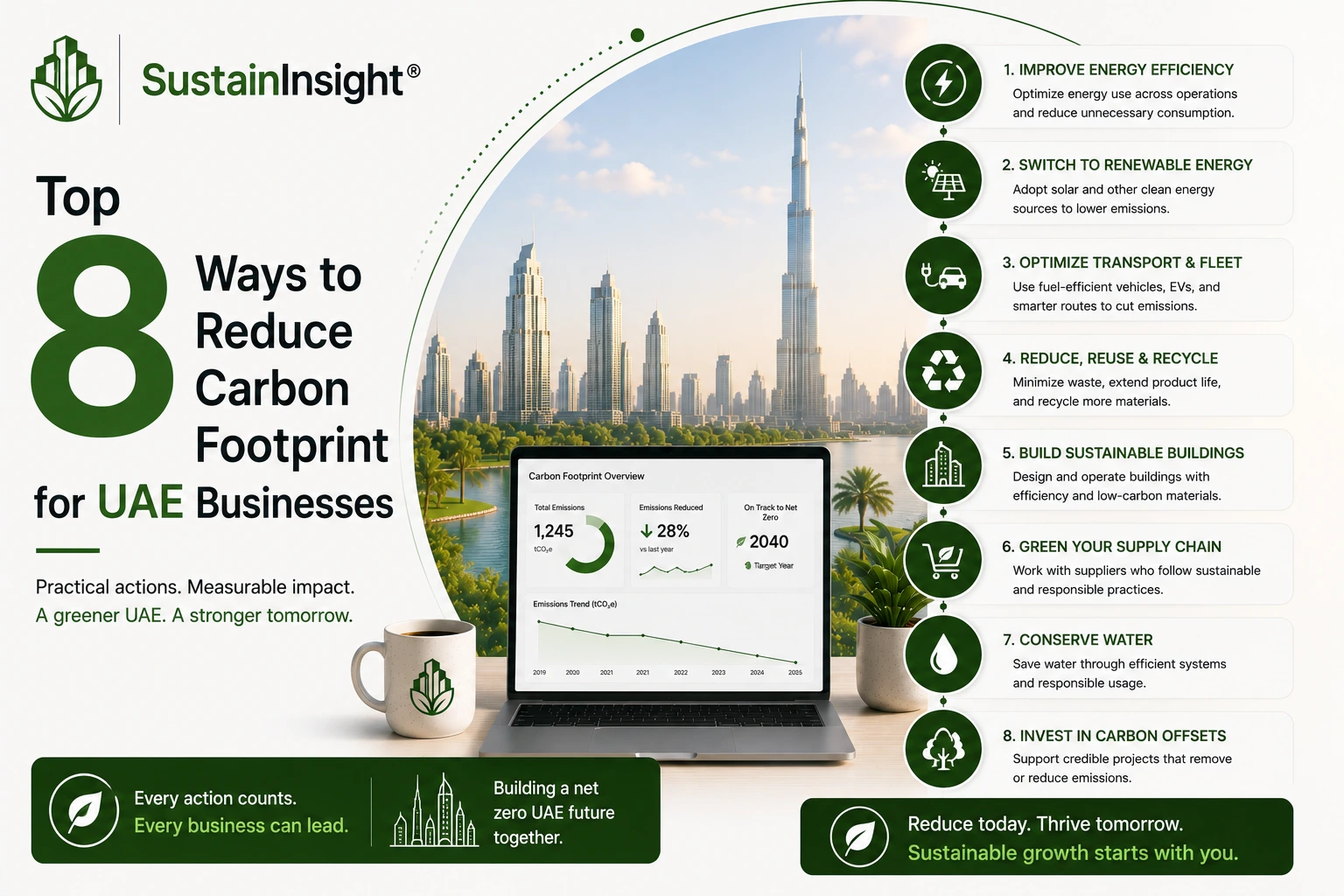
Climate change, rising stakeholder expectations, and evolving sustainability regulations are driving businesses to take meaningful action toward reducing greenhouse gas emissions. Today, understanding how to reduce carbon footprint is no longer just an environmental responsibility—it's a strategic business priority. Organizations that actively reduce their carbon footprint can lower operational costs, improve ESG performance, strengthen investor confidence, and align with the UAE's ambitious Net Zero 2050 vision.
A carbon footprint represents the total greenhouse gas (GHG) emissions generated directly and indirectly by a business. These emissions typically come from energy consumption, transportation, manufacturing processes, purchased goods, waste, and supply chain activities. By measuring and reducing emissions across operations, businesses can improve sustainability performance while creating long-term value.
In this guide, you'll learn how to reduce carbon footprint through practical strategies, why carbon reduction matters for UAE businesses, and how SustainInsight helps organizations automate carbon accounting and ESG reporting.
What Is a Carbon Footprint?
A carbon footprint is the total amount of greenhouse gases emitted by an organization, expressed as carbon dioxide equivalent (CO₂e). It includes emissions from daily business activities and is generally measured across:
- Scope 1 emissions – Direct emissions from company-owned operations.
- Scope 2 emissions – Indirect emissions from purchased electricity, heating, or cooling.
- Scope 3 emissions – Indirect emissions across the value chain, including suppliers, business travel, logistics, and waste.
Measuring these emission sources provides organizations with a clear understanding of where reductions can have the greatest impact.
Why Reducing Your Carbon Footprint Matters
Reducing your carbon footprint offers more than environmental benefits. It also helps businesses:
- Improve ESG reporting
- Reduce energy and operational costs
- Strengthen investor and customer confidence
- Support regulatory compliance
- Enhance brand reputation
- Achieve sustainability and Net Zero goals
- Build long-term business resilience
For businesses operating in the UAE, proactive carbon management also supports national sustainability initiatives while improving competitiveness in global markets.
How to Reduce Carbon Footprint: 8 Effective Strategies
1. Measure Your Carbon Footprint First
The first step in reducing emissions is understanding where they originate.
Businesses should calculate:
- Scope 1 emissions
- Scope 2 emissions
- Scope 3 emissions
Accurate carbon accounting helps identify high-emission activities and prioritize reduction opportunities. Without reliable data, meaningful climate action becomes difficult.
2. Improve Energy Efficiency
Energy consumption is often one of the largest contributors to business emissions.
Simple improvements include:
- Switching to LED lighting
- Installing smart energy management systems
- Upgrading HVAC equipment
- Optimizing manufacturing processes
- Using energy-efficient office equipment
Reducing energy use lowers both emissions and operating expenses.
3. Transition to Renewable Energy
Replacing conventional electricity with renewable energy sources is one of the fastest ways to reduce Scope 2 emissions.
Businesses can consider:
- Solar energy systems
- Renewable electricity suppliers
- Green energy certificates
- Energy purchase agreements
Renewable energy supports long-term sustainability while reducing dependence on fossil fuels.
4. Optimize Transportation and Logistics
Transportation contributes significantly to business emissions.
Organizations can reduce their carbon footprint by:
- Using electric or hybrid company vehicles
- Optimizing delivery routes
- Encouraging virtual meetings
- Supporting employee carpooling
- Reducing unnecessary business travel
These initiatives improve fuel efficiency while lowering operational costs.
5. Reduce Waste and Improve Recycling
Waste management plays an important role in sustainability.
Businesses should:
- Minimize paper usage
- Increase recycling programs
- Reduce single-use plastics
- Improve inventory management
- Adopt circular economy practices
Reducing waste lowers landfill emissions while improving resource efficiency.
6. Build a Sustainable Supply Chain
For many organizations, Scope 3 emissions represent the largest share of total emissions.
Businesses can reduce supply chain emissions by:
- Selecting environmentally responsible suppliers
- Purchasing sustainable materials
- Reducing packaging
- Optimizing freight and logistics
- Collaborating with suppliers on emission reduction goals
Supplier engagement is essential for long-term carbon reduction.
7. Engage Employees in Sustainability
Employees play a critical role in reducing organizational emissions.
Organizations can encourage:
- Energy-saving workplace practices
- Remote and hybrid work options
- Sustainability awareness programs
- Green office initiatives
- Responsible travel policies
A sustainability-focused culture often leads to measurable environmental improvements.
8. Use Technology to Automate Carbon Management
Managing emissions manually through spreadsheets can be time-consuming and error-prone.
Modern businesses increasingly rely on AI-powered sustainability platforms to:
- Automate carbon accounting
- Track Scope 1, Scope 2 & Scope 3 emissions
- Monitor sustainability KPIs
- Generate ESG reports
- Support compliance with global reporting frameworks
Digital platforms enable faster reporting, better data quality, and more informed decision-making.
Common Challenges in Carbon Footprint Reduction
Many organizations struggle with:
- Incomplete emissions data
- Manual calculations
- Complex supplier reporting
- Measuring Scope 3 emissions
- Limited sustainability resources
- Evolving ESG reporting requirements
Addressing these challenges requires centralized data management and intelligent automation.
How SustainInsight Helps Businesses Reduce Their Carbon Footprint
Successfully reducing a business's carbon footprint starts with accurate data and efficient reporting. SustainInsight is an AI-powered ESG and sustainability platform that helps organizations measure, manage, and reduce emissions through intelligent automation.
Key capabilities include:
- Automated carbon accounting
- Scope 1, Scope 2 & Scope 3 emissions tracking
- AI-powered ESG reporting
- Real-time sustainability dashboards
- ESG KPI monitoring
- Automated sustainability report generation
- Framework-aligned reporting for GRI, ISSB, CSRD, TCFD, ISO 14064-1, and the GHG Protocol
- Audit-ready compliance reporting
By transforming operational data into actionable sustainability insights, SustainInsight enables businesses across the UAE to reduce emissions, improve reporting accuracy, and accelerate their sustainability journey.
Conclusion
Understanding how to reduce carbon footprint is essential for organizations that want to improve sustainability, strengthen ESG performance, and remain competitive in a rapidly changing business environment. From improving energy efficiency and adopting renewable energy to optimizing supply chains and automating carbon accounting, every step contributes to measurable environmental and business value.
With intelligent solutions like SustainInsight , businesses can simplify emissions tracking, automate ESG reporting, and make informed decisions that support long-term growth and the UAE's sustainability ambitions.