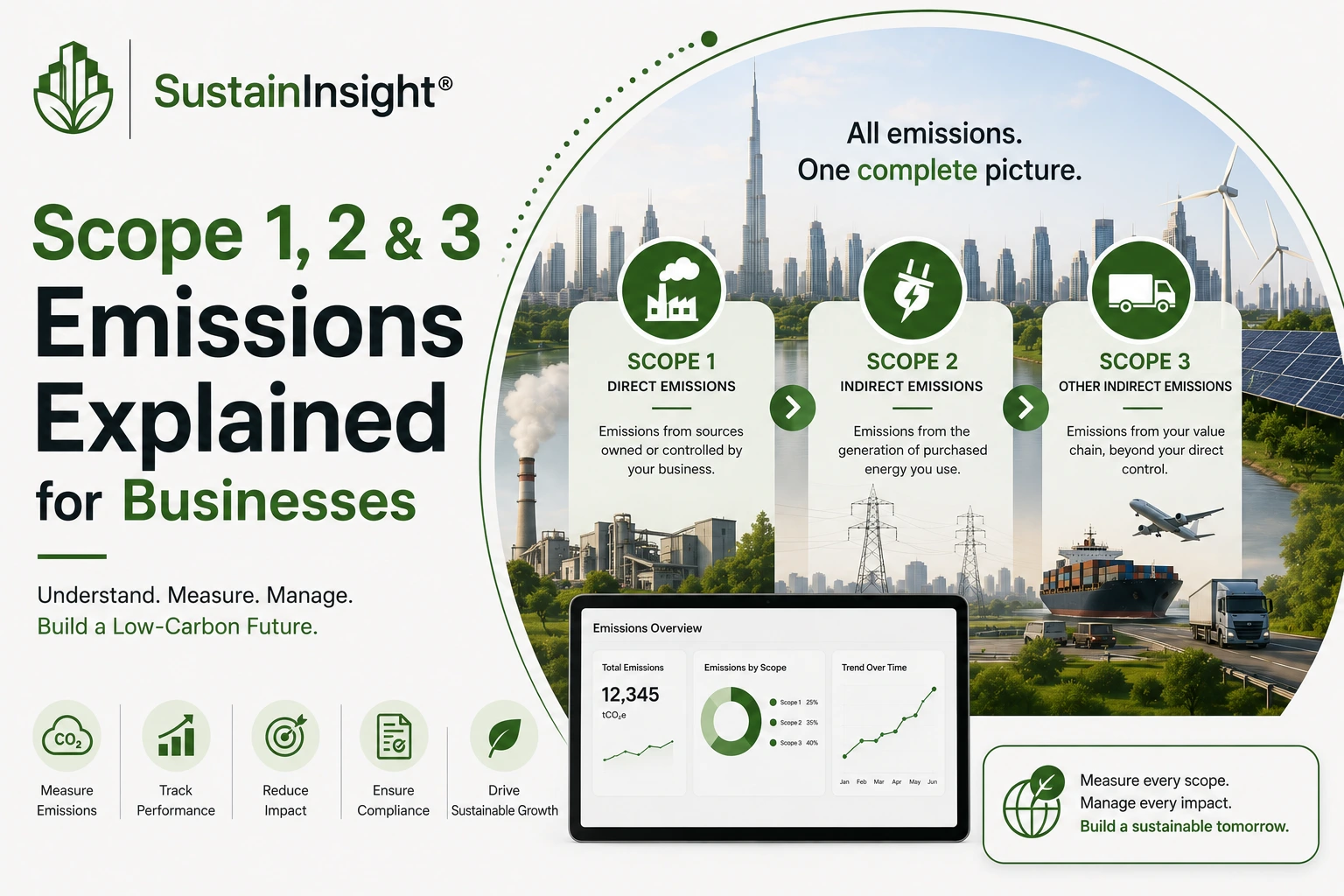
As businesses across the UAE strengthen their sustainability strategies, understanding Scope 1, Scope 2, and Scope 3 emissions has become essential. These three categories form the foundation of carbon accounting and ESG reporting, helping organizations measure, manage, and reduce their greenhouse gas (GHG) emissions. The GHG Protocol, the world's most widely used greenhouse gas accounting standard, classifies corporate emissions into these three scopes to provide a complete picture of an organization's environmental impact.
Whether your organization is beginning its ESG journey or preparing sustainability reports, knowing how each emissions category works is critical for regulatory readiness, investor confidence, and achieving long-term sustainability goals.
In this guide, we'll explain what Scope 1, Scope 2, and Scope 3 emissions are, why they matter for businesses in the UAE, and how SustainInsight helps organizations simplify carbon accounting and ESG reporting.
What Are Scope 1, 2, and 3 Emissions?
Scope 1, Scope 2, and Scope 3 emissions are the three categories used by the GHG Protocol to classify greenhouse gas emissions generated by an organization's operations and value chain. These categories help businesses understand where emissions originate and identify opportunities to reduce their carbon footprint.
Accurately measuring all three scopes enables organizations to produce credible ESG reports, establish Net Zero strategies, and meet growing stakeholder expectations.
What Are Scope 1 Emissions?
Scope 1 emissions are direct greenhouse gas emissions from sources that are owned or controlled by the company. These emissions are generated through day-to-day business operations.
Examples of Scope 1 Emissions
- Fuel used in company-owned vehicles
- Diesel generators
- Manufacturing equipment
- Natural gas boilers
- Refrigerant leaks from cooling systems
- On-site industrial processes
Because businesses have direct control over these activities, Scope 1 emissions are often the easiest to monitor and reduce.
What Are Scope 2 Emissions?
Scope 2 emissions are indirect emissions generated from the purchase of electricity, steam, heating, or cooling consumed by a business. Although these emissions occur at the energy producer's facilities, they result from the organization's energy consumption.
Examples of Scope 2 Emissions
- Purchased electricity for offices
- Electricity used in factories
- District cooling
- Purchased steam or heating
For many UAE businesses, electricity consumption is one of the largest contributors to Scope 2 emissions, making energy efficiency initiatives an important part of sustainability planning.
What Are Scope 3 Emissions?
Scope 3 emissions are all other indirect emissions that occur throughout an organization's value chain. They often represent the largest share of a company's total carbon footprint but are also the most challenging to calculate because they involve suppliers, logistics partners, customers, and other third parties.
Examples of Scope 3 Emissions
- Purchased goods and services
- Business travel
- Employee commuting
- Transportation and distribution
- Waste disposal
- Capital goods
- Supplier activities
- Product use by customers
- End-of-life product disposal
For many organizations, Scope 3 emissions account for more than 70% of total emissions, making supplier engagement and value chain collaboration essential for achieving meaningful carbon reductions.
Why Measuring Scope 1, 2, and 3 Emissions Matters
Accurately measuring Scope 1, Scope 2, and Scope 3 emissions offers significant business benefits beyond regulatory compliance.
Organizations that monitor emissions can:
- Improve ESG reporting
- Build investor confidence
- Identify carbon reduction opportunities
- Enhance operational efficiency
- Support Net Zero commitments
- Strengthen stakeholder trust
- Improve sustainability performance
For UAE businesses, emissions measurement is becoming increasingly important as sustainability expectations continue to evolve.
Challenges of Measuring Scope 3 Emissions
Among the three categories, Scope 3 emissions are the most difficult to measure because they rely on data from external suppliers and business partners.
Common challenges include:
- Limited supplier data
- Inconsistent emissions methodologies
- Complex global supply chains
- Manual data collection
- Data quality issues
- Multiple reporting frameworks
This is why many organizations are adopting AI-powered carbon accounting platforms to automate emissions tracking and improve reporting accuracy.
Best Practices for Managing Scope 1, 2, and 3 Emissions
To improve emissions management, businesses should:
- Establish clear organizational boundaries.
- Collect accurate operational and supplier data.
- Measure emissions regularly using recognized methodologies.
- Align reporting with the GHG Protocol, GRI, ISSB, and ISO 14064-1.
- Set science-based emission reduction targets.
- Use digital platforms to automate carbon accounting and ESG reporting.
How SustainInsight Simplifies Carbon Accounting
Tracking Scope 1, Scope 2, and Scope 3 emissions manually can be complex and time-consuming. SustainInsight is an AI-powered ESG and sustainability platform that helps organizations automate carbon accounting, centralize sustainability data, and simplify ESG reporting.
Key capabilities include:
- Automated carbon accounting
- Scope 1, Scope 2 & Scope 3 emissions tracking
- AI-powered ESG reporting
- Real-time sustainability dashboards
- ESG KPI monitoring
- Framework-aligned reporting for GRI, ISSB, CSRD, TCFD, ISO 14064-1, and the GHG Protocol
- Audit-ready sustainability reports
By transforming operational and value chain data into actionable sustainability insights, SustainInsight enables UAE businesses to improve reporting accuracy, strengthen compliance, and accelerate their journey toward Net Zero.
Conclusion
Understanding Scope 1, Scope 2, and Scope 3 emissions is fundamental to building an effective ESG strategy and reducing your organization's carbon footprint. While Scope 1 emissions cover direct operations, Scope 2 emissions relate to purchased energy, and Scope 3 emissions extend across the entire value chain.
By accurately measuring all three categories, businesses can improve ESG reporting, enhance transparency, meet stakeholder expectations, and support long-term sustainability goals.
With intelligent platforms like SustainInsight, organizations can simplify carbon accounting, automate emissions tracking, and confidently manage ESG reporting while aligning with globally recognized sustainability standards.