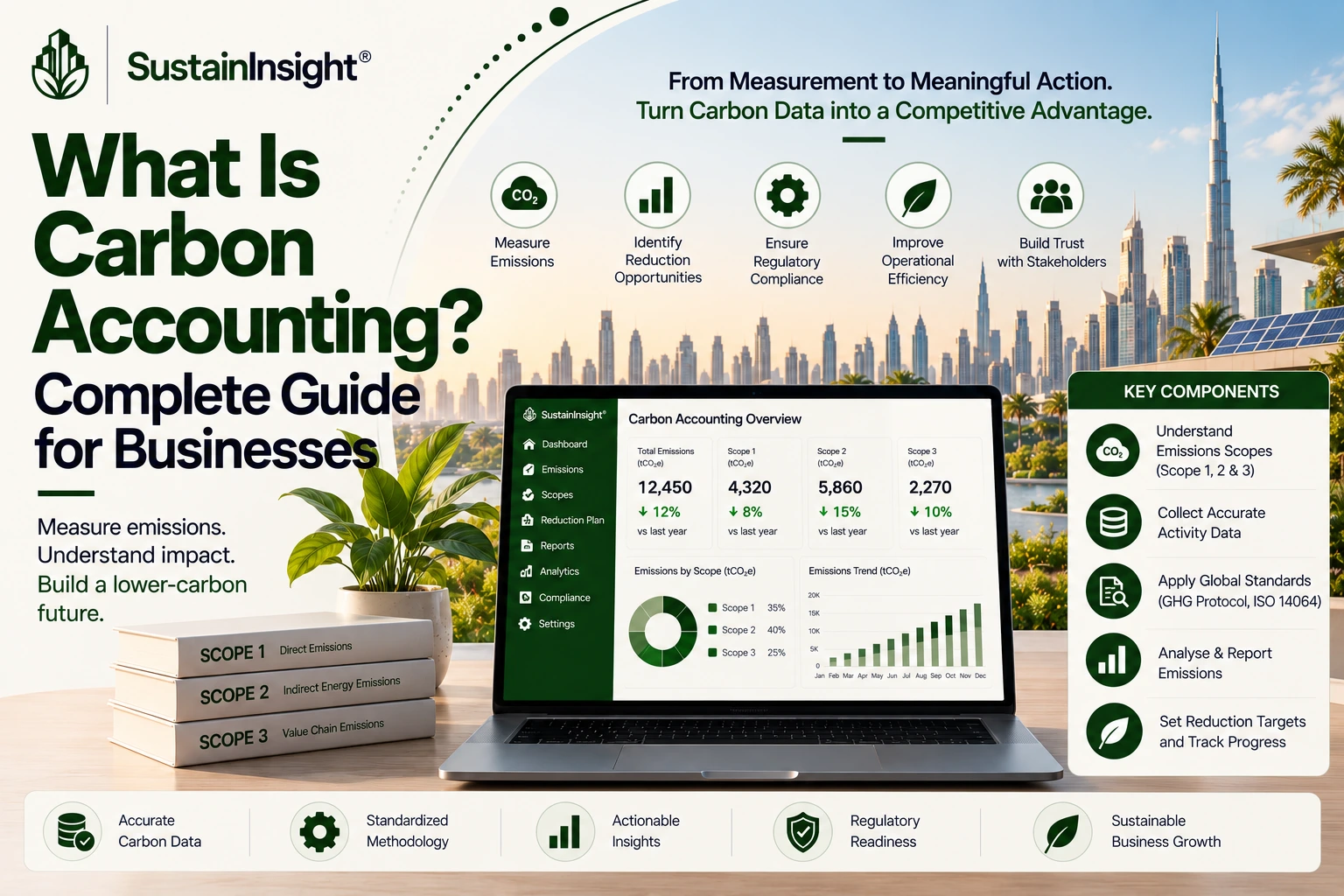
Carbon accounting is the practice of measuring, tracking, and reporting the greenhouse gas emissions an organization is responsible for — the same way financial accounting measures, tracks, and reports money. It's the foundation underneath nearly every ESG disclosure, climate target, and sustainability claim a business makes: without accurate carbon accounting, none of it can be verified or trusted. As regulatory requirements tighten and investors, customers, and partners increasingly expect credible emissions data, carbon accounting has moved from a specialist sustainability function to a core business capability. This guide covers what carbon accounting is, how it works, and what UAE and GCC businesses need to know to get started.
What Is Carbon Accounting?
At its core, carbon accounting converts an organization's activities — burning fuel, consuming electricity, purchasing goods, shipping products — into a common unit: carbon dioxide equivalent (CO2e), which allows different greenhouse gases (CO2, methane, nitrous oxide, and others) to be compared and summed using their relative warming potential. The result is a carbon footprint: a quantified, comparable measure of an organization's total climate impact, broken down by source and activity so it can be tracked over time, reported to stakeholders, and targeted for reduction.
The Three Scopes of Carbon Accounting
Carbon accounting is organized around the GHG Protocol's three-scope framework, the globally recognized standard for categorizing emissions:
Scope 1: Direct emissions. Emissions from sources an organization owns or directly controls — company vehicles, on-site fuel combustion, manufacturing processes, and refrigerant leaks, for example.
Scope 2: Indirect emissions from purchased energy. Emissions associated with the electricity, steam, heating, or cooling an organization purchases and consumes, even though the emissions physically occur at the power plant, not the organization's own site.
Scope 3: Indirect value chain emissions. All other emissions in an organization's value chain — purchased goods and services, business travel, employee commuting, transportation and distribution, and the use and disposal of sold products. For most organizations, Scope 3 represents the largest share of total emissions, often 70% or more, despite being the hardest category to measure.
Why Carbon Accounting Matters for Businesses?
Regulatory frameworks including CSRD, California SB-253, and increasingly ISSB-aligned standards require or strongly encourage disclosure of carbon accounting data, making it a compliance necessity for a growing number of businesses. Investors and lenders increasingly factor emissions data into financing decisions, and credible carbon accounting supports access to green and sustainability-linked financing. Customers — particularly large multinational buyers — increasingly require supplier-level emissions data as part of procurement decisions, making carbon accounting a competitive factor, not just a compliance one. And accurate carbon accounting is the prerequisite for setting meaningful, defensible reduction targets and avoiding greenwashing accusations tied to unsubstantiated climate claims.
How Carbon Accounting Works: The Basic Process
1. Define organizational and operational boundaries
Determine which entities, facilities, and operations are included in the accounting (organizational boundary), and which scopes and activities will be measured (operational boundary).
2. Collect activity data
Gather the underlying data — fuel consumption, electricity bills, travel records, purchased goods data — needed to calculate emissions for each relevant category.
3. Apply emission factors
Convert activity data into CO2e using recognized emission factors (standardized conversion rates published by government bodies, industry groups, or reputable databases) specific to each activity type and region.
4. Calculate and aggregate
Sum emissions across all sources and scopes to produce a total carbon footprint, broken down by scope, category, and business unit for analysis.
5. Verify and report
Validate the data and calculations, then report the results — internally for decision-making, and externally for regulatory, investor, or voluntary disclosure purposes.
6. Track and reduce
Use the baseline to set reduction targets, monitor progress over time, and identify the highest-impact opportunities for emissions reduction.
Carbon Accounting for UAE and GCC Businesses
UAE businesses face a specific mix of drivers for carbon accounting: the UAE's Net Zero by 2050 strategic initiative and national climate ambitions shape expectations even ahead of formal mandates; SCA guidance and DFM/ADX exchange requirements increasingly expect ESG disclosure from listed companies; and businesses trading internationally face indirect pressure from EU regulations like CSRD and CBAM, which require emissions data from UAE suppliers and subsidiaries connected to European markets. Building solid carbon accounting capability now positions UAE businesses ahead of both local regulatory evolution and international customer expectations.
Common Challenges in Carbon Accounting
1. Scope 3 complexity
The largest share of most organizations' footprint is also the hardest to measure, requiring supplier engagement and estimation methodologies that take time to mature.
2. Data fragmentation
Activity data often sits across dozens of disconnected systems — utility accounts, expense systems, supplier records — making consolidation a significant manual effort without the right tools.
3. Emission factor selection
Choosing the right, most current emission factors for each activity and region requires ongoing attention as databases and methodologies are updated.
Keeping pace with evolving standards. As frameworks and expected reporting granularity evolve, carbon accounting processes built for yesterday's requirements may need rework to meet tomorrow's.
How SustainInsight Helps?
-
AI-powered data capture that automates the collection of activity data from utility bills, invoices, and connected systems across Scope 1, 2, and 3
-
Automated emission factor application using current, region-appropriate factors, including UAE and GCC-specific grid electricity data
-
Full Scope 1, 2, and 3 coverage, including category-based Scope 3 estimation across all 15 GHG Protocol categories
-
Framework-aligned reporting that maps a single validated carbon accounting dataset to CSRD, ISSB, SEC, and California SB-253 disclosures
-
Predictive analytics that help identify the highest-impact reduction opportunities based on tracked data
-
Audit-ready data trails supporting the credibility of both regulatory disclosures and voluntary climate commitments
Conclusion
Carbon accounting is the measurement discipline that makes every other part of ESG and climate strategy possible — you can't manage, report, or credibly claim progress on what you haven't accurately measured. For UAE and GCC businesses navigating a tightening mix of local and international expectations, building strong carbon accounting capability now, rather than scrambling when a specific mandate arrives, is the more resilient path. SustainInsight's platform is built to make that measurement process accurate, automated, and audit-ready from day one.