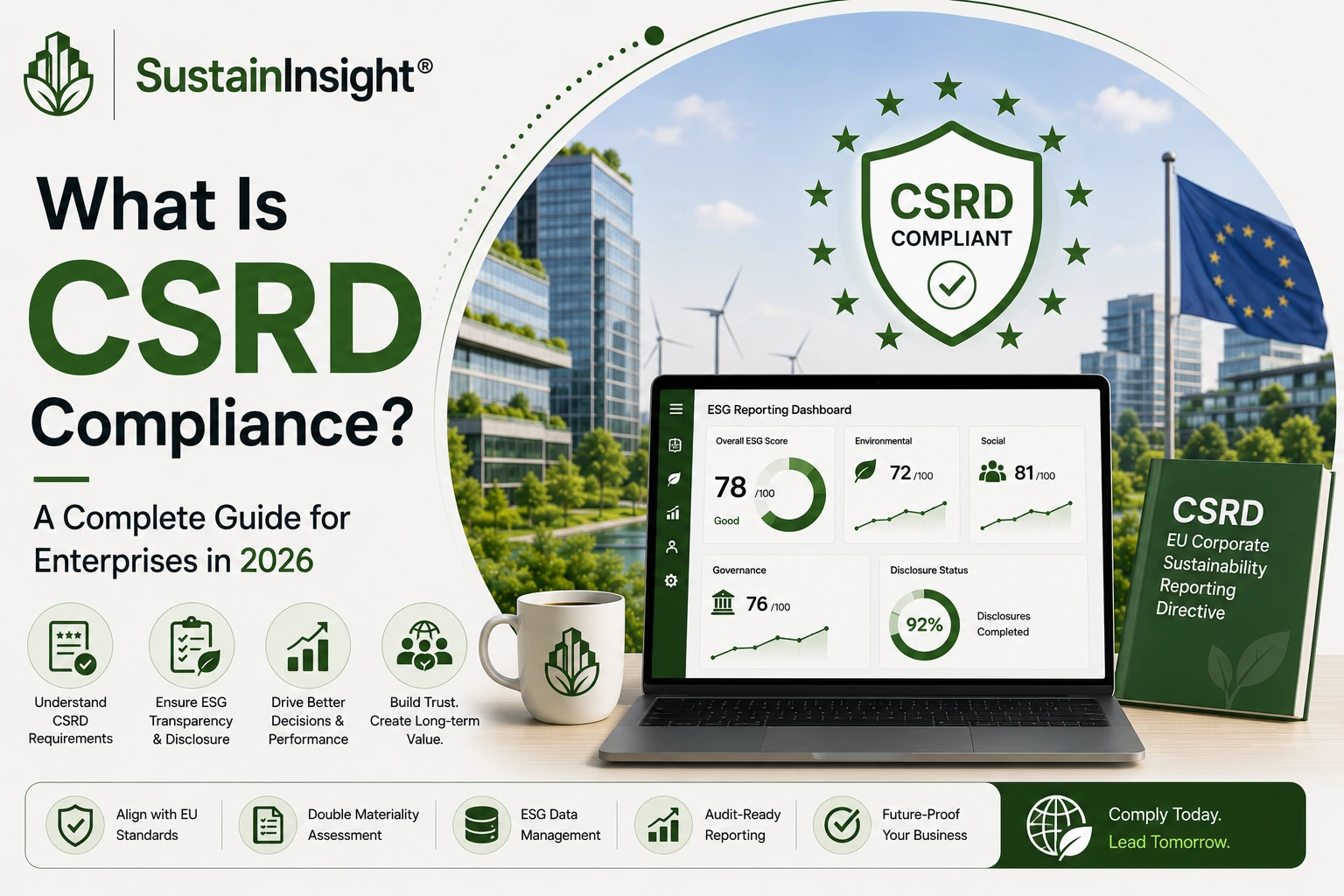
The Corporate Sustainability Reporting Directive (CSRD) is one of the most far-reaching sustainability regulations to date, requiring thousands of companies to disclose detailed environmental, social, and governance data. For businesses with operations, subsidiaries, or significant trading relationships in the European Union — including many UAE and GCC-based organizations — understanding CSRD compliance is no longer optional. It is quickly becoming a condition of doing business with EU partners, investors, and supply chains.
This guide explains what CSRD compliance means, who it applies to, what it requires, and how businesses can prepare with the help of an AI-powered platform like SustainInsight.
Why Businesses Need to Understand CSRD Compliance in 2026?
CSRD replaces the EU's earlier Non-Financial Reporting Directive (NFRD) with a much broader and more detailed set of requirements. Businesses that understand CSRD compliance early can:
Avoid last-minute compliance scrambles and penalties
Prepare accurate, audit-ready sustainability data ahead of deadlines
Strengthen relationships with EU customers, investors, and supply chain partners
Turn sustainability reporting into a competitive advantage rather than a burden
Align CSRD reporting with other frameworks such as ISSB, TCFD, and GRI
As more UAE and GCC companies expand into or trade with the EU, CSRD awareness is becoming essential well beyond companies headquartered in Europe.
What Is CSRD Compliance?
CSRD compliance means meeting the European Union's requirements for detailed, standardized sustainability reporting under the Corporate Sustainability Reporting Directive. Companies in scope must disclose information across environmental, social, and governance topics using the European Sustainability Reporting Standards (ESRS), covering areas such as:
Climate change and greenhouse gas emissions (Scope 1, 2 & 3)
Pollution, water, and biodiversity impacts
Workforce, human rights, and community impacts
Business conduct and governance practices
Unlike voluntary ESG reporting, CSRD disclosures must be prepared according to a standardized format, subject to third-party assurance, and filed alongside financial statements.
Who Must Comply with CSRD?
CSRD is being phased in over several years, with scope covering large EU companies, listed companies (including listed SMEs), and non-EU companies with significant EU revenue or subsidiaries. The exact thresholds and timelines have been the subject of ongoing EU simplification discussions, so businesses should confirm current requirements with official EU guidance or a compliance advisor rather than relying on any single source — but the direction is clear: scope is broad and includes many companies outside the EU that trade with or operate in it.
Key CSRD Reporting Requirements
Double Materiality Assessment
Companies must assess sustainability topics from two angles: how the topic affects the business financially, and how the business affects the environment and society. This double materiality assessment shapes which ESRS disclosures apply.
Scope 1, 2 & 3 Emissions Reporting
CSRD requires detailed greenhouse gas emissions data, including Scope 3 (value chain) emissions — often the hardest category for businesses to collect and verify.
Third-Party Assurance
Unlike many earlier voluntary frameworks, CSRD disclosures require external assurance, starting at limited assurance with expectations to move toward reasonable assurance over time.
Standardized Format
Reports must follow the ESRS taxonomy and be filed in a machine-readable digital format alongside the company's annual financial report.
Challenges of CSRD Compliance
Many organizations preparing for CSRD compliance face common obstacles:
Fragmented ESG data spread across departments and systems
Difficulty measuring Scope 3 emissions across the value chain
Uncertainty about exact scope and timeline as EU rules evolve
Limited internal sustainability reporting expertise
Preparing data to withstand third-party assurance
These challenges are pushing more businesses toward dedicated CSRD compliance software rather than manual, spreadsheet-based reporting.
How Does SustainInsight Simplify CSRD Compliance?
Preparing for CSRD requires reliable data, standardized reporting, and audit-ready documentation. SustainInsight is an AI-powered ESG and sustainability platform that helps businesses in the UAE, GCC, and beyond prepare for CSRD and other global reporting requirements.
Key capabilities include:
AI-powered ESG and CSRD-aligned reporting
Automated carbon accounting and Scope 1, 2 & 3 emissions tracking
Double materiality assessment support
Real-time ESG dashboards and KPI monitoring
Compliance alignment with GRI, ISSB, CSRD, TCFD, ISO 14064-1, and the GHG Protocol
Audit-ready reporting built for third-party assurance
For businesses preparing for CSRD compliance, SustainInsight centralizes sustainability data and automates reporting, reducing the manual effort typically required to meet the directive's standards.
Conclusion
CSRD compliance represents a significant shift in how companies are expected to measure, manage, and disclose sustainability performance. Businesses that start preparing early — understanding scope, gathering reliable data, and adopting the right reporting tools — will be far better positioned than those that wait until deadlines are imminent.
With AI-powered platforms like SustainInsight, businesses across the UAE and GCC can simplify CSRD compliance, automate emissions tracking, and build audit-ready sustainability reports that meet evolving global standards.