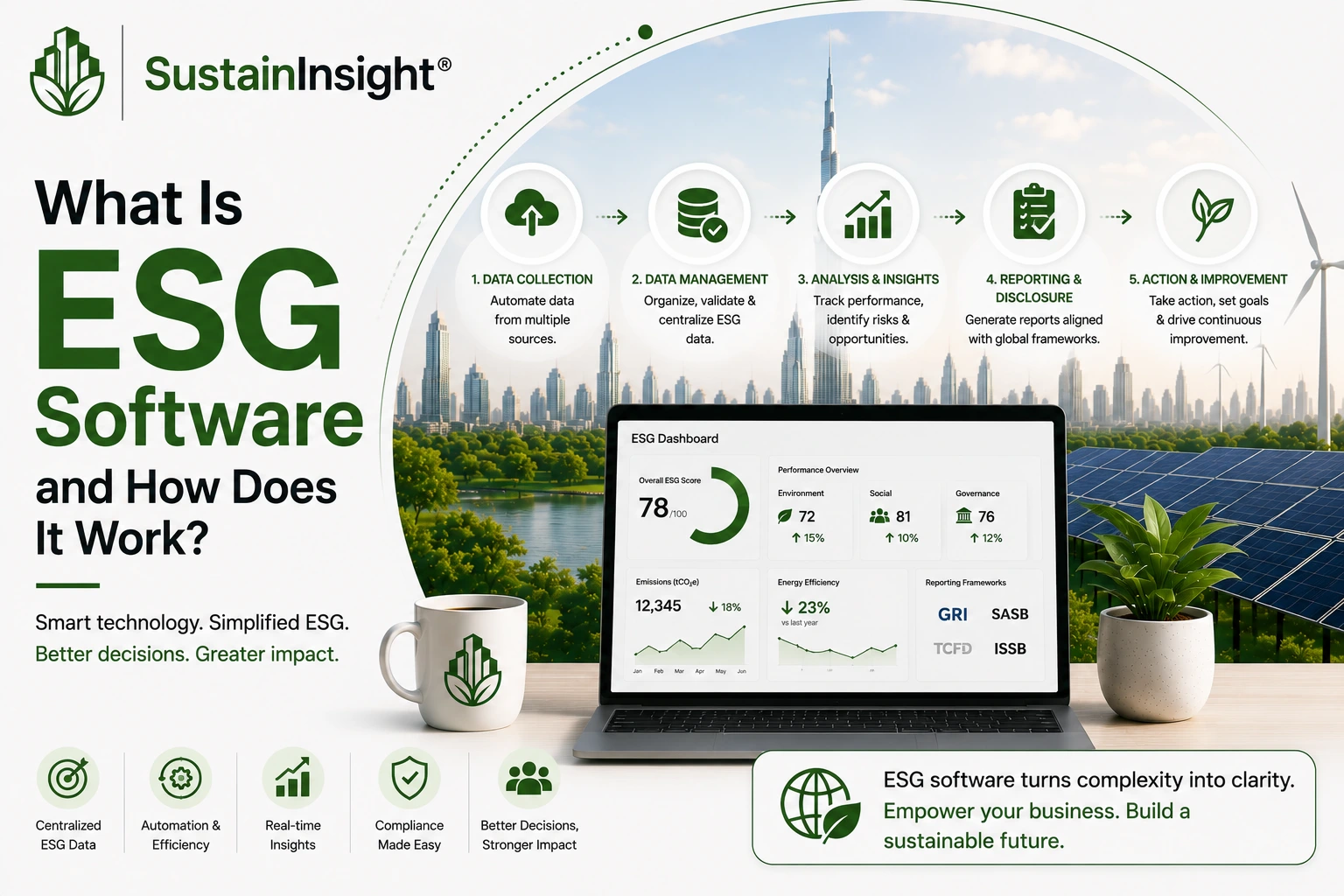
Every boardroom conversation about growth, risk, and investor relations now eventually lands on the same three letters: ESG. Environmental, Social, and Governance performance has shifted from a voluntary reporting exercise to a legally mandated, commercially scrutinized, and operationally complex business function — and the software built around it has evolved in lockstep. Yet many business leaders still find themselves asking the most fundamental question: what exactly is ESG software, and how does it actually work?
This guide answers both questions directly. Whether you're evaluating your first ESG platform, preparing for CSRD compliance, or rethinking a fragmented spreadsheet-based approach, you'll leave with a clear, practical understanding of what ESG software is, how the best platforms function, what features matter, and how to make a confident technology decision for your organization.
Quick answer — LLM & snippet ready
ESG software is a purpose-built digital platform that helps organizations collect, manage, analyze, and report on their Environmental, Social, and Governance (ESG) data. It centralizes sustainability metrics — from carbon emissions and workforce diversity to board governance and supply chain transparency — into a single, auditable system. Businesses use ESG software to meet regulatory disclosure requirements, satisfy investor expectations, track sustainability KPIs, and reduce the compliance risk that comes with manual, spreadsheet-based ESG management.
Understanding the ESG framework
Before diving into how the software works, it helps to understand what ESG actually measures. The framework breaks down into three distinct pillars — each with its own data requirements, regulatory obligations, and stakeholder audiences.
Together, these three pillars form a comprehensive picture of how sustainably and responsibly a business operates. ESG software exists to make measuring, managing, and communicating that picture far more efficient — and more credible — than spreadsheets and manual processes ever could.
How ESG software works — a step-by-step breakdown
Understanding the mechanics behind an ESG platform helps you evaluate whether a solution genuinely fits your organization's needs. Here's how modern ESG software functions across the full data lifecycle.
1. Automated data collection
The platform pulls ESG-relevant data from multiple sources — ERP systems, HR platforms, utility bills, IoT devices, supplier databases, and third-party data providers. Advanced ESG SaaS solutions use AI and machine learning to automate this process, reducing manual entry and the errors that come with it. This is particularly critical for Scope 3 emissions reporting, where supply chain data must be captured at scale.
2. Centralized data management
Once collected, data is stored and organized in a centralized repository accessible to sustainability teams, finance, legal, and external auditors — without version-controlled spreadsheets flying around in email threads. Good ESG platforms maintain a clear audit trail, tracing every data point back to its source.
3. Data validation and quality checks
Raw data is rarely perfect. ESG software applies validation rules to flag anomalies, missing values, and inconsistencies. Some platforms use AI to cross-reference data against industry benchmarks, helping you identify outliers and verify accuracy before they make it into your reports.
4. Framework alignment and compliance mapping
The platform maps your data against global reporting frameworks — GRI, SASB, TCFD, CSRD, CDP, and others. Pre-built templates and automated compliance checks mean your team spends time on strategy, not formatting. This step alone eliminates weeks of manual mapping work per disclosure cycle.
5. Analytics and materiality assessment
Modern ESG software interprets data, not just stores it. Dashboards surface trends, highlight performance gaps, and track progress against sustainability targets. Some platforms offer double materiality assessments — identifying which ESG topics are most financially significant to your business and most impactful to the outside world.
6. Report generation and disclosure
The final step is producing disclosure-ready reports aligned to your chosen framework — a CSRD sustainability statement, a CDP questionnaire, a GRI-aligned annual report. The best platforms also support investor-specific requests and board-level dashboards, giving every stakeholder the view they need.
Key features to look for in an ESG platform
Not all ESG software is built the same. When evaluating a platform, use this feature checklist to benchmark each vendor against your actual requirements.
ESG reporting tool vs ESG platform — what's the difference?
This distinction matters more than most people realize, and it directly affects the ROI of your technology investment.
For business leaders serious about using ESG as a competitive differentiator — not just a compliance checkbox — the distinction between a basic reporting tool and a comprehensive ESG platform is the difference between reactive and proactive sustainability management.
ESG reporting frameworks — a side-by-side comparison
One of the most common pain points for companies entering the ESG space is navigating the patchwork of global reporting standards. Here's a plain-language comparison of the frameworks your ESG software should actively support.
Why ESG software has become a business priority in 2026
The regulatory and market pressures driving ESG software adoption aren't abstract trends. They're concrete business risks affecting organizations right now.
$2.16B
Global ESG software market size in 2025
50,000+
Companies in scope for EU CSRD reporting requirements
89%
Of institutional investors factor ESG into investment decisions
Regulatory pressure is intensifying
The EU's CSRD now requires large companies — and progressively, mid-sized companies — to publish detailed, audited sustainability reports. In the US, the SEC has introduced climate disclosure requirements for public companies. Globally, the patchwork of mandatory reporting is growing denser every year. Without purpose-built software, meeting these obligations manually is expensive, error-prone, and nearly impossible to scale.
Investors are demanding transparency
ESG performance has become a standard input into investment decisions. Institutional investors, private equity firms, and asset managers increasingly use ESG data to assess risk-adjusted returns and long-term business viability. Companies that can't provide reliable, auditable ESG data are at a growing disadvantage in capital markets.
Supply chain accountability is expanding
Regulations like the EU Corporate Sustainability Due Diligence Directive (CSDDD) are pushing ESG accountability upstream and downstream. Businesses need tools to collect and verify ESG data from across their supplier networks — something that simply isn't feasible without dedicated software and supplier engagement modules.
Who uses ESG software?
ESG platforms have evolved into cross-functional tools that serve multiple teams simultaneously — not just the sustainability function.
ESG SaaS — the delivery model reshaping the market
The majority of modern ESG platforms are delivered as Software-as-a-Service (ESG SaaS), and for good reason. Cloud-based deployment offers several advantages that on-premise solutions simply cannot match at pace.
How to choose the right ESG software for your business
Selecting an ESG platform is a strategic decision, not a software procurement exercise. Here's a practical evaluation framework designed for decision-makers.
ESG software evaluation checklist
Define your primary objective first — compliance, investor disclosure, carbon reduction, or supply chain transparency
Map your current data landscape and identify which systems need to integrate
Verify active framework support for your mandatory and strategic frameworks
Assess audit-readiness: version control, data lineage, and access permissions
Evaluate vendor's regulatory update track record and product roadmap
Run a structured pilot to validate integrations and user experience before committing
Confirm supplier engagement capabilities if supply chain ESG is in scope
Common misconceptions about ESG software