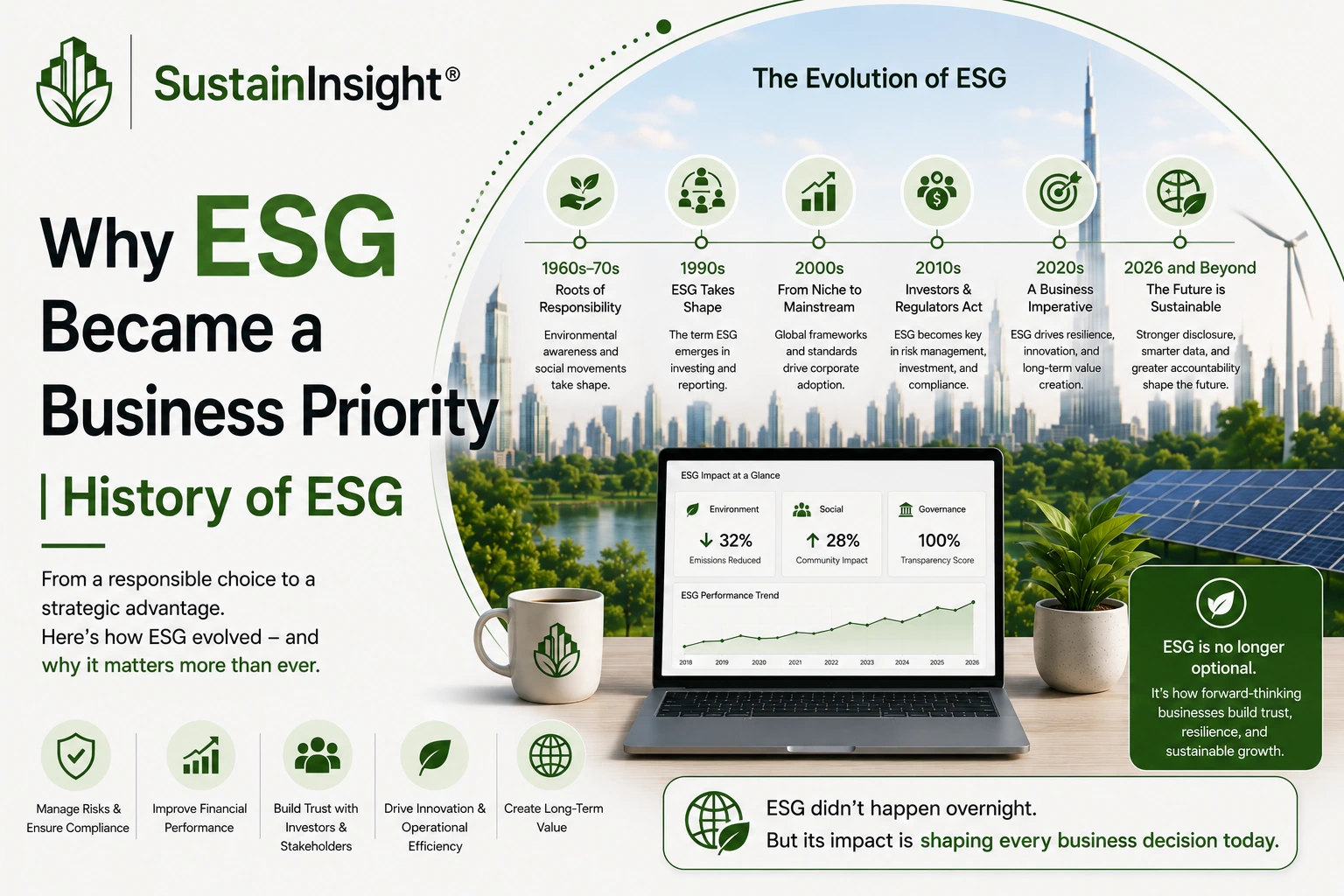
ESG is now a core part of how businesses operate—but that wasn't always the case. A few decades ago, companies were mostly evaluated on financial performance alone. Today, they are also judged on how they manage environmental impact, social responsibility, and governance practices.
This shift didn't happen suddenly. The history of ESG reflects a gradual change in how businesses, investors, and regulators define success. What started as voluntary efforts has now become a structured, data-driven approach to building sustainable and resilient organizations.
What Is ESG?
ESG (Environmental, Social, and Governance) is a framework used to evaluate how responsibly a company operates. It focuses on three key areas:
Environmental: emissions, energy use, climate impact
Social: employees, communities, supply chains
Governance: leadership, ethics, transparency
ESG helps measure whether a business is built for long-term sustainability and responsible growth.
The History of ESG in Brief
The history of ESG began with corporate social responsibility (CSR) practices in the mid-20th century and evolved into a formal framework in the early 2000s. It gained widespread importance in the 2010s as investors, regulators, and businesses began using ESG data to assess risk, performance, and long-term value.
ESG evolved from voluntary responsibility into a measurable, strategy-driven business framework.
Before ESG: The Role of CSR
Before ESG, companies focused on Corporate Social Responsibility (CSR). CSR typically included:
Charity and donations
Community initiatives
Basic environmental efforts
These actions were important, but they had clear limitations. There was no standard way to measure impact, compare companies, or link these efforts to business performance.
CSR was based on intent, while ESG is based on measurable outcomes.
When ESG Started Gaining Attention
The early 2000s marked a turning point. A major milestone was the "Who Cares Wins" report (2004), which introduced ESG as a framework for evaluating companies in financial markets. This changed how businesses were viewed. For the first time:
Sustainability was linked to financial performance
ESG factors were treated as risk indicators
Investors began using ESG in decision-making
ESG became important when investors started using it to evaluate long-term business risk.
How ESG Became Mainstream
The 2010s played a critical role in shaping ESG into a business priority.
Growing investor focus
Investors started looking beyond short-term profits. They wanted to understand:
Which companies were future-ready
Which businesses carried long-term risks
Which organizations were sustainable
This led to a significant rise in ESG-focused investments.
Better measurement and reporting
During this period, ESG became more structured. Frameworks and reporting standards helped companies:
Measure ESG performance
Share data transparently
Benchmark against competitors
This made ESG more credible and actionable.
Rising expectations
Stakeholders began expecting more from businesses:
Customers preferred responsible brands
Employees valued ethical workplaces
Regulators introduced disclosure requirements
This shift made ESG a standard expectation rather than an optional initiative.
Why ESG Is Now a Business Priority
Today, ESG is not just about responsibility—it is a key part of business strategy. Main reasons behind this shift:
Investor demand — Investors use ESG data to evaluate risk and long-term performance.
Regulations — Governments are introducing stricter sustainability and reporting requirements.
Climate risks — Businesses must manage environmental and operational risks.
Consumer expectations — Customers prefer transparent and responsible companies.
Long-term growth — ESG helps businesses become more resilient and future-ready.
ESG became a priority due to investor pressure, regulations, climate concerns, and changing market expectations.
ESG vs CSR: A Clear Difference
CSR is about doing good. ESG is about measuring and managing impact.
What ESG Looks Like Today
Today, ESG is fully integrated into business operations. Companies use ESG in:
Strategic planning
Risk management
Investor communication
Sustainability initiatives
Common examples include:
Net-zero commitments
ESG reporting and disclosures
Sustainable supply chains
Governance improvements
ESG is now a core part of decision-making at the leadership level.
What's Next for ESG
ESG will continue to evolve as expectations increase. Key trends include:
More mandatory reporting requirements
Greater transparency in disclosures
Integration with financial performance
Increased use of technology and data
Focus on supply chain and indirect emissions
ESG will become more structured, more regulated, and more important for business success.
Final Thoughts
The history of ESG shows how business priorities have changed over time. What began as voluntary responsibility has become a structured and measurable approach to managing risk, performance, and long-term value.
Today, ESG is essential—not just for compliance, but for building a business that can grow sustainably in a changing world.