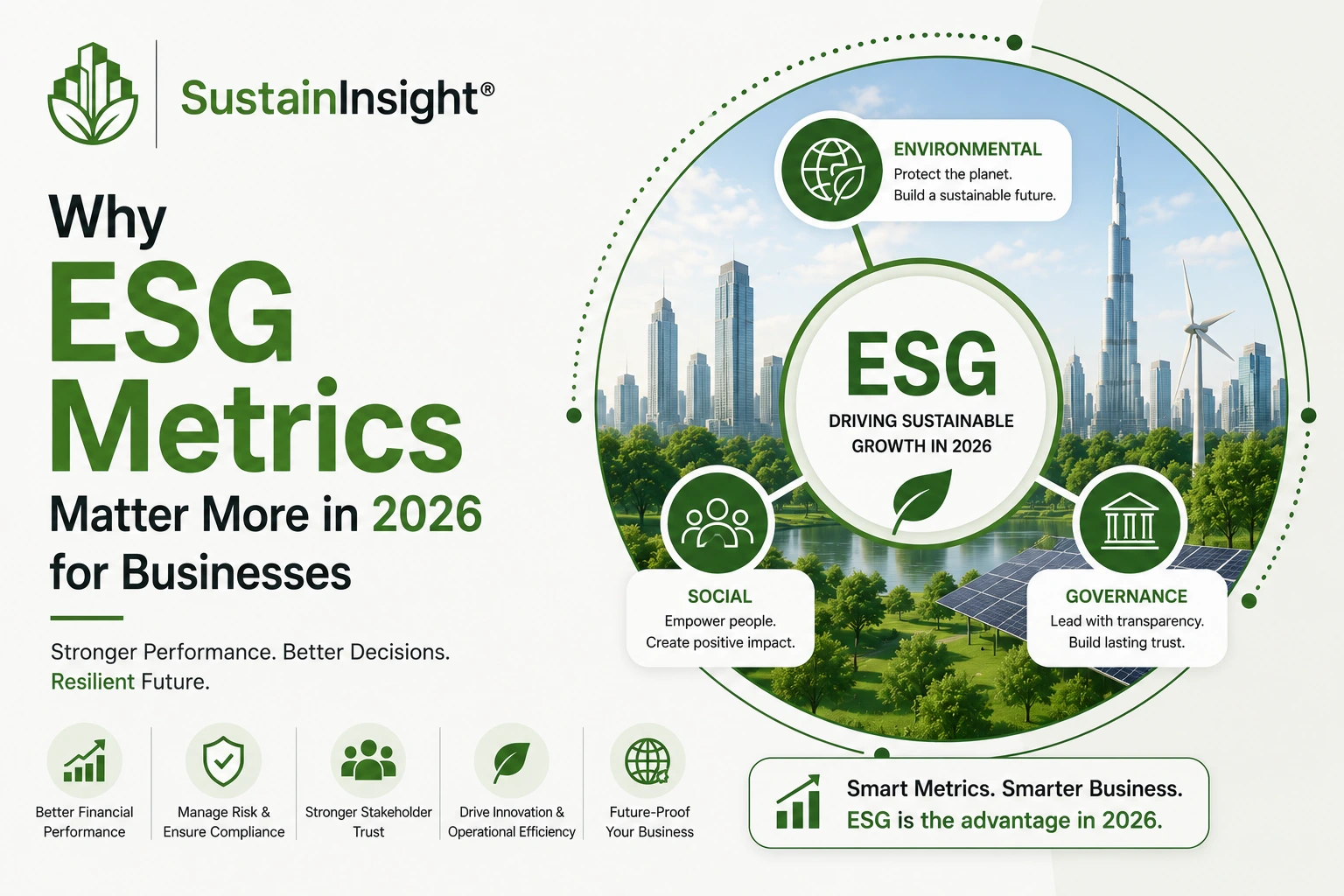
As businesses prepare for a more transparent and sustainability-driven future, ESG metrics are becoming one of the most important indicators of corporate performance. In 2026, organizations across the UAE and globally are expected to face greater scrutiny from investors, regulators, customers, and financial institutions regarding how they measure and report their Environmental, Social, and Governance (ESG) performance.
The conversation around ESG has shifted dramatically. It's no longer enough to publish sustainability commitments—organizations must now support those commitments with accurate, measurable, and verifiable ESG metrics. Companies that can demonstrate strong ESG performance through reliable data are more likely to attract investment, strengthen stakeholder trust, improve operational resilience, and remain competitive in a rapidly evolving business environment.
In this guide, we'll explore why ESG metrics will matter more in 2026, the key metrics every organization should track, and how SustainInsight helps businesses automate ESG measurement and reporting.
What Are ESG Metrics?
ESG metrics are measurable indicators used to evaluate an organization's performance across environmental, social, and governance factors.
These metrics help businesses monitor sustainability performance while providing investors and stakeholders with transparent, data-driven insights.
Examples of common ESG metrics include:
-
Carbon emissions
-
Energy consumption
-
Water usage
-
Waste generation
-
Employee diversity
-
Workplace health and safety
-
Board diversity
-
Business ethics and compliance
-
Supply chain sustainability
-
Data privacy and cybersecurity
Unlike general sustainability goals, ESG metrics provide quantifiable evidence of an organization's progress and accountability.
Why ESG Metrics Will Matter More in 2026 ?
1. Increasing Global ESG Disclosure Requirements
Governments and regulatory bodies continue to strengthen sustainability disclosure expectations. Businesses are increasingly expected to report ESG performance using internationally recognized frameworks such as GRI, ISSB, CSRD, TCFD, and the GHG Protocol.
Organizations that already track reliable ESG metrics will be better prepared to meet evolving compliance requirements and reduce reporting complexity.
2. Investors Are Prioritizing Data-Driven ESG Performance
Investors no longer rely solely on sustainability commitments. They increasingly evaluate organizations based on measurable ESG metrics that demonstrate long-term resilience and effective risk management.
Strong ESG performance can help businesses:
-
Improve investor confidence
-
Increase access to sustainable finance
-
Reduce investment risk
-
Enhance corporate valuation
Reliable ESG data enables investors to make informed decisions while comparing organizations across industries.
3. Carbon Emissions Measurement Is Becoming Essential
As countries pursue ambitious climate goals, measuring carbon emissions has become a fundamental part of ESG reporting.
Businesses should accurately monitor:
-
Scope 1 emissions
-
Scope 2 emissions
-
Scope 3 emissions
Tracking these emissions enables organizations to identify reduction opportunities, improve carbon accounting, and support Net Zero commitments.
4. Better ESG Metrics Improve Business Decision-Making
Reliable ESG metrics provide valuable operational insights beyond compliance.
Organizations can use ESG data to:
-
Improve resource efficiency
-
Reduce operational costs
-
Identify sustainability risks
-
Optimize energy usage
-
Strengthen supply chain resilience
-
Monitor long-term sustainability goals
Data-driven decision-making enables businesses to improve performance while reducing environmental impact.
5. Customers and Stakeholders Expect Greater Transparency
Modern customers increasingly support organizations that demonstrate genuine environmental and social responsibility.
Transparent ESG reporting supported by accurate ESG metrics helps businesses:
-
Build customer trust
-
Strengthen brand reputation
-
Improve stakeholder engagement
-
Demonstrate corporate accountability
Organizations that provide transparent sustainability disclosures are more likely to strengthen long-term customer relationships.
6. AI Is Transforming ESG Measurement
One of the biggest ESG trends in 2026 is the growing use of artificial intelligence to automate sustainability reporting.
AI-powered ESG platforms enable organizations to:
-
Collect ESG data automatically
-
Validate sustainability metrics
-
Generate ESG reports
-
Monitor performance in real time
-
Predict future sustainability risks
Automation significantly reduces manual reporting while improving data quality and audit readiness.
Key ESG Metrics Every Business Should Track
Organizations should establish a consistent ESG measurement strategy that includes:
Environmental Metrics
-
Carbon footprint
-
Energy consumption
-
Renewable energy usage
-
Water consumption
-
Waste diversion rates
-
Greenhouse gas emissions
Social Metrics
-
Employee retention
-
Diversity and inclusion
-
Health and safety incidents
-
Employee training hours
-
Customer satisfaction
-
Community investment
Governance Metrics
-
Board diversity
-
Ethics and compliance
-
Data security
-
Risk management
-
Executive accountability
-
Regulatory compliance
Monitoring these ESG metrics helps organizations benchmark performance and demonstrate continuous improvement.
Challenges Businesses Face When Measuring ESG Metrics
Despite growing awareness, many organizations still struggle with ESG measurement due to:
-
Disconnected data systems
-
Manual spreadsheets
-
Inconsistent reporting methodologies
-
Scope 3 emissions complexity
-
Multiple reporting frameworks
-
Limited sustainability expertise
Without centralized ESG data management, producing reliable sustainability reports becomes increasingly difficult.
How SustainInsight Helps Businesses Track ESG Metrics
As ESG reporting becomes more data-intensive, organizations need intelligent technology to simplify measurement and compliance.
SustainInsight is an AI-powered ESG and sustainability platform that helps businesses automate ESG data collection, measure sustainability performance, and generate framework-aligned reports.
Key capabilities include:
-
AI-powered ESG reporting
-
Real-time ESG metrics dashboards
-
Carbon accounting
-
Scope 1, Scope 2 & Scope 3 emissions tracking
-
Automated sustainability reporting
-
Data verification and audit readiness
-
Predictive sustainability analytics
-
Compliance with GRI, ISSB, CSRD, TCFD, ISO 14064-1, and the GHG Protocol
By transforming operational data into audit-ready sustainability insights, SustainInsight enables organizations across the UAE and GCC to improve reporting accuracy, strengthen compliance, and make data-driven sustainability decisions.
Conclusion
In 2026, ESG metrics will become more than reporting requirements—they will be strategic business indicators that influence investment decisions, regulatory compliance, operational performance, and stakeholder trust.
Organizations that invest in reliable ESG measurement today will be better positioned to navigate changing regulations, strengthen sustainability performance, and create long-term business value.
With AI-powered solutions like SustainInsight, businesses can automate ESG reporting, improve carbon accounting, and confidently manage sustainability performance through accurate, actionable ESG metrics.